We are creative, ambitious and ready for challenges!

Categories
Blogs

RF Connectors: Innovations and Applications in Modern Technology

rf_connectors-_innovations_and_applications_in_modern_technology.png

Key Takeaways

  • Advancements in RF connectors focus on miniaturization, allowing high-frequency performance in compact devices. These innovations benefit industries like aerospace and telecommunications, ensuring reliable signal integrity in small, lightweight applications.
  • Modern RF connectors are built to withstand extreme conditions, including high temperatures and vibrations. Military and aerospace industries demand robust designs that ensure long-lasting performance in harsh environments, improving system efficiency.
  • Innovations like quick-lock and push-pull mechanisms simplify RF connector usage, enabling faster, more secure connections. These advancements enhance efficiency in medical, industrial, and telecommunications applications, where speed and reliability are critical.
  • The future of RF connectors includes ultra-compact designs, higher frequency capabilities, and smart self-monitoring technologies. These advancements will improve predictive maintenance, reduce downtime, and enhance reliability in mission-critical applications.

RF (Radio Frequency) connectors play a vital role in modern technology, enabling the seamless transmission of signals in various industries, from telecommunications to aerospace. As technology advances, the demand for more efficient and innovative RF connectors continues to grow. At Orbis Systems, we are deeply interested in exploring the world of RF connectors and their impact on modern applications. While we do not sell these components yet, we recognize their importance in RF component testing, communication systems, and beyond.

In this blog, we will discuss the latest innovations in RF connectors, their various applications, and the role they play in technology today. We will also explore the different types of RF connectors, answer the question, “What is an RF cable?”, and examine the types of antenna connectors used in different applications.

What is an RF Cable?

An RF cable is a type of coaxial cable specifically designed to carry radio frequency signals with minimal loss and interference. These cables are vital in ensuring efficient and reliable transmission of RF signals between devices, playing a crucial role in various industries such as telecommunications, broadcasting, aerospace, and medical equipment.

RF cables are built with multiple layers of shielding to prevent signal degradation and external interference. They are available in different impedance ratings, such as 50-ohm and 75-ohm variants, to match the specific requirements of the system they are used in. Additionally, RF cables vary in flexibility, durability, and frequency range, making them adaptable to diverse applications, from high-speed data transmission to precision medical imaging systems.

The Role of RF Connectors in Modern Technology

RF connectors serve as critical components in various systems, allowing for reliable and efficient signal transmission. Whether in communication networks, radar systems, medical equipment, or consumer electronics, RF connectors ensure minimal signal loss and maximum performance.

One of the key aspects of these connectors is their role in RF component testing. Engineers and manufacturers rely on high-quality RF connectors to ensure that components meet stringent performance standards. Without reliable connectors, the accuracy of testing processes can be compromised, leading to suboptimal product performance.

Innovations in RF Connectors

1. Miniaturization and High-Frequency Performance

As devices become smaller and more compact, the demand for miniaturized RF connectors has increased. Innovations in design allow for connectors that maintain high-frequency performance while fitting into increasingly tight spaces. Industries like telecommunications and aerospace benefit significantly from these advancements, as they require components that deliver reliable signal integrity in small, lightweight packages.

2. Enhanced Durability and Reliability

Modern RF connectors are designed to withstand extreme conditions, including high temperatures, vibrations, and environmental exposure. Military and aerospace applications, in particular, require connectors that can operate reliably in harsh environments. New materials and improved manufacturing techniques contribute to increased durability and longevity.

3. Improved Signal Integrity

Reducing signal loss is a top priority in RF connector design. New innovations focus on minimizing interference and maximizing efficiency. Advanced shielding techniques, better conductor materials, and refined connector interfaces help maintain signal integrity, especially in high-frequency applications.

4. Quick-Lock and Push-Pull Mechanisms

Traditional screw-on RF connectors can be cumbersome to use, especially in fast-paced environments. The introduction of quick-lock and push-pull mechanisms has streamlined the process, making connections faster and more secure. These innovations are particularly useful in medical and industrial applications where speed and reliability are crucial.

Understanding the Different Types of RF Connectors

There are several types of RF connectors, each designed for specific applications and requirements. Some of the most commonly used connectors include:

1. BNC (Bayonet Neill-Concelman) Connectors

BNC connectors are widely used in video, RF component testing, and telecommunications applications. They feature a quick-connect mechanism, making them easy to use.

2. SMA (SubMiniature Version A) Connectors

SMA connectors are known for their high-frequency performance and compact design. They are commonly used in wireless communication, GPS, and RF testing applications.

3. N-Type Connectors

These connectors are designed for high-power applications and offer excellent durability. They are frequently used in radar systems, satellite communication, and military applications.

4. TNC (Threaded Neill-Concelman) Connectors

TNC connectors are similar to BNC connectors but feature a threaded design for enhanced stability. They are commonly found in mobile communication and aerospace applications.

AD_4nXdiCel3hQzE0Uw8cUIKQcMwOJ1nPSBJR_bCeHmMNjH7NLIA2xXKWJyU-YMZGW8K0rV_gpPHvAzgtE9Yyhzwzqex9vJl9fI3zaqUexLus7reD8eIPvF5UBDGM7C0vu2VE0pD6d83?key=iQMM2jL_WG0u2us1UH9vL_tk

Types of Antenna Connectors

The types of antenna connectors used in various applications depend on the specific requirements of the system. Some of the most commonly used antenna connectors include:

1. F-Type Connectors

These connectors are widely used in cable television and satellite systems. They provide a secure connection for transmitting high-frequency signals.

2. RP-SMA (Reverse Polarity SMA) Connectors

RP-SMA connectors are commonly found in Wi-Fi antennas and wireless networking equipment. They feature a unique design that prevents standard SMA connectors from being used interchangeably.

3. UHF (Ultra High Frequency) Connectors

UHF connectors are often used in amateur radio and CB (Citizens Band) radio systems. They are known for their ease of use and reliability.

4. MMCX (Micro-Miniature Coaxial) Connectors

These miniature connectors are designed for applications requiring compact and lightweight solutions. They are frequently used in GPS systems and mobile communication devices.

The Future of RF Connectors

As technology advances, the demand for more capable RF connectors is accelerating. Future innovations will focus on ultra-compact designs, higher frequency handling, and enhanced durability to support high-performance systems in aerospace, telecommunications, and industrial automation. Miniaturization will be key, allowing connectors to maintain signal integrity in increasingly compact devices.

As 5G continues to grow and 6G begins to emerge, supporting faster data rates has become essential. RF connectors must deliver reliable performance at millimeter-wave frequencies to keep up with the increasing need for high-bandwidth, low-latency communication in areas like autonomous technology, the Internet of Things (IoT), and medical imaging.

Sustainability and longevity are also shaping connector design. Manufacturers are turning to recyclable materials, lead-free components, and corrosion-resistant finishes to meet environmental regulations and extend product life. Improved sealing and wear-resistant contacts will ensure long-term reliability in harsh environments.

An exciting development is the rise of smart RF connectors, integrated with sensors that monitor performance metrics like temperature, signal degradation, or moisture exposure in real time. This allows for predictive maintenance and helps reduce system downtime in critical applications.

Summing It Up

RF connectors are essential components in modern technology, playing a critical role in various industries, from telecommunications to aerospace. The ongoing advancements in miniaturization, durability, and signal integrity continue to push the boundaries of what these connectors can achieve.

At Orbis Systems, we are committed to staying at the forefront of technological advancements, particularly in RF component testing. By understanding the latest innovations and applications of RF connectors, we can ensure the highest standards in our work and contribute to the ever-evolving world of RF technology.

Frequently Asked Questions

What are RF connectors, and why are they important in modern technology?

RF (Radio Frequency) connectors are specialized electrical connectors designed to transmit high-frequency signals with minimal loss and interference. They play a critical role in various industries, including telecommunications, aerospace, medical equipment, and consumer electronics. These connectors enable seamless data transfer in systems like radar, satellite communications, and wireless networks.

Their importance lies in ensuring reliable and efficient signal transmission, reducing the chances of data corruption, and maintaining system performance. Without high-quality RF connectors, modern communication and testing systems would suffer from significant inefficiencies.

What is RF component testing, and how do RF connectors contribute to it?

RF component testing is a crucial process in which engineers evaluate the performance of various radio frequency components, such as antennas, amplifiers, and transmitters, to ensure they meet industry standards. High-quality RF connectors are essential in this process, as they provide a stable and low-loss connection between test equipment and the components being analyzed.

Poor-quality connectors can introduce signal distortions, leading to inaccurate test results. By using reliable RF connectors, engineers can maintain signal integrity and ensure precise measurements, ultimately leading to better-performing RF systems in industries like defense, telecommunications, and medical technology.

What is an RF cable, and how does it differ from a standard electrical cable?

An RF cable is a type of coaxial cable specifically designed to carry high-frequency radio signals with minimal loss and interference. Unlike standard electrical cables, which primarily transmit power or low-frequency signals, RF cables are built with multiple shielding layers to prevent signal degradation caused by electromagnetic interference.

These cables come in different impedance ratings, such as 50-ohm and 75-ohm, to match specific application requirements. They are widely used in broadcasting, aerospace, telecommunications, and precision medical imaging systems where clear and stable signal transmission is crucial.

How are RF connectors evolving to meet modern technological demands?

The demand for more advanced RF connectors has led to several key innovations:

  • Miniaturization: As devices become smaller, RF connectors are being designed to fit compact spaces while maintaining high-frequency performance, benefiting industries like aerospace and telecommunications.
  • Enhanced Durability: New materials and improved manufacturing techniques allow RF connectors to withstand extreme temperatures, vibrations, and harsh environmental conditions, making them more reliable for military and industrial applications.
  • Improved Signal Integrity: Advances in shielding and connector design minimize signal loss, ensuring better efficiency in high-frequency applications.
  • Quick-Lock and Push-Pull Mechanisms: These features simplify connections, improving speed and security in applications where efficiency is crucial, such as medical and industrial settings.
  • Smart Technologies: Future developments may introduce self-monitoring RF connectors that detect and report performance issues in real time, reducing maintenance needs and improving system reliability.

As technology continues to advance, RF connectors will evolve to meet the increasing demands for higher performance, reliability, and efficiency across various industries.

Categories
Blogs

MIMO Technology: The Backbone of High-Speed 5G Networks

AD_4nXd15Rc9i1wZb4L9x_TE_QeHyh1Wf54pwoG9qsrBcx1P_-EIOa47zDaOtNxnAnseX_rbvrUJd1X6QGJ4y4Swb9rDWfP9L6Z-L_m6CVqdgIyKy_5jtdsoHSmBIAWrZsbjMhDlgaG1Ym2k49SWXOlxOA?key=6szmHKwHJqaWvL3cv3EnfJBB

Key Takeaways:

  • MIMO technology enhances 5G networks by using multiple antennas to increase speed, reduce latency, and improve reliability for various industries.
  • 5G measuring equipment ensures MIMO systems function optimally by testing signal strength, speed, and interference, helping industries maintain seamless communication.
  • Industries like intelligent manufacturing and electronics rely on MIMO-powered 5G for automation, real-time monitoring, and efficient production processes.
  • Orbis Systems provides advanced MIMO testing solutions, helping businesses optimize wireless networks and improve the quality of electronic manufacturing services.

The world is more connected than ever, and high-speed internet has become a necessity. With the rise of 5G networks, we are experiencing faster speeds, lower latency, and more reliable connections. But what makes this possible? The answer lies in MIMO (Multiple-Input Multiple-Output) technology. This technology plays a key role in boosting the performance of 5G networks, ensuring seamless connectivity for various industries. A crucial part of developing and optimizing MIMO technology is the use of 5G measuring equipment, which helps ensure that networks deliver the speed and reliability we expect.

What Is MIMO Technology?

MIMO technology is a method used in wireless communications to improve network efficiency. Traditional networks use a single antenna to send and receive data, but MIMO networks use multiple antennas. This allows multiple data streams to be transmitted and received simultaneously, which significantly increases speed and reliability. In 5G networks, massive MIMO is implemented, meaning dozens or even hundreds of antennas work together to improve performance.

By using 5G testing equipment, engineers can test and optimize MIMO configurations. These tools help ensure that technology meets performance standards, providing users with faster and more reliable connections.

The Role of MIMO in 5G Networks

MIMO technology is one of the most important advancements in 5G networks. It enhances network capacity, reduces interference, and improves coverage. Without MIMO, 5G networks wouldn’t be able to support the massive amounts of data required for modern applications like video streaming, autonomous vehicles, and smart cities.

Increased Throughput: MIMO enables the parallel transmission of multiple data streams over the same frequency band by using multiple antennas at both the transmitter and receiver. This increases the overall data throughput and helps to meet the high bandwidth demands of 5G users.

Beamforming: Beamforming is a key feature of MIMO technology, enabling the use of multiple antennas to direct signals in specific directions, improving signal strength, coverage, and network capacity

To ensure these benefits, telecom providers rely on 5G measuring equipment to test signal strength, speed, and reliability. This equipment helps identify network issues and ensures that the MIMO system functions as expected.

How MIMO Benefits Intelligent Manufacturing

Intelligent manufacturing is revolutionizing the production industry by integrating automation, artificial intelligence, and real-time data analysis. These systems rely on 5G networks for smooth operations. MIMO technology enhances the reliability and speed of these networks, making real-time communication between machines more efficient.

For example, in a smart factory, hundreds of sensors and robots need to communicate without delays. MIMO technology ensures that these devices receive and send data without interference. MIMO technology enhances everything from real-time data exchange, machine-to-machine communication, and automation to IoT integration and support for advanced technologies. By improving the efficiency, reliability, and scalability of wireless communication in the factory. MIMO supports the growing demand for wireless connectivity in the manufacturing environment.

MIMO’s Impact on the Electronics Industry

The electronics industry depends on high-speed networks for everything from design to production. Electronics manufacture requires seamless data transfer, remote monitoring, and automated production lines. MIMO technology helps support these needs by providing strong, fast, and reliable wireless connections.

The Role of MIMO in Home Internet Carriers

MIMO technology plays a crucial role in improving the speed, reliability, and efficiency of home internet services. By utilising multiple antennas to transmit and receive data simultaneously, MIMO enhances bandwidth capacity, reducing latency and congestion in high-traffic areas. This is especially beneficial for modern households with multiple connected devices, ensuring seamless streaming, gaming, and remote work. Home internet carriers leverage MIMO to optimise network performance, providing users with faster and more stable connections, even in challenging environments. As internet demands grow, MIMO continues to be a key technology driving enhanced wireless connectivity and improved user experiences.

How 5G Measuring Equipment Optimizes MIMO Performance

To get the most out of MIMO technology, engineers and telecom providers must perform extensive testing. 5G measuring equipment plays a vital role in this process. It helps assess different parameters such as signal strength, latency, interference, and data speed. By analysing this data, experts can fine-tune MIMO systems to ensure optimal performance.

Advanced 5G measuring equipment, including network analysers and signal generators, is essential for evaluating key performance metrics such as gain, directivity, and beamforming precision in MIMO antenna arrays. Precise calibration ensures that each antenna operates at peak efficiency, delivering optimal signal coverage while minimizing interference.

By meticulously aligning and fine-tuning antenna arrays, measuring equipment enhances the beamforming process—an essential technique for directing signals toward specific users or devices with pinpoint accuracy. This optimisation not only maximises signal strength but also improves overall network reliability, enabling seamless connectivity in high-density environments.”

AD_4nXdqhYFSMrRatb66av275l1N0nQWoP2XjDNoKuyo_uQQCkDIbLtGB_LOQS2plbSNozusMkDHfCnQFw11hm_CVqUNkMYOp-6f4a3VP6HZUp792mYSKPlusLL3-rcg_320hr_Q0ZLtUYyuRoDoQ2BcLiE?key=6szmHKwHJqaWvL3cv3EnfJBB

Challenges of Implementing MIMO in 5G

While MIMO technology offers numerous benefits, its implementation is not without challenges. Some of the key challenges include:

  • Complexity: Managing multiple antennas requires advanced coordination and processing power.
  • Interference: With multiple signals being transmitted at once, interference can become an issue if not managed properly.
  • Cost: Deploying MIMO technology and testing it with 5G testing equipment can be expensive.
  • Network Optimization: Ensuring that MIMO systems work effectively in different environments requires continuous testing and improvements.

Despite these challenges, MIMO technology remains a crucial component of 5G networks, enabling faster and more reliable communication.

Orbis Systems’ Role in MIMO Testing Solutions

At Orbis Systems, we specialize in providing customized testing solutions for MIMOx technology and 5G networks. We offer advanced testing services to ensure the quality, performance, and reliability of MIMO-based systems. Our expertise in RF testing, automated test solutions, and performance validation helps businesses optimize their wireless communication networks and stay ahead in the fast-paced world of electronic manufacturing services.

The Future of MIMO in 5G

As 5G technology continues to evolve, MIMO will become even more advanced. Future developments may include:

  • More efficient algorithms to manage data transmission and reduce interference.
  • Smaller, more powerful antennas that can be easily integrated into various devices.
  • Advanced 5G testing equipment that provides real-time analytics and insights for optimizing network performance.
  • Better integration with AI and machine learning to enhance network efficiency and adaptability.

The future of MIMO in 5G networks promises continued advancements in capacity, speed, and efficiency. As 5G continues to evolve, the integration of Massive MIMO, advanced signal processing, and AI-driven optimization will transform wireless communication. This will support high-performance applications like autonomous vehicles, smart cities, virtual reality, and industrial automation, ultimately leading to a more connected, intelligent world.

Conclusion

MIMO technology is the foundation of high-speed 5G networks, enabling faster data transmission, lower latency, and improved reliability. Home internet carriers leverage this technology to deliver 5G download speeds, seamless streaming, and lag-free connectivity, ensuring a superior user experience for households and businesses alike.

To ensure MIMO systems perform at their best, engineers use 5G measuring equipment to test and optimize network performance. As technology continues to advance, MIMO will play an even bigger role in shaping the future of wireless communication, paving the way for a more connected world.

Frequently Asked Questions

What is MIMO technology, and how does it improve 5G?

MIMO (Multiple-Input Multiple-Output) uses multiple antennas to transmit and receive data simultaneously, boosting speed, reducing latency, and improving reliability in 5G networks for seamless connectivity across industries like manufacturing and electronics.

Why is 5G measuring equipment important for MIMO systems?

5G measuring equipment tests signal strength, speed, and interference, ensuring MIMO networks function optimally. 5G measuring equipment helps test the performance of MU-MIMO. It allows for accurate testing, validation, and fine-tuning of key MIMO parameters, such as beamforming, interference management, multi-user performance, and channel estimation.

It can evaluate how well the system handles simultaneous connections, manages interference, and allocates resources effectively to maximize data throughput for each user

How does MIMO technology benefit intelligent manufacturing?

MIMO enhances real-time machine communication in smart factories, supporting automation and AI-driven production. It ensures stable, fast, and interference-free data exchange, helping manufacturers improve efficiency, reduce downtime, and maintain seamless operations.

What challenges arise in implementing MIMO for 5G?

MIMO systems face challenges like managing multiple antennas, interference issues, high deployment costs, and continuous network optimization needs. Engineers use 5G testing equipment to fine-tune configurations and ensure smooth, efficient wireless performance.

  • High Power Demand: The increased number of antennas and the need for complex signal processing can lead to higher power consumption.
  • Heat Dissipation: Managing the heat generated by the additional RF components and processing units becomes an issue, particularly in small base stations or mobile devices.

How does MIMO technology enhance 5G home internet services?

MIMO technology plays a crucial role in improving 5G download speed and network efficiency for Home Internet Carriers. By using multiple antennas to transmit and receive data simultaneously, MIMO increases network capacity, reduces congestion, and delivers faster, more stable connections. This ensures that households experience seamless streaming, gaming, and smart home connectivity without interruptions. Additionally, MIMO optimizes bandwidth allocation, allowing Home Internet Carriers to provide consistent high-speed internet to multiple devices while maximizing 5G download speed for users.

Categories
Blogs

Industry 4.0 Unleashed: Key Strategies for Smart Manufacturing

AD_4nXcBrNaj516l1_p6XLqcuYa1RJGPOE6Yu_kBDnl-iM3jDImYMbwaTL-WuhQAnxXMUIDPxFWDfdk0poYsIh1RQklV6GEYTG-fth8teeEcqAhSOKA3cxmAQW7_h2RYteistICEP9b9jT18oy9pOYJnCrI?key=doystzq4XZxleUQXPwOBpuP8

The Fourth Industrial Revolution, or Industry 4.0, is a major shift toward decentralized smart production and manufacturing. To effectively use edge analytics to control and coordinate industrial production processes, intelligent devices, networks, and systems that can exchange and respond to information independently are required. By integrating systems throughout production chains, this shift is changing how businesses interact with consumers, develop and produce new goods, and do business.

But what makes this transformation possible? The answer lies in advanced manufacturing test systems.

As manufacturing grows more complex, the need for intelligent manufacturing becomes more apparent. This blog explores key strategies for embracing Industry 4.0, focusing on the critical role of manufacturing test systems and their impact on quality, efficiency, and innovation.

What are The Key Pillars of Industry 4.0?

Automation and Robotics

Advanced robotics and automation are essential in intelligent manufacturing. Robots equipped with AI and machine learning can perform complex tasks with high precision, adapting to changing production needs and enhancing safety in the manufacturing environment. This level of automation allows smart factories to maintain consistent quality and accelerate production cycles.

IoT and Connectivity

The Internet of Things (IoT) connects machines, sensors, and gadgets through the Internet, enabling real-time communication and data collection. The Industrial Internet of Things (IIoT) expands on this idea in an industrial setting by enabling smart factories to use sensor and machine data to enhance production procedures and boost productivity. To properly monitor and manage operations, IoT devices with sensors offer important information about the location, performance, and condition of physical assets.

Advanced Manufacturing Test Systems

By using extensive testing and monitoring, they preserve efficiency, consistency, and quality. This comprises non-destructive testing (NDT), which finds flaws without causing harm, automated inspections utilizing cameras and artificial intelligence, and in-process monitoring, which prevents deviations. Furthermore, traceability and statistical process control (SPC) systems enhance quality management by providing a thorough history of every product and enabling proactive modifications.

Big Data and Analytics

They serve as the backbone of Industry 4.0, providing insightful information to enhance processes and prevent equipment failures. Algorithms for machine learning (ML) and big data analytics sort through large datasets to forecast demand, optimize workflows, and enable predictive maintenance. The large volumes of data generated by machines, sensors, and other systems are analyzed to gain insights. Big Data and advanced analytics help in predicting maintenance needs, optimizing processes, improving supply chain management, and enabling data-driven decision-making

Cyber-Physical Systems

They combine physical processes with digital systems, connecting the real and virtual worlds. Features like real-time feedback loops, digital twins, and adaptive control systems allow for dynamic optimization and decentralized control. Cyber-Physical Systems (CPS) enhance human-machine interaction, fostering collaboration and better decision-making. By adopting these principles, manufacturers can develop smart factories that are more efficient, flexible, and responsive to the needs of today’s market.

Cloud Computing

Cloud computing provides a scalable and flexible infrastructure for storing and processing large amounts of data. It allows manufacturers to access real-time data remotely, collaborate across locations and benefit from advanced computational power without the need for significant investment in local hardware.
AD_4nXeXcEawcoFYyjUNGumkMKocN-OWbHZCAD9lurtkzM87lKlNAPpL5G2iwIxyXtpnjQ2oXt-DMZYpdIUEVTP2Ghbndtt36XO9f23q0t58sfmvYF_IpEOmJOmMISghFwWXZZXsIC-hEJcoR3G4-BumSfA?key=doystzq4XZxleUQXPwOBpuP8

Key Strategies for Smart Manufacturing with Advanced Test Systems

1. Physical Integration and Operational Optimization:

  • Seamless System Integration: Advanced test systems integrate with production lines, enabling smooth data flow and consistent quality checks.
  • AI and ML Applications: Identify patterns and optimize physical operations by analyzing production data.
  • Production Efficiency: Reduces waste, improves output speed, and ensures higher accuracy.
  • Enhanced Collaboration: Facilitates better coordination between teams and systems for streamlined operations.

2. Automation and Robotics:

  • Automated Test Systems: Minimize human error and accelerate testing processes.
  • Collaborative Robots (Cobots): Support assembly and testing, enhancing production efficiency.
  • Impact on Electronics Manufacturing: Streamlines high-precision production lines, reducing defects and boosting quality.
  • Robotic Process Automation (RPA): Automates repetitive tasks, increasing overall efficiency.

3. IoT and Connected Devices:

  • Real-Time Data Collection: Sensors monitor environmental conditions and equipment performance.
  • Predictive Insights: Anticipate maintenance needs and prevent unexpected breakdowns.
  • Enhanced Test Capabilities: Improve responsiveness and ensure consistent product quality.
  • Remote Monitoring: Enables oversight and control from off-site locations.

4. Digital Twin Technology:

  • Digital Twin Technology: Creates virtual models of physical assets for testing and optimization.
  • Simulation and Validation: Reduces trial-and-error in production, saving time and resources.
  • Performance Forecasting: Uses virtual models to predict system behavior under different conditions.

5. Flexible and Scalable Test Systems:

  • Adaptability: Adjust to changing production needs without major infrastructure changes.
  • Scalability: Support both small-batch and high-volume electronics manufacturing.
  • Relevance for Electronics Manufacturing Services: Handle diverse production requirements efficiently.
  • Customizable Solutions: Tailor test systems to specific production environments and goals.

The Critical Role of Manufacturing Test Systems in Industry 4.0

Why Traditional Testing Methods Fall Short

Conventional testing methods often fail to keep up with the speed and complexity of modern production. They’re slow, prone to errors, and lack real-time capabilities, leading to production delays and quality issues.

The Need for Advanced Manufacturing Test Systems

Advanced test systems address these challenges through automation, data-driven processes, and real-time monitoring. They enhance production quality and operational efficiency by:

  • Real-Time Monitoring: Tracks production processes and identifies issues before they escalate.
  • Predictive Maintenance: Reduces downtime by anticipating equipment failures.
  • Enhancing Human-Machine Interaction: Advanced test systems in Industry 4.0 integrate with human-machine interfaces (HMIs), augmented reality (AR), and virtual reality (VR) tools, providing real-time feedback and guidance, enhancing operator efficiency and effectiveness.
  • Traceability: Provides complete visibility across the electronics manufacturing lifecycle.
  • Scalability: Adapts to evolving production needs without major infrastructure changes.

Real-World Benefits of Smart Manufacturing with Advanced Test Systems

  1. Enhanced Efficiency and Productivity: Faster production cycles and optimized workflows. Advanced test systems allow manufacturers to monitor products in real time and automatically detect defects
  2. Cost Reduction: Minimize waste and lower operational costs.
  3. Superior Product Quality: Consistent, defect-free output.
  4. Greater Agility: Quick adaptation to market demands and production changes.
  5. Data-Driven Decision Making: Real-time insights for better strategic planning.
  1. Stronger Competitiveness: Stay ahead in the rapidly evolving electronics manufacturing landscape.
  2. Predictive Maintenance and Reduced Downtime: By using IoT-enabled sensors smart manufacturing systems predict when machines or components will fail and schedule maintenance before an issue arises. This minimizes unplanned downtime, leading to higher productivity and less disruption

Conclusion

Industry 4.0 offers transformative potential for manufacturers worldwide. By adopting advanced manufacturing test systems, companies can improve efficiency, enhance product quality, and reduce operational costs. As intelligent manufacturing continues to evolve, embracing these innovations ensures long-term success and competitiveness.

Ready to improve your electronics manufacturing processes? Contact Orbis Systems today to learn how our tailored testing solutions can drive your Industry 4.0 transformation.

FAQs

  1. Why are advanced manufacturing testing systems essential for Industry 4.0?

To achieve the smooth automation and connection that Industry 4.0 demands, advanced manufacturing testing methods guarantee consistent product quality, operational efficiency, and real-time monitoring. Advanced manufacturing testing systems are essential for Industry 4.0 because they enable manufacturers to fully leverage the capabilities of automation, data analytics, IoT, and AI.

  1. How does RF and wireless testing impact smart manufacturing?

Reliable RF and wireless testing are crucial for IoT-enabled factories, ensuring seamless device communication and data transfer. Proper testing prevents signal interference and performance issues, which can disrupt automated workflows and real-time monitoring systems.

  1. What is the role of Over-the-Air (OTA) testing in connected manufacturing environments?

OTA testing evaluates the wireless performance of connected devices in real-world conditions. In Industry 4.0, where IoT devices drive production efficiency, OTA testing ensures these devices maintain strong, consistent connectivity and function as intended across production lines.

  1. How do digital twins enhance manufacturing test processes?

Digital twin technology creates virtual replicas of physical systems, allowing manufacturers to simulate, monitor, and optimize production processes. Paired with advanced testing solutions, digital twins help identify performance issues early, improve predictive maintenance, enabling constant monitoring and minimizing downtime.

  1. Why is scalability important in manufacturing test systems?

As production demands shift, scalable testing systems can easily adapt without requiring major infrastructure changes. This flexibility ensures manufacturers maintain efficiency and quality, whether producing small batches or scaling up for high-volume output.

Categories
Blogs

Electronic Test Equipment Racks: A Guide to Selecting the Right Model for Your Needs

AD_4nXfG5EMSun3jz7MYctCXQ5lAw7x1c5SnnuXFN0FnzyO39Q61jm78c8CNoYLU6EerDr-bS6FXyyXcs6O2M1QQjwrpBPRmdVInTrVUxyqng6DjPU2CZ5spYs1GGAH42vpKdNrh3gKknC0-zq6b6YefjVA?key=8MMpci4Zazod8cgegLVpAWMp

Key Takeaways

  • Electronic test equipment racks organize and protect testing equipment in industries such as telecom, aerospace, and manufacturing.
  • When choosing a test equipment rack, consider its size, cooling, cable management, shielding, and modularity.
  • Custom test equipment racks are ideal for specialized applications, while off-the-shelf racks suit general needs.

Introduction

Electronic test equipment racks serve as essential components in holding and organizing test instruments, ensuring that equipment is easily accessible, secure, and properly arranged for testing operations. They come equipped with integrated cooling, which is essential to ensure that the equipment does not overheat. This prolongs the life of sensitive components.

But how do you choose the right testing rack for your specific needs? In this blog, we have covered everything you need to know about selecting a test equipment rack, from the benefits of custom vs. standard designs to the latest trends shaping the industry.

Things to Consider When Choosing a Test Equipment Rack

Choosing the right rack depends on multiple factors. Here are the most important considerations:

Load Capacity & Size

  1. Weight Support: The rack you select must be able to support the weight of all your rack mount test equipment.
  2. Dimensions: Check the rack’s height and depth. Can it accommodate the size of your existing and future test equipment?
  3. Future Expansion: Design matters. So, choose a design that can support any future expansion. This means it should have extra space for any additional equipment as your testing needs grow.

Material & Durability

  1. Aluminum: Aluminum racks are lightweight and corrosion-resistant, making them durable and easy to move.
  2. Steel: If you have heavy test equipment, a steel rack might be perfect. Steel racks are made of strong materials and are highly durable.
  3. Composite Materials: These are for you if you prefer custom solutions that can provide particular benefits, such as enhanced strength or reduced weight.
  4. Corrosion Resistance: Any test equipment rack you select must have long-term performance. This is especially true for environments prone to humidity or chemical exposure.

Cable & Power Management

  1. Built-in Cable Management: Select a rack that maximizes the performance of the wiring. It should lessen the possibility of accidental disconnections and clutter.
  2. EMI Reduction: If your priorities lie with cleaner and more accurate test results, then proper cable management is a must-have feature. This helps in reducing electromagnetic interference.

Modularity & Scalability

  1. Modular Design: These adaptable racks are convenient for the easy addition and removal of equipment from the rack.
  2. Future-Proofing: Ensure that the rack you choose is ready for any future expansion. It should be able to accommodate new tech and rack mount test equipment as they become available.

Compliance

  1. Compliance: Ensure that the rack adheres to industry standards like 19-inch racks to ensure compatibility with various equipment.

Custom vs. Off-the-Shelf Test Equipment Racks: Which One is Right for You?

Off-the-Shelf Racks

Best for: Standardized testing setups with general equipment needs.

Pros:

  1. They are pre-manufactured and, as a result, readily available.
  2. These racks are more affordable than custom solutions, making them cost-effective.
  3. They come with easy-to-install instructions and require minimal setup time.

Cons:

  1. Limited Flexibility
  2. May Not Meet Specialized Requirements

Custom Test Equipment Racks

Best for: Industries requiring specialized designs (e.g., RF shielding, automation, high-precision testing).

Pros:

  1. Custom testing equipment racks are customized to the specific needs of your testing environment.
  2. Custom racks can include advanced cooling solutions and EMI protection, which ensures that your equipment’s performance and reliability are at their peak.

Cons:

  1. Higher Cost
  2. Longer Lead Time

Industry-Specific Applications of Electronic Test Equipment Racks

RF & 5G Testing

  • These are required for EMI/RFI shielding for interference-free signal measurements.
  • Also, these racks are perfect for high-performance cooling for power-hungry RF amplifiers.

Telecommunications

  • Electronic Test equipment racks are used to house network testing equipment like protocol analyzers and signal testers.
  • Modular designs are especially necessary in telecom industries for easy expansion and reconfiguration.

Automotive & Aerospace

  • These racks are used to organize test equipment for radar, sensors, and control systems.
  • For environments like the automotive and aerospace industries, they also come in shock-resistant designs.

Industrial & Manufacturing

  • In the industrial and manufacturing industries, these racks are integrated with automated test setups.
  • These are essential for ensuring the safety and accuracy of the quality control process.

Introducing the Orbis Systems Electronic Test Equipment Racks: A Solution

Having a controlled environment is essential for accurate RF testing. External RF interference can compromise measurement accuracy and equipment performance. The Orbis Systems RF Shielded Rack provides a strong enclosure that reduces external RF signals, creating a dedicated testing space.

AD_4nXcB2ExPS-F3Eh6dbQhBIkGJmrN-pZYLtfncJwpciqBpiNTyQGQcqEuV1kQ56RQbSgj0v3xZaKQkTBbEsGBHTksDrRCgBLwLpc0uQK2BtQRBDmuZ1GDSup9Kj1CtpWyvFnQiXtdmGRVM9J_w89sniQ?key=8MMpci4Zazod8cgegLVpAWMp

Key Features and Benefits:

  • High RF Isolation: Effectively prevents or minimizes external interference.
  • Spacious Design: Fits standard 19-inch rack modules, offering ample space.
  • Durable Construction: Sturdy steel with black paint (RAL9005) for long-lasting use.
  • Integrated Power Distribution: Main switch, indicator, and multiple receptacles (US/EU).
  • Mobility and Ventilation: Casters for easy movement and air ventilation to prevent overheating.

Conclusion

If you are selecting the right model of an equipment test rack, ensure that it enhances the equipment’s efficiency, accuracy, and durability. Whether you need a custom or off-the-shelf solution, ensure you choose one with features like cooling, modularity, and shielding.

Orbis Systems is a leading 5G test solutions provider that specializes in custom test equipment racks customized for RF, telecom, and industrial testing needs. Our solutions incorporate advanced shielding, cooling, and cable management to enhance testing efficiency.

Get in touch today to discuss your needs for custom electronic test equipment racks!

FAQs

Can electronic test equipment racks be upgraded or modified after installation?

Yes, many racks offer modular designs that allow for upgrades, expansions, and reconfigurations as testing needs evolve.

What safety features should I look for in a test equipment rack?

To ensure safety in testing environments, look for features such as grounding, fire-resistant materials, locking mechanisms, and overload protection.

How do I ensure proper ventilation in a fully loaded test rack?

Use forced-air cooling, perforated panels, and strategically placed exhaust fans to maintain optimal airflow and prevent overheating.

What is the typical lifespan of a test equipment rack?

With proper maintenance, a high-quality rack can last 10-20 years, depending on material durability and environmental conditions.

Are there specific test equipment racks designed for extreme environments?

Yes, some racks are built with shock resistance, corrosion-proof coatings, and temperature control for use in harsh industrial or military settings.

Categories
Blogs

OTA Measurement for IoT Wireless Device Performance – Ensuring Seamless Connectivity

AD_4nXf2pALEhu1uYdnintWlaU4-8s_1B0LlHXq2DK0HNtFmTIxN3Olz9JVUEEgaHjx4dT7P09c1t-d5OQx-d_iSg_bBlfqdmpS3yqgm7LC8aM46mzZyDFejY-M3UZwhQ3ZHxslQoTF7090qC1br7PdR_Pw?key=Yu0ZYM1W-dKTtiu3VRug-zI1

Key Takeaways

  1. OTA testing is essential for verifying wireless performance in real-world conditions, ensuring devices function as expected.
  2. From design to production and certification, OTA testing refines devices and guarantees compliance.
  3. OTA testing addresses challenges like cost and accuracy, and it ensures seamless integration with other systems.

What is OTA?

OTA, or Over-The-Air technology, is a method used to send data, updates, and configurations to devices wirelessly. It is crucial to evaluate the performance of Internet of Things (IoT) wireless devices in real-world conditions. As IoT devices are booming across various sectors, the need for efficient and reliable wireless communication has become increasingly important. That’s where OTA measurement comes in. Over-the-air testing is a method used to evaluate the operating performance of wireless devices.

In this blog post, we’ll explore how an OTA performance test system ensures IoT wireless device efficiency and why it’s crucial for their long-term performance. We’ll also dive into the role of OTA wireless communication and IoT updates in this process.

Why OTA Testing is Essential for IoT Devices

If an IoT device has any performance issues, it can lead to delayed responses, data loss, and device failures. So, OTA (Over-The-Air) testing is essential to evaluate their performance, which directly impacts user experience and the cost of IoT systems.

Here’s why OTA is essential

Reliable Connectivity: OTA testing identifies potential issues with signal strength, range, and interference, ensuring consistent data transmission between the IoT device and the network

Remote Updates: IoT devices often need frequent software updates for new features, bug fixes, or security patches. OTA testing ensures that these updates can be delivered efficiently and safely to devices without the need for physical interaction

Improved User Experience: OTA testing ensures that updates are applied seamlessly, maintaining a smooth user experience

Compliance with Standards: OTA testing is often required to meet regulatory standards for wireless communication, ensuring devices operate within legal parameters.

Understanding OTA Performance Test Systems

An OTA performance test system is a specialized setup used to measure the wireless performance of IoT devices in real-world conditions. It tests the efficiency of OTA wireless communication and evaluates its ability to handle data transfers and IoT updates.

Key components of OTA performance test systems include:

  • Anechoic Chamber: A controlled environment that eliminates external wireless interference.
  • Measurement Antennas: Devices that capture and analyze signals sent by the IoT device.
  • Signal Analyzers: Tools that measure signal strength, quality, and reliability.

Types of OTA Tests Conducted:

  • Throughput Testing: Measures the data transfer rate of the device.
  • Sensitivity Testing: Evaluates how well the device picks up weak signals.
  • Radiation Pattern Testing: Analyzes how signals are emitted and received in different directions.
  • Environmental Testing: Simulates conditions like temperature fluctuations, humidity, and interference from other devices to assess how the IoT device handles real-world environmental changes.
  • Interference Testing: Testing how the device performs in the presence of other wireless signals to ensure robust communication
AD_4nXewTDDpSk9GtBjSJIwv1h77PDkwSKYZhAQ8X8JK89d9ls133T-ok8Agxp_JUyZuVoQ8zO2Jti27aOTTSValhLEVN4ndQETfGxUKhHRMNzlPBRC1yRt-CxIeuhQzaZZqVAIw3JWusDB0AYIwl7kh5nU?key=Yu0ZYM1W-dKTtiu3VRug-zI1

How OTA Performance Test Systems Optimize IoT Wireless Devices

Here’s how OTA performance test systems optimize IoT wireless devices:

  1. Ensuring Reliable Wireless Communication: OTA testing ensures stable and efficient data transmission by evaluating the device’s ability to maintain connections under varying conditions.
  2. Improving Data Throughput and Bandwidth Efficiency: By assessing the speed and consistency of data transmission, OTA performance tests help optimize bandwidth usage and improve overall network efficiency.
  3. Reducing Latency and Improving Response Time: OTA testing measures latency levels, ensuring IoT devices can quickly respond to network requests and provide real-time functionality.
  4. Enhancing Power Efficiency: Since many IoT devices run on battery power or are constrained in terms of energy resources, power efficiency is critical. OTA performance test systems evaluate the power consumption of devices under different operating conditions and network usage scenarios.
  5. Antenna Efficiency: By measuring the radiation pattern of the antenna, OTA testing ensures the device’s antenna design is optimized for efficient signal transmission and reception across different orientations.

Real-World Applications of OTA Testing in IoT

Here are some real-world applications of OTA testing in IoT:

  1. Smart Homes and Consumer Electronics: Thermostats, security cameras, and smart assistants rely on OTA updates for new features and security patches.
  2. Industrial IoT (IIoT): Sensors and monitoring devices in factories depend on strong wireless connections for accurate data transmission.
  3. Automotive and Transportation: Connected vehicles use OTA technology for software updates and performance enhancements.
  4. Healthcare: Remote patient monitoring systems, wearable health trackers, and wireless diagnostic equipment need consistent wireless performance for real-time data syncing.
  5. Smart Cities: Smart lighting, traffic management systems, and environmental monitoring networks need performance evaluations for reliable data collection and efficient operation of city services.

Common Challenges Faced in OTA Testing

While OTA testing is essential, it does come with challenges:

1. Power consumption: Many IoT devices, particularly wearables and remote sensors, rely on limited battery power. OTA testing needs to evaluate how updates and wireless communication impact power consumption.

2. Interference from other devices: IoT devices often operate in crowded wireless spectrums, where interference from other devices (e.g., Wi-Fi routers, Bluetooth devices, microwave ovens, etc.) can affect their communication performance. This can be challenging to replicate in a controlled environment.

3. Environmental factors: IoT devices deployed in varying environmental conditions may experience reduced performance or failures if not properly tested under different weather conditions or physical obstructions (walls, metal structures, etc.).

4. Network Bandwidth Limitations: OTA updates require significant network bandwidth, and many IoT devices are deployed in areas with limited connectivity (e.g., rural areas, remote locations, or low-coverage areas).

5. Firmware version management: IoT devices may require the ability to handle multiple versions of firmware and software updates over time. Managing version compatibility between different firmware versions and ensuring backward compatibility can be complex.

Conclusion

OTA measurement is essential for ensuring the seamless performance of IoT wireless devices. By using an advanced OTA performance test system, manufacturers can enhance device reliability, improve user experience, and ensure smooth IoT updates.

If you’re looking for cutting-edge OTA testing solutions, Orbis Systems offers the expertise and technology you need. Get in touch today to learn more about their comprehensive testing services.

FAQs

  1. How often should OTA testing be performed on IoT devices during their lifespan beyond the initial production and certification phases?

“Over-the-air (OTA) testing for IoT devices should be performed periodically throughout their lifespan, beyond the initial production and certification phases, to ensure continuous functionality, security, and performance. Regular testing, typically quarterly, semi-annually, or when significant changes are mad,e is essential to ensure the device continues to operate as expected throughout its life.”

  1. What are the implications of emerging wireless technologies like 5G or future 6G standards on current OTA testing methodologies and equipment?
  • OTA testing equipment needs to be upgraded to support higher frequencies and to test devices operating at higher bands.
  • The speed and efficiency of OTA updates needs to be tested in both high-traffic environments and in low-signal conditions
  • OTA testing needs to incorporate these new communication protocols and standards into test scenarios to ensure compatibility and successful updates across a wide range of network configurations
  • Interference and network congestion testing will be more important, as the high number of devices on a network could affect the success of OTA updates
  1. How do geographical location and varying environmental conditions impact OTA testing results and required testing parameters?

Geographical location and environmental conditions have a significant influence on OTA (Over-the-Air) testing results for IoT devices. These factors impact signal propagation, device performance and network coverage

Environmental factors can significantly alter signal propagation. Tests should simulate these conditions, and parameters should be adjusted to reflect real-world deployment scenarios.

Hence, testing must consider different network topographies, weather conditions, interference levels, and mobility scenarios to ensure that devices perform reliably in the real world.

  1. Are there specific security protocols or encryption methods that should be tested within OTA testing to ensure the integrity and confidentiality of data transmitted by IoT devices?

Yes, Security testing must verify protocol effectiveness and encryption strength under various signal conditions. This ensures data integrity and protects against potential vulnerabilities.

  1. For IoT devices that use multiple wireless communication protocols, how are these protocols integrated and tested within a single OTA testing setup?

To integrate and test multiple wireless communication protocols within a single OTA (Over-the-Air) testing setup for IoT devices, a dedicated testing platform is typically used. Multi-protocol testing requires specialized equipment that can simultaneously measure and analyze different wireless signals. Test setups must account for potential interference between protocols.

Categories
Blogs

How Automated Test Equipment is Revolutionizing Mobile Device Manufacturing

AD_4nXfbgdZXUA7hKAIaQ4nXAiVBMXMOi_ZsRp9vmMp0TmNe5aB356HCKIcgvgX4CvtcTAo7Fvs9g8MrLWgFLMvML55Gg7IqBnhWPsM9Aonh7PeTltIoQ1g_D7Qc8bxOsNiTAXG9CJkJOKuqZzPuJ3GrWrY?key=dltkE3JyTofxWuejmy-Tbiyc

Key Takeaways

  • For efficient and error-free testing of mobile devices, automated test equipment (ATE) is essential.
  • They make R&D, mass production, and the testing process more streamlined.
  • ATE enables adaptation to new technologies (5G, IoT, foldable) and reduces time-to-market.
  • While requiring initial investment, ATE delivers long-term ROI through cost reduction and improved product quality.

Introduction

When a mobile device enters the market, its performance makes or breaks its success. That’s why it is tested beforehand to ensure it performs without flaws. However, due to high demand, mobile devices are being manufactured on a large scale. As a result, testing each device manually can slow down the process.

That’s where automated test equipment helps in the manufacturing process. It’s a system that uses automation for repetitive tasks to test mobile devices. This helps assess their performance and compliance with industry meets.

In this blog, we have discussed how these pieces of equipment are revolutionizing the manufacturing of mobile devices.

How Does Automated Test Equipment Help in Mobile Device Testing?

Automated Test Equipment (ATE) is essential in the mobile device testing process, helping to ensure that devices adhere to high standards of quality, performance, and reliability. Here are some important ways ATE aids in mobile device testing:

1. Reducing Testing Time

Automated Test Equipment can speed up testing processes by allowing multiple tests to run simultaneously or in a programmed sequence. This reduces any delays caused by manual testing and the time needed to test mobile devices. Hence, the manufacturing process can be sped up without sacrificing quality.

2. Improving Precision and Reliability

A manual testing setup can frequently lead to human errors and inconsistent results. Automated testing dramatically minimizes the chances of these mistakes and delivers accurate and reliable test outcomes. This approach allows manufacturers to guarantee that their mobile devices adhere to the same standards.

3. Scaling for Mass Production

Manufacturers can scale their production yield efficiently by using automated testing equipment. These systems can be reprogrammed to test new devices with various specifications and functionalities. This way, automated testing ensures that even when there is a high production of mobile devices, they are thoroughly tested with no loss in quality.

4. Adapting to 5G, IoT, and Foldable Devices

Automated test equipment is essential for verifying 5G network compatibility and low-latency performance. It can also test antenna efficiency, conduct stress tests in foldable devices, and assess sensor accuracy for applications such as facial recognition and fingerprint scanning. Parameters like battery performance and charging speed can be evaluated under real-world conditions without human error, making the manufacturing process a breeze.

ATE systems can be connected to the Internet of Things (IoT) devices, enabling remote monitoring and control of the testing process.

It integrates with the broader ecosystem of smart manufacturing, where connected devices, real-time data, and automated systems work together to create a more efficient, responsive, and data-driven production environment.

AD_4nXfiQfU4YjV7SEPsHMg52v6cnLIorqCVUX3FkinFyypDFu9Fmuw5rUvArQsuZQ5dUo76QYDtl4eXIwg-92meGPY8sYv0FyQSxgT52SBjjoGpAZWPZP-l-nCbgTm7KATkmEbQtq_1dAzW-Qj2Sm233DA?key=dltkE3JyTofxWuejmy-Tbiyc

Ensuring Compliance & Standardization with Automated Testing Equipment

Mobile devices must meet global regulatory standards like FCC, CE, and 3GPP. So, an automated testing tool can help by conducting high-speed, high-accuracy tests. ATE predicts defects early and ensures devices meet strict quality standards before they leave the factory, which helps in reducing costly recalls. Moreover, it meets 5G, LTE, and Wi-Fi certification requirements that help manufacturers comply with EMC (Electromagnetic Compatibility) regulations. This prevents interference with other devices and helps manufacturers avoid costly fines.

Things to Consider When Choosing Automated Test Equipment

The most common requirement when selecting testing equipment is maximum and long-term ROI. But here are some other requirements that you should think about before making a decision:

1. Testing Capabilities & Scalability

You need to choose a testing solution that can handle multiple testing capabilities, such as RF performance, functional testing, and more. Additionally, it grows with technological innovations like 5G, IoT, and AI-powered gadgets.

2. Compatibility with Existing Workflows

The testing equipment you select must be compatible with your existing manufacturing and testing setup. If it is compatible with the existing frameworks, tools, and software, the entire process will be minimally disrupted.

3. Accuracy & Reliability

When testing equipment gives false positives and undetected flaws, it can cause higher costs and risk to reputation. Go for testing equipment with high precision, automation, and advanced algorithms to identify defects so that every mobile device meets quality standards.

4. Cost & ROI

Investing in automated testing equipment can have high initial costs. But in the long run, you get maximum ROI, such as reduced manual labor, efficient production, and more.

Conclusion

Automated Test Equipment is revolutionizing the way mobile devices are being manufactured. This is possible as it increases the speed, accuracy, and scalability of the entire process. With the rising advancements in mobile technologies, manufacturers must make these investments for high-quality production.

Consult Orbis Systems for custom electronic test solutions. We are a leading 5G test solutions provider and can help your manufacturing process.

Reach out to us today and discover how we can help automate your testing processes.

FAQs

1. Can automated test equipment simulate real-world user conditions?

Yes, modern automated mobile device test equipment can simulate real-world conditions, including environmental simulation (Temperature and Humidity testing), pattern usage simulation, and network and connectivity testing. By simulating these scenarios, ATE ensures that products meet high standards of durability, performance, and reliability.

2. What role do AI and machine learning play in automated testing solutions?

AI aids in predicting possible defects, optimizing test sequences, and gradually improving efficiency in automated testing solutions. On the other hand, machine learning aids in analyzing test data to find patterns that may be used to improve the accuracy of test cycles.

3. How does automated testing improve sustainability in mobile manufacturing?

Automated test solutions help improve sustainability by minimizing waste, lowering power consumption, and optimizing resources. As a result, production becomes more efficient, and defective devices don’t reach consumers.

4. What challenges do manufacturers face when transitioning to automated testing solutions?

When transitioning to automated testing solutions, manufacturers face challenges such as high initial costs, integration with current workflows, and the requirement for skilled employees to operate and maintain the equipment. However, the long-term benefits of it outweigh these challenges.

5. How does Automated Testing Equipment ensure security in mobile devices during the testing phase?

Automated electronic test equipment performs security vulnerability tests during the testing phase to guarantee security. This is done to find unauthorized data leaks, encryption flaws, and hardware backdoors. In this manner, the mobile device meets cybersecurity requirements before being made available to consumers.

Categories
Blogs

Understanding High Power RF Switches: Key Features and Uses in Modern Technology

AD_4nXdvh_VgkI7vFbRpYXGHeS8NI40gpJc2wxO3Ba7r7LdUMPHOWSOmci5pn0OspE6gYWJ-Thca3YiK08VWyH-KFhPjdMJhA7lUc7UOcCp6h2ezNdSFlLcydrjFkbZ9aRjf92KOrMSyf6dAUPu2gkEfEOw?key=dQ6gF1NOYp-70PKYEG4w2ARr

Key Takeaways

  • What is a high power RF switch? It’s an electronic component used in various RF systems to switch between different paths for high-frequency signals. In modern technology, RF switches route signals between different transmission paths, antennas, etc.
  • Why does it matter? It ensures low signal loss, high-speed switching, and precise RF signal management in 5G, aerospace, and defense industries.
  • Who needs it? The telecom, military, medical, and IoT industries rely on them to transmit signals precisely.

Introduction

Networks need smooth RF signal routing to ensure communication without interruption. Without them, there will be signal degradation, low latency for mobile networks, and interference while on call. That’s why it’s important to control the route of these RF signals with the help of a High-Power RF Switch, an electronic component created to handle high power levels.

But why are they so important in modern technology?

In this blog, we have discussed that answer along with the capabilities of these switches and which industries they are used in.

What is a High Power RF Switch?

As discussed above, a high power RF switch is an electronic device used to control the routing (flow) of multiple RF signals between different paths in a network. The result? Optimal signal integrity with minimal loss. This signal management is done through an RF switch module that can connect and disconnect signal paths in a circuit.

Types of RF Switches

  1. Mechanical RF Switches: As the name suggests, these use mechanical relays to control signal routes physically. They are highly durable but have slower switching speeds.
  2. FET-Based RF Switches: These switches use Field-Effect Transistors (FETs) and are an electrical RF signal routing switch.
  3. PIN Diode RF Switches: PIN diodes switch RF signals, making them perfect for high-frequency and fast-switching applications.
  4. MEMS RF Switches: These miniature switches are used for compact, high-efficiency systems. They provide superior isolation and low insertion loss at high frequencies.

Exploring the Key Features of High Power RF Signal Routing Switches

The best RF switch will have the following features:

  1. High Power Handling: They have high power handling abilities, which means they support high-wattage signals without distortion.
  2. Low Insertion Loss: They have low insertion loss and, as a result, maintain signal strength with minimal loss.
  3. High Isolation: With high isolation, these switches prevent interferences between signal paths.
  4. Scalability: These switches are scalable. Modular RF switch module solutions provide a variety of system configurations.
  5. Broad Frequency Range: These switches operate in a variety of GHz bands due to their broad frequency range.
  6. Reliability: They are reliable and durable, making them perfect for harsh environments like military applications.
AD_4nXcikueALEzhIhDtNO-VZdYlKHHdyVzM7kuoMGgv4dsRmXGvaEjtAnzbgK-bvFdPmqOs-7QI-y2hFX_62VBYWKtjBJfc_UUI2DCzVapbMBBDoTNXEDmjOLOt0bw4OAXBlZYFbuOAh-VVbucXGxSZkw?key=dQ6gF1NOYp-70PKYEG4w2ARr

Applications of High Power RF Switches in Modern Technology

As these switches are made to handle high power levels, they are perfect for many modern technologies, such as:

5G & Telecommunications

These RF switches play a significant role in testing base stations, satellite communications, and (3G, 4G, 5G) mobile networks. They help control the route of signals and ensure reliable communication.

Aerospace & Defense

In aerospace and defense, an RF switch module helps with radar systems, tactical communication systems, and electronic warfare. It also aids in switching between different antennas in complex communication setups. In military applications, RF switches are used in EW systems, where they help in jamming and signal interception by switching between different transmission paths.

Medical Technology

Medical techs, such as CT Scanners and MRI, use these switches to control the transmission and reception of signals.

Industrial Automation & IoT

These high-power switches support smart manufacturing, sensor networks, and industrial robotics in these industries. They make automated RF testing and control in complex industrial settings easy.

Things to Consider Before Selecting the Right High-Power RF Switch

  1. Ensure the switch can handle the maximum power levels required by your application, including peak and average levels.
  2. Understand that the frequency range of the switch should be compatible with that of your system.
  3. Always ensure that the insertion loss is lower, as this means there will be less signal degradation.
  4. The switch you select must have high isolation. This prevents the leakage of signals from one path to another when it is in the ‘off’ state.
  5. Fast switching speeds are always beneficial. So, make sure that the switch has a high switching speed.
  6. One parameter that can’t be ignored is durability. Ensure the operational lifetime of a switch is longer.

The Future of High-Power RF Switches: Key Trends to Watch

As technology continues to advance, high-power RF signal routing switches also continue to experience great innovations. These advancements will shape their future by several trends, such as:

Advancements in 5G & Beyond

As we look towards 6G and beyond, the demand for the RF switch module will continue to grow.

Miniaturization & Increased Efficiency

With the trend of miniaturization, smaller RF switches like MEMS RF Switches are being developed. These are designed to maximize efficiency in compact spaces.

AI-Driven Signal Routing

With the rise of AI, signal routing can be evolved to smarter switching, predictive maintenance, and automated RF networks.

Conclusion

High Power RF switch is perfect for ensuring RF signal management. As a result, it has become a game-changer for modern technology. It plays a great role in maintaining signal strength and is used in various industries, such as telecommunications, military, and medical tech. As technology continues to evolve, these RF switches will remain at the forefront of technological innovation.

Ready to elevate your projects with a high-power RF signal routing switch? Explore the innovative RF technologies of Orbis Systems, a leading 5G test solutions provider. We provide custom solutions that help you achieve seamless signal routing management.

Contact us today for expert consultation!

FAQs

What are the common challenges faced while integrating a high-power RF switch into large-scale industrial applications?

While integrating a high-frequency power RF switch into large-scale industrial applications, the common challenge often faced is managing thermal dissipation, ensuring there is minimal signal loss. Other challenges are power surges or spikes, which could lead to permanent damage or failure of the switch. Ensuring proper design margins for power handling capacity and incorporating redundant components can enhance reliability. High-power RF systems are sensitive to EMI. As a result, shielding the RF switch and ensuring proper grounding, filtering, and isolation techniques can help mitigate EMI.

How do we address the issue of signal interference in high-density RF environments?

Signal interference can be resolved by choosing RF switches with high isolation and low insertion loss. Proper shielding, grounding, and filtering techniques can also reduce interference.

What are the cost implications of upgrading to a high-power RF switch in telecom infrastructure?

Upgrading to high-power RF switches will require initial investment costs such as the purchase of switches, maintenance and support costs, etc.

How can we ensure that RF signal routing switches are reliable and long-lasting in harsh environments?

To ensure that RF signal routing switches are reliable and long-lasting, you must choose switches that are highly durable and have effective thermal management. Plus, it can also be maintained by regular maintenance.

What are the key differences between a high-power RF switch and a low-power RF switch?

The main differences between high- and low-power RF switches lie in their power handling, size, and application areas. While high-power switches can handle high power and are often used in telecom or military applications, low-power ones are used in consumer electronics and low-power IoT devices.

Unlike a low-power RF level switch, High-power RF switches are designed to handle high levels of RF power [typically in the range of Kilowatts]. On the other hand, low-power RF switches generally have faster switching speeds than High-power RF switches. It’s because they are smaller and lighter and use solid-state technology or MEMS to switch signals without mechanical delays. Lastly, high-power RF switches are generally more expensive than low-power switches due to their strong construction and power-handling capabilities.

Categories
Blogs

Choosing the Right Antenna Testing Chamber for Your Communication Needs

AD_4nXdtHtPuKxXHLaWFHV0NUYyhR8mM3s3KbBnFRo7EMSt0mgCBDAgHTeDF2aOiCn1RbYjN0F5OSw6_TmUlKZDYBr0-0CpUsc34_UyNP9fZmkkDBKA8l2qfZ8WccGVaX1JmZ59Frl7XBwamn4nFpBFJ0j4?key=5QpM5QkEVt2mu1CbbO7vOBUu

Key Takeaways

✔ Define Your Needs – Choose an antenna performance testing chamber based on size, frequency range, and application.

✔ Prioritize Accuracy – Make sure that the chamber is up to industry standards and gives reliable measurement conditions.

✔ Maximize ROI – Reduce costs, accelerate product development, and enhance overall performance with the right investment.

Introduction

Antennas are an essential component in many industries, such as 5G technology, satellite communications, and even local area networks. They receive and transmit signals from one point to another and can differ in type, size, and shape. It’s important to know if an antenna is performing optimally before utilizing them in projects. This is done with the help of an antenna testing chamber, a controlled space where you can test the performance, pattern radiation, and signal transmission of antennas. This is done by eliminating any external interfaces.

In this blog, we will cover everything you need to know for choosing the right testing chamber for your communication needs.

What To Consider When Choosing the Right Antenna Testing Chamber

1. Frequency Range and Size

The right testing chamber must match the frequency and physical size of the antenna. For example, for a small IoT antenna, a compact chamber design for high-frequency testing is perfect. But, when it comes to satellite communication systems, a larger RF testing chamber with low-frequency testing is better.

2. Compliance with Industry Standards

Every industry has different standards for compliance. For example:

  • In the case of telecommunication providers, they must be certified by the FCC or CE certifications.
  • The aerospace and defense industries need to comply with MIL-STD and ITU rules.
  • As for commercial devices, choose chambers that comply with CISPR (set standards for EMC) criteria for consumer electronic devices. This standard protects radio reception from interference caused by electrical or electronic appliances.

A chamber that promotes compliance testing reduces approval time and prevents regulatory delays.

3. Accuracy and Precision

Some antennas require a great degree of precision for performance testing. If they are not tested with that level of precision, the outcomes may be inaccurate. This, in turn, can result in greater failure rates, decreased performance, and signal loss.

4. Cost Efficiency

Buying a high-end antenna measurement chamber may require a significant upfront investment. However, choosing the right testing chamber can lower operational costs in the long run.

So, businesses that optimize testing early on reduce:

  • recalls
  • rework
  • and compliance failures.

5. Chamber Dimensions and Test Distance:

Ensure you consider the chamber dimensions and test distance when selecting the right testing chamber for your needs.

  • The chamber must be large enough to house the DUT and any required positioning systems.
  • Also, make sure that the chamber you select has the ideal test distance. This depends upon the size of the device and the types of testing being conducted. The standard test distances include 3 meters, 5 meters, and 10 meters.

6. Absorptive Materials

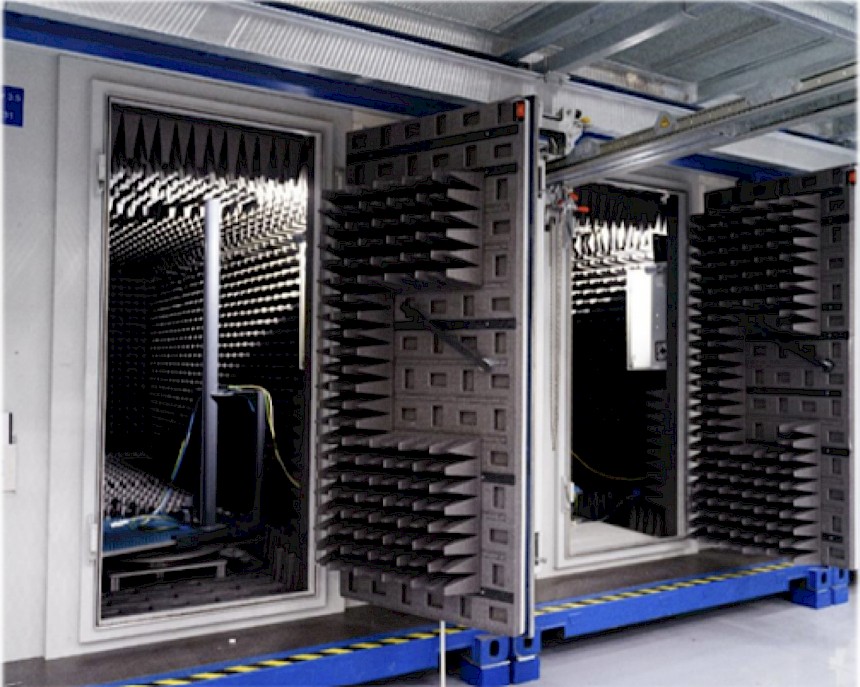
Generally, a polyurethane foam base with added conductive particles like Carbon Black absorbs electromagnetic radiation across a wide range of frequencies, effectively minimizing reflections within the chamber.

AD_4nXcxrGOHbAjUEyJi-5cy3bXoSbDTjK-3DOVdnH6KKrWJ9RdONQshE3-0X0n04HzmPa9r-9B1du4m2YRZoDfNrleJQWjAlp8rtmzBvZZ_z1JnmQCYHM91DdWm5U5HuE5rOjXL-wIKHNuZMrv4zdQhqjM?key=5QpM5QkEVt2mu1CbbO7vOBUu

Finding the Right Chamber to Meet Your Unique Needs

Antennas come in many sizes and as a result, testing chambers also come in varieties. To select the right one for your unique needs, you must take in factors such as your business size, industry requirements, and the testing scope. Here’s how different organizations find the right testing chamber for their needs:

1. For Startups and Small Enterprises

Cost and space efficiency are key for startups and small businesses developing IoT devices, wearables, or consumer electronics.

  • Small RF testing chambers provide controlled environments for testing compact antennas.
  • Semi-anechoic chambers have a reflective floor and are commonly used for radiated emissions testing.

2. For Large Corporations

Corporations dealing with 5G infrastructure, automotive communication, or satellite systems require high-performance, scalable antenna performance testing chambers.

  • Full anechoic chambers have absorptive materials on all surfaces, including the floor, which eliminates reflections and provides a more controlled environment.
  • Automated measurement systems streamline high-volume testing for production efficiency.

3. For Specialized Industries (Aerospace, Defense, etc.)

Industries like aerospace, military, and defense require specialized chambers to ensure compliance with strict regulations.

  • Shielded RF chambers eliminate external interference critical for secure military-grade communications.
  • High-frequency test environments support satellite and radar system validation.

The ROI of Choosing the Right Antenna Testing Chamber

1. Cost Reduction

When you purchase a high-quality RF Testing chamber, it can lower the operational costs by:

  • Minimizing retesting expenses—Accurate, first-time results prevent costly redesigns.
  • Reducing labor costs—Automated testing minimizes manual intervention, leading to faster and more efficient processes.
  • Optimizing resource utilization—Energy-efficient designs lower long-term operational expenses.

2. Reduced Time-to-Market

Time is money, especially in industries where fast innovation cycles define competitiveness. The right antenna performance testing chamber:

  • Speeds up prototype validation—Minimizing delays in R&D.
  • Eliminates external lab dependency—On-premise testing removes bottlenecks.
  • Ensures compliance upfront—Avoids last-minute regulatory setbacks.

3. Improved Product Performance

Some antennas are high-performance and, thus, need precise calibration. So, when you select a suitable antenna measurement chamber, it can provide these benefits:

  • Minimizes reflections and interferences—Better signal quality.
  • Aligned antenna placement—Essential for repeatable and reliable measurements.
  • Positive market reception—Provides a competitive edge.

Wrapping Up

It’s essential to choose the right antenna testing chamber only after considering several factors. That’s why it’s essential to match the testing chamber with your specific needs. To gain maximum ROI, consult a leading 5G test solutions provider like Orbis Systems.

We understand that no two businesses are equal, and each one has unique testing needs. That’s why we provide customized antenna performance testing solutions. Ready to optimize your antenna testing process?

Contact Orbis Systems today and make the right choice today!

FAQs

1. What risks will we face if we choose the wrong antenna testing chamber?

Selecting an unsuitable chamber can lead to inaccurate measurements, compliance failures, and product performance issues. It may also result in higher costs due to retesting and delays in product development.

2. How do I test antennas with different frequency ranges in a single antenna measurement chamber?

To do this, it requires careful management of equipment (network analyzer, positioning system), calibration of reference antenna, chamber configuration, and testing protocols. Now, to accurately test antennas designed for different frequency ranges, ensure the chamber is wideband and adjustable, use the right measuring tools, and lastly, calibrate for each frequency band.

3. What are common mistakes businesses make when setting up an antenna performance testing chamber?

Some common mistakes that many businesses make are:

  • Choosing a chamber that is either too small or too large for the antennas being tested leading to inaccurate measurement or efficient use of space.
  • Inadequate isolation/ shielding. This means having inadequate absorber materials and ignoring regulatory requirements.
  • Not accounting for environmental interference and neglecting regular calibration, which can impact the test accuracy.

4. How can I future-proof my investment in an antenna testing chamber?

To future-proof your investment in a testing chamber, it’s important to choose one that provides automation, scalability, and upgrades. As a result, you can easily adjust to new testing standards and tech advances.

5. Is outsourcing antenna testing a better option than investing in a chamber?

It depends on your testing frequency and budget. Outsourcing is cost-effective for occasional testing, but owning a chamber provides long-term savings for businesses with frequent testing needs.

Categories
Blogs

The Complete Guide to Antenna Positioning Systems: Enhancing Signal Accuracy and Coverage

AD_4nXcnZlRIGKW9JLr0z2Yfh6MmMXWPOCFRB1n4f-e6OFmesury94ks7gbI0XSI692xvDLh5pGTc5BllSfazV5ENED8W6d-64bubCQRNNhgzE6D-qlFeRlKIjhB0oKo7smrGAuM5LiUe_WbZUiKJ2FFWA?key=NHo1FK3nQtptzt7S7NUknaf-

For there to be uninterrupted communication, signal antennas must be aligned properly, so that they don’t lead to poor signal quality and major project setbacks. The Antenna Positioning system controls the physical orientation of an antenna to optimize signal reception or transmission by directing the antenna toward the desired source.

In this blog, we have covered everything you need to know about the importance of positioning systems, their components, applications, and the benefits they bring to industries.

Antenna Positioning Systems: The Backbone of Seamless Communication!

An antenna positioning system helps to control the alignment of antennas, which play a big role in influencing the quality of signals transmitted and received.

That’s why, to ensure that antennas perform at their peak potential, these systems control their orientation.

Its Key Components

  • Actuators: These are mechanized tools that enable multi-axis movement. It helps in fine-tuning the antenna’s orientation.
  • DUT (Device Under Test) Positioner: Positions the device being tested accurately.
  • Control Unit: The control unit ensures that the antenna is always positioned accurately.
  • Real-Time Sensors: These provide real-time feedback to ensure the system adapts to its dynamic environment.

Antenna Positioning Systems: How They Work to Perfect the Signals

These systems help in enhancing signal accuracy improvement. But does it work to achieve that? Here’s how:

  • Multi-Axis Movements: In many systems, it helps move the antenna in various orientations, such as azimuth, elevation, or tilt adjustments.
  • Drive System: Servo motors or steppers move the antenna with precision.
  • Sensors & Software: These provide feedback on the antenna’s current position and orientation.
  • Control System: Processes sensor feedback and commands the drive system to adjust the antenna’s position.

Things to Consider Before Investing in Antenna Positioning Systems

There are certain things you need to understand before investing in an antenna positioning system, such as:

  • Application Requirements: Understand your application’s needs. What is its required range, including range of motion and precision?
  • System Compatibility: Confirm whether the positioning system is compatible with your current infrastructure & equipment.
  • Budget: Ensure you have a proper understanding of the system’s cost. You must include the installation and maintenance in this so that it fits your budget.
  • Reliability and Durability: Choose antenna alignment tools known for their reliability and durability, especially if they are used in harsh environments.
  • Technical Support: Make sure that the system you are buying has technical support and training from the manufacturer.
AD_4nXfGPTxu1XpT364Nm8lHSbBH6JURaTclGa7jzlOfe02jwrbu4MOVUuLh-cHLXpR8UQkI8DBjib4nHYZaySpO9ZhmFWV1W_gowZits4sYHkNmeIPBM1pqI9cbSll8KbEY8H2QFX52yRv6ULcnqyOKlmQ?key=NHo1FK3nQtptzt7S7NUknaf-

Advanced Antenna Technology: The Key to Faster and Smarter Connectivity!

From 5G networks to satellite communications, Wi-Fi advancements, and beyond, advanced antenna systems are the backbone of much of the connectivity infrastructure.

  1. Beamforming: It’s a signal processing technique used to focus a signal in a specific direction rather than broadcasting it in all directions. It can be applied in transmit and receive modes.
  2. MIMO (Multiple Input, Multiple Output): MIMO technology uses multiple antennas to transmit and receive more than one data signal simultaneously. This process takes place over the same radio channel. It plays a key role in increasing data rates, improving reliability, and extending the range of wireless networks.
  3. Phased Array Antennas: Phased array antennas allow the direction of the beam to be electronically controlled without physically moving the antenna.

Precision Perfected: How Antenna Alignment Tools Enhance Positioning Accuracy!

Without these, it is challenging to ensure precision during antenna installation and maintenance. Antenna alignment tools help in measuring and adjusting these key parameters:

  • Azimuth
  • Tilt
  • Polarization

Various alignment tools are available, such as:

  • Laser Alignment Devices: By projecting laser beams, technicians use these to achieve accurate antenna alignment.
  • Software-based Alignment Applications help make real-time positioning adjustments based on current conditions using GPS, sensors, Ethernet Interface (REST API), or other data sources.

Key Applications of Antenna Positioning Systems and Their Impact

Positioning systems are used in many industries, such as:

  • Telecommunications: To provide effective signal transmission, cutting latency, and guaranteeing exact beam alignment for 5G networks.
  • Broadcasting: Optimizing the delivery of signals for television and radio networks.
  • Aerospace: Enabling communication and satellite tracking in challenging settings.
  • Defense: To provide accurate positioning for UAVs (unmanned Aerial vehicles). This helps them operate effectively.
  • IoT and Smart Cities: These systems help to improve the connection for smart infrastructure and IoT devices.

Conclusion

Antenna positioning systems are foundational to the seamless connectivity experiences we expect today and will be at the forefront of the next generation of communication technologies, empowering faster, smarter, and more reliable networks worldwide.

Are you ready to enhance your communication systems with the help of advanced antenna positioning technology?

As the leading 5G test solutions provider, Orbis Systems provides solutions that can improve your testing capabilities. As a result, you can position your organization at the forefront of 5G technology.

Contact us today and take the first step towards uninterrupted connectivity.

FAQs

1. Why is accurate antenna positioning important for my business?

Accurate antenna positioning is important for your business. It helps achieve maximum signal quality and coverage and improves customer experiences through better network efficiency and faster speed.

2. How do I choose the right advanced antenna technology for the needs of my organization?

You can select the right positioning system for your organization by considering several factors, including the specific application, technology options like MIMO, beamforming environmental conditions, frequency range, budget, and more.

3. How often do antenna positioning systems need to be maintained?

  1. Routine Inspections (Monthly / Quarterly) like Visual tests (i.e., to check for any damage) and Movement tests (i.e., verify Antenna moves smoothly)
  2. Software / Firmware updates (as needed)

4. Can I integrate antenna alignment tools with existing infrastructure?

Yes, you can integrate these alignment tools with existing infrastructure

As a result, it can greatly improve how accurate and efficient the antenna alignment process is.

5. What support options are available after purchasing an antenna positioning system?

There are various support options, such as technical support, staff training, maintenance services, and software updates.

Categories
Blogs

How Can an Antenna Testing Chamber Enhance Wireless Performance

As our world becomes ever more interconnected, wireless technology performance has never been more critical. Antenna design and testing are integral parts of developing effective communication systems from smartphones to IoT devices; an anechoic chamber provides an effective means of optimizing wireless performance. In this article we discuss how anechoic chamber testing improves wireless performance, its purpose in creating communication systems as well as some commonly asked questions regarding this technology.

An Antenna Testing Solution

An antenna testing solution, also referred to as an anechoic chamber, is a facility specifically designed to assess antenna performance in an anechoic environment. Lined with materials designed to absorb reflections, these rooms enable precise measurements of radiation patterns, gain, efficiency and other metrics related to antenna anechoic chamber performance.

Definition and Role of Antennas in Wireless Applications

Antennas are devices designed to transmit or receive electromagnetic (EM) energy for specific applications. They act as the backbone of efficient wireless connectivity and data transfer. Conducting antenna tests provides valuable insight into their performance, enabling high accuracy and reliability levels to be met.

Key Features of an Anechoic Chamber for Antenna Testing

Measurement of the precise antenna pattern and characterization of performance

They particularly have anechoic chambers for measuring very high-accuracy antenna patterns by understanding radiation characteristics, gain, and beam width. Such precise measurement capability, they say, helps in proper antenna characterization to ensure that the gadgets meet the given specifications and can perform accurately depending on the applications.

Eliminate external disturbances

One of the significant functions of an anechoic chamber is that it blocks disturbances from the external environment likely to interfere with the testing of antennas. It achieves this by absorbing reflections and hence preventing unwanted electromagnetic interference so that the measurements reflect the true performance of the antenna under test in a controlled environment.

Analysis of Deeper Wireless Devices Performance

Anechoic chambers provide the detailed analysis of performance of wireless devices since they shield the devices from their surroundings and thus provide comprehensive testing. Advanced measurements within these chambers allow the engineer to understand the device’s behavior, diagnose its problems, and optimize its designs to provide better reliability and functionality in real-life situations.

How Anechoic Chamber Testing Improves Wireless Performance

Accurate Performance Measurement

  • Antenna measurement anechoic chamber offer a controlled environment in which antennas can be evaluated without interference from outside sources, making measurements precise and reflective of an antenna’s true performance in key areas such as:
  • Radiation Patterns: Anechoic chambers provide detailed measurements of how antennas emit energy in different directions – an essential factor when considering antenna design and placement.
  • Gain and Efficiency: These measurements assess antenna gain by showing how effectively an antenna converts input power into radio waves, while efficiency measurements enable users to assess performance at multiple frequencies.

Validating and Optimizing Designs

At the design stage, antenna testing solutions enable engineers to evaluate and refine designs before production begins. Testing prototypes in these chambers allows engineers to detect design flaws such as:

  • Frequency Response: Assuring efficient performance within an intended frequency range by identifying resonance frequencies and bandwidth limitations.
  • Impedance Matching: Testing helps achieve optimal impedance matching between antennas and transmission lines, minimizing reflections and optimizing power transfer.
  • Compliance With EMC Regs: Many countries enforce stringent regulations on electromagnetic emissions; antenna chambers can help manufacturers comply by performing functions like:
  • EMI and EMC Testing: These tests ensure devices do not interfere with other electronics and operate as intended in their target environments.
  • Safety Standards Testing: Testing verifies performance parameters necessary for certifications – an essential step toward market access.

Resemble Real World Conditions

Antenna testing solutions or chambers can simulate real world conditions, including:

  • Mobility Scenarios: Chambers recreate real-life usage scenarios where antennas experience various orientations and locations, like when used on vehicles.
  • Environmental Factors: Temperature and humidity control allows testing antenna performance under specific environmental conditions.

Antenna Testing Chambers for Wireless Technologies

Wireless technologies have become ubiquitous, from communication devices to medical equipment; thus making antenna testing chambers integral components of modern life. Antenna design chambers present several benefits when used within wireless communication systems:

  • Reliable Testing: Anechoic chambers provide a controlled environment that accurately represents device performance without external interference.
  • Quality Assurance: Manufacturers can utilize these chambers to assess product quality, leading to improved designs and enhanced user experiences.
  • Research and Development: Researchers can conduct groundbreaking wireless technology research within these chambers, pushing the limits of what is possible when it comes to communication.

Additional Advantages of Anechoic Chambers for Wireless Communication Testing

  • Improved Signal Quality: High-performance antennas minimize dropouts and boost signal strength to enhance user experiences.
  • Greater Coverage: Well-designed antennas extend wireless communication range, enabling devices to work effectively over longer distances.
  • Optimized antennas: It help optimize network efficiency by decreasing congestion and increasing data transmission rates, helping increase network performance overall.
AD_4nXeGJ54ZGpjFZo1TKSVVVxLEW_L0ikU4qNWLDhkFmgzpdJ4AdPilDnBhvRPCOiihbRvOX93j759Vgbe8M2aU7vqsCLstHRS7GDAGMXKAFzDSNqQBzlMNeaQcNFPS2vczwKUG7me8wwqaN-R3K_hpQ1fWJtqt?key=faxSu3ESWbnNjDuwo7CqVg

The Value of Antenna Testing for Wireless Technologies

Wireless technologies are now ubiquitous in almost every facet of everyday life. The dependability of communication devices and medical equipment is determined by the performance of their antennas. Using antenna testing chambers is crucial for ensuring that these devices work properly, resulting in:

  • Improved Signal Quality: High-performance antennas eliminate dropouts and increase signal strength, improving the user experience.
  • Greater Coverage: Well-designed antennas may increase the range of wireless communication, enabling devices to work more efficiently over longer distances.
  • Enhanced Network Efficiency: Optimised antennas improve overall network performance by lowering congestion and increasing data transmission.
AD_4nXeBfcqG_mpqxPXo-hoUmOYXBEOGMB5SB5oZ4gXFK8Fb7sQX8AHb-1DprV46amRPxjv7e8MxPCaXMs_hloankygFXTDQ1okPdz6sZEsd3gGEj8zsJPLlR9vxnlME1vROHSyEkWm4vvPhY4Pen2hgyfJ_9e-j?key=faxSu3ESWbnNjDuwo7CqVg

Conclusion

Antenna testing solutions help optimize wireless performance by creating a controlled environment for precise measurements, design validation, regulatory compliance and real-world scenario modeling. With the continual advancement of wireless technologies comes increased demand for optimized antenna design and testing; investing in quality antenna testing solutions from Orbis Systems ensures optimal device performance while increasing connectivity and user satisfaction across wireless environments.

At present, most smartphones and other devices rely on wireless technology. Utilizing an antenna test chamber is key to reaching peak performance as it helps identify any performance issues, strengthen networks and increase reliability – ultimately providing smooth communication and effortless operations in various applications.

Orbis Systems specializes in custom testing solutions tailored specifically for each project; visit us to discover how our services can optimize testing processes. Discover how we can help optimise your testing processes.

FAQ’s

1. What kind of antennas may be evaluated in an antenna testing chamber?

Antenna testing chambers may hold a broad range of antennas, such as dipoles, monopoles, patches, and phased array antennas. They may also be used to test antennas in a variety of frequency bands, such as cellular, Wi-Fi, and satellite communications.

2. How long does antenna testing take?

The length of antenna testing varies depending on the design’s complexity and the exact measurements needed. Simple tests may take a few hours, but extensive testing and optimisation might take many days.

3. What is the cost of employing an antenna testing chamber?

Costs vary greatly depending on the institution, the complexity of the tests, and the equipment employed. Some organisations may charge an hourly fee for chamber usage, while others may offer package offers for full testing services.

4. Should I test my antenna design in-house or at a professional testing facility?

While it is feasible to set up an in-house testing facility, professional antenna testing chambers are usually outfitted with modern measuring gear and anechoic designs that provide significantly more precise findings. It is advised that key applications be tested at a competent facility to guarantee accurate and consistent results.