
How Can We Help? If you need any help, please feel free to contact us.
Signal Switching Units (SSUs) from Orbis Systems are advanced programmable platforms designed to simplify and automate RF signal routing. These systems play a vital role in telecom and wireless testing by managing the flow of signals between test instruments and Devices Under Test (DUTs). Instead of manually reconnecting RF cables, SSUs provide a reliable, repeatable, and automated method for executing complex test sequences — reducing setup time, minimizing human error, and improving test repeatability.
Part of our broader test and switching solutions portfolio, SSUs work alongside tools like programmable attenuator models to form a complete RF signal management system.
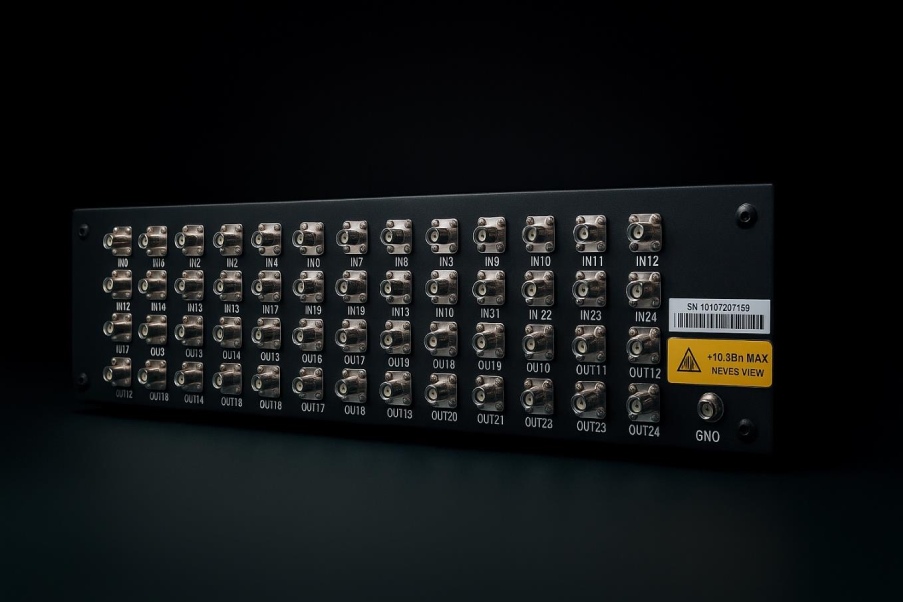
Orbis Systems’ SSUs are built with a modular and scalable architecture, allowing them to expand alongside evolving test requirements without a complete redesign.
They are suitable for a wide range of environments, from R&D labs and validation setups to production testing, and can be configured for different matrix sizes, port counts, and frequency ranges. For multi-channel phase control, explore our phase shift matrix module.
The SSUs support a broad frequency range from DC up to millimeter-wave bands, making them ideal for legacy telecom, 5G, and beyond-5G applications.
Their ability to maintain high accuracy and low loss across wide bandwidths ensures dependable performance for telecom and aerospace industries.
The SSUs deliver low insertion loss, high isolation, and excellent repeatability, ensuring consistent RF performance.
They are available in multiple configurations, including blocking and non-blocking matrices, variable attenuator matrices, and phase-shifter matrices, enabling flexible integration into complex test architectures.
Equipped with programmable control software and automation-ready interfaces (e.g., LAN, GPIB, USB, or RS-232), Orbis SSUs are easy to configure, monitor, and maintain.
They support real-time diagnostics and integrate seamlessly with Over-the-Air (OTA) chambers, positioners, and other automated test equipment, forming a complete test solution for 5G and OTA validation systems.
Looking for a dependable signal routing unit or programmable SSU for your lab, OTA chamber, or production line?
Contact Orbis Systems today to learn more about verified specifications and discover the best solution for your test environment.
Manually reconnecting RF cables between every test is slow, inconsistent, and a nightmare at scale. Programmable SSUs automate the entire signal routing process switching between DUTs and test instruments in milliseconds, reducing human error, and keeping test sequences fast, clean, and repeatable every single time.
From DC all the way up to millimeter-wave bands. Telecom signal switch modules are built to handle legacy telecom, 5G, and beyond-5G applications within a single platform maintaining low insertion loss and high isolation across the full bandwidth, so performance never degrades as frequencies climb.
Very. Signal routing units are available in multiple configurations blocking and non-blocking matrices, variable attenuator matrices, and phase-shifter matrices covering everything from compact R&D labs to large-scale OTA production test lines, all without a complete redesign when requirements change.
Seamlessly. Programmable SSUs support LAN, GPIB, USB, and RS-232 interfaces, plugging directly into OTA chambers, positioners, and automated test equipment. Real-time diagnostics and programmable control software mean your entire test workflow runs smoothly, no manual intervention required.
By eliminating the bottlenecks. Signal routing units automate complex multi-channel test sequences that would otherwise require manual cable changes between each DUT dramatically cutting cycle times, reducing downtime, and letting production lines run at full speed without sacrificing measurement accuracy.

Orbis Systems provides quality control solutions, functional testing solutions, components and services for its customers’ R&D, production and after sales needs. Our products and services increase efficiency and performance in our customers’ processes and hence shorten time to market, lower process costs and increase the end customers’ satisfaction.