
Custom positioners
Get Connected!
How Can We Help? If you need any help, please feel free to contact us.
info@orbissystems.eu
Custom Azimuth & RF Test Positioners Designed for Automotive Applications
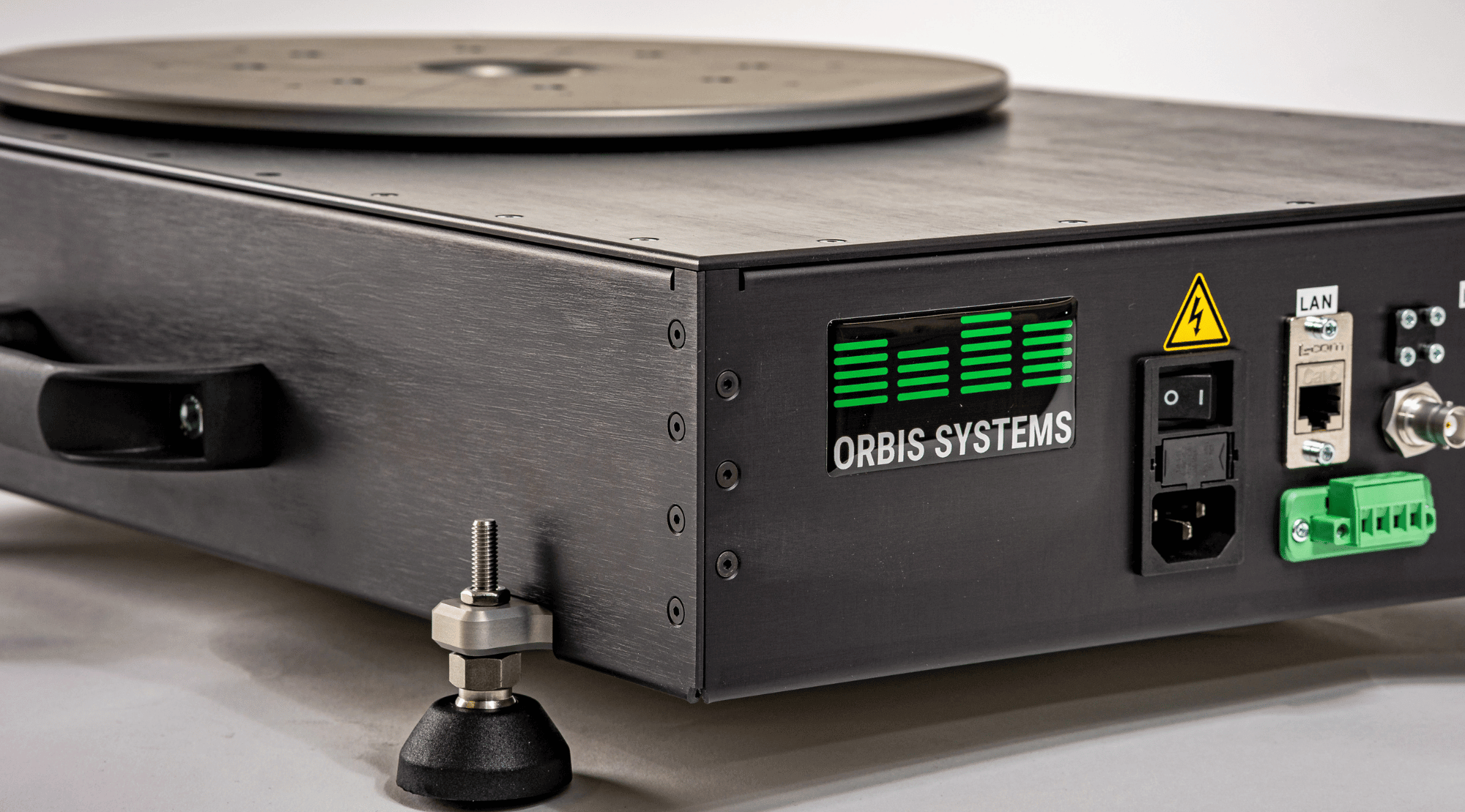
Orbis Systems designs and delivers configurable positioner solutions tailored to demanding test workflows, from connected-vehicle modules to high-volume RF production lines. These positioners form part of Orbis Systems’ scalable positioning solutions for automotive and other industries. They can be adapted to support validation of ADAS radar sensors, EV connectivity modules, and V2X communication devices.
Why choose Orbis custom positioners?
Orbis systems positioners are engineered to deliver repeatable, automated RF and OTA testing. Standard controllers provide a REST API over Ethernet, simplifying integration with test automation frameworks.
Each axis is equipped with absolute position sensors, giving real-time positional data and retaining positional reference even after power loss. These capabilities make Orbis systems positioners easy to integrate into automated test rigs and laboratory software, ensuring accuracy, reliability, and efficiency. For fully automated multi-axis setups, explore our automated positioning systems built for high-throughput OTA environments.
Key technical features
- Configurable travel ranges: Azimuth and elevation axes with customizable ranges (e.g., ±90° azimuth, ±30° elevation) for antenna beam-pattern verification and DUT orientation.
- High payload capacity: Options up to 140 kg for Sub-6 GHz positioners and 40 kg for mmWave positioners, supporting DUTs from small antennas to full automotive ECUs.
- Precision alignment: Axes for height, distance, and polarization control, with calibrated zero/home positions to ensure repeatable and accurate measurement setups.
- Advanced motion control: Continuous-drive and synchronized measurement modes accelerate OTA sweeps, while low-reflection mechanical designs (Theta/Phi configurations) reduce chamber interference and improve measurement accuracy.
Applications
Orbis systems RF test positioners are used for OTA characterization, beamforming and beam-tracking validation, production RF regression testing, and automotive RF/antenna performance validation. They are designed to operate seamlessly in Sub-6 GHz and mm Wave OTA chambers and are available as configurable turnkey solutions. Our azimuth positioners are particularly suited for rapid beam-pattern sweeps and antenna characterization workflows.
Ready to specify a custom positioner?
If you need a positioner designed for automotive DUTs (such as ECUs, antennas, or V2X modules), high-speed azimuth sweeps for rapid OTA characterization, or integration into complete RF test racks, Orbis systems can tailor the mechanics, controller interfaces, and fixtures to your specific test plan. Explore our base station UE testing positioners for telecom-grade validation needs.
Contact Orbis Systems to discuss requirements and request datasheets or a customized quotation
If you're validating ADAS radar sensors, V2X modules, or EV connectivity systems, generic positioners won't cut it. Custom positioners for automotive testing are engineered around your exact DUT geometry, payload, and frequency range, delivering the precision and repeatability that automotive-grade RF validation demands.
Speed without sacrifice. Custom azimuth positioners support high-speed continuous-drive and synchronized measurement modes, enabling rapid azimuth sweeps across the full antenna beam pattern cutting OTA characterization time dramatically without compromising a single degree of accuracy.
More than you might expect. RF test positioners are available with payload capacities up to 140 kg for Sub-6 GHz setups and up to 40 kg for mmWave configurations handling everything from compact antennas to full automotive ECUs without breaking a sweat.
Out of the box, yes. Every RF test positioner comes with REST API over Ethernet as standard, making integration into automated test rigs, lab software, and production frameworks straightforward. Absolute position sensors on every axis mean real-time positional data even after a power cycle.
Off-the-shelf is built for everyone, which means it's perfect for no one. Custom azimuth positioners are designed around your specific test plan configurable travel ranges, calibrated zero positions, low-reflection Theta/Phi mechanics, and fixtures tailored to your DUT. The result? Measurements you can actually rely on.