Table of Contents
- Establish the RF Test Baseline
- Make Wireless Validation Repeatable
- How to Test Wireless Wearables in a Controlled RF Environment
- Where Controlled RF Testing Adds Value
- Turn Test Results Into Engineering Evidence
- From RF Measurements to Reliable Product Decisions
- Frequently Asked Questions
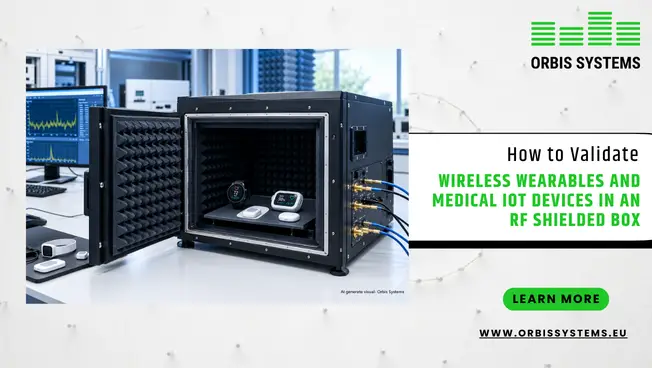 Wearables and connected medical products are becoming smaller, smarter, and more dependent on reliable wireless links. Smartwatches, health patches, portable monitors, and connected diagnostic devices may use Bluetooth, Wi-Fi, cellular, or proprietary radios while operating under tight power and space limits. That combination makes controlled RF validation increasingly important.
Wireless wearable testing should prove more than basic connectivity. Engineers need repeatable evidence that the radio, antenna, firmware, power system, and software maintain defined performance. Medical IoT device testing follows the same principle, with additional attention to communication continuity and safe system behavior.
The need for disciplined verification is clear. Medical device programs across the sector face significant volumes of post market reports involving device malfunctions and adverse events, which underscores why structured verification and traceable engineering evidence matter, particularly for products with critical wireless functions.
Key Takeaways
- Controlled environments make RF measurement results more repeatable.
- RF testing for wearables should cover transmit power, receiver sensitivity, throughput, packet error rate, latency, and link recovery.
- RF shielded testing helps separate DUT behavior from external interference.
- IoT device RF testing should include realistic multi radio operating states.
- Compact shielding can support both R&D and production verification.
- Medical device programs benefit from traceable RF evidence tied to product requirements.
Establish the RF Test Baseline
A practical validation plan starts with the device under test, or DUT. Engineers should define supported radios, frequency bands, channels, bandwidths, modulation, antenna configuration, power states, and expected performance limits. These parameters can then be mapped to measurable device characteristics such as output power, receiver sensitivity, throughput, packet error rate, latency, and link stability.
RF shielded testing provides a controlled environment by limiting external signals and unwanted coupling. RF isolation testing becomes useful when teams compare antenna revisions, firmware builds, power states, or production lots. The objective is straightforward: change the DUT or test condition deliberately rather than allowing the surrounding RF environment to change the measurement.
Make Wireless Validation Repeatable
Wireless device validation depends on repeatability. DUT orientation, fixture geometry, cable routing, battery state, temperature, instrument settings, and test distance should all be controlled and documented.
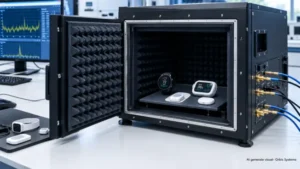
For compact devices, a portable RF shielded box can provide a practical setup for development, quality assurance, and production. It allows power, data, RF, and automation connections to the DUT to be maintained consistently, without moving the device into a larger chamber for every measurement.
IoT device RF testing should also consider coexistence. A wearable may operate Bluetooth, Wi-Fi, cellular radios, sensors, and processors inside a very small enclosure. Transmissions can change current draw and create local electromagnetic interactions. Testing individual radios remains useful, but combined operating states can expose problems that isolated measurements miss.
How to Test Wireless Wearables in a Controlled RF Environment
A practical question is how to test wireless wearables in an RF shielded box while keeping results representative. A defined baseline measurement, repeated under controlled conditions, makes wireless wearable testing easier to compare across hardware and firmware revisions.
- Verify the RF path: Before connecting to the DUT, confirm the frequency, channel, bandwidth, power level, antenna path, and instrument calibration.
- Verify shielding performance: Confirm that the enclosure provides adequate attenuation across all operating bands. Doors, seams, connectors, filters, and feedthroughs deserve particular attention, since leakage at any of these points can affect repeatability.
- Lock the DUT state: Record firmware version, battery condition, orientation, sensor activity, and communication mode. For medical products, include the relevant operating states as part of the record.
- Measure core performance: Capture transmit power, receiver sensitivity, throughput, packet error rate, latency, and link recovery. For wearable devices, both steady state operation and radio state transitions should be included.
- Add realistic stress cases: Include low signal conditions, channel changes, simultaneous multi radio activity, sleep to active transitions, and burst traffic. Medical device RF testing should also verify that the system detects communication interruptions and responds appropriately.
- Automate regression tests: Programmable instruments and consistent acceptance criteria reduce operator dependent variation and make results easier to interpret across different hardware and firmware revisions.
Where Controlled RF Testing Adds Value
RF isolation testing is valuable during design verification because it separates product behavior from environmental noise. When a change in receiver performance is observed in a controlled shielded environment, engineering investigation into interference, antenna, grounding, or shielding can begin from a more substantial baseline.
For production teams, a portable RF shielded box can bring repeatable RF checks closer to the manufacturing line. The setup can be combined with switching, functional fixtures, instrumentation, and software controlled test sequences.
This engineering led approach is reflected in companies such as Orbis Systems, where shielded solutions for R&D and production testing support technologies including Wi-Fi, Bluetooth, 4G, 5G, and custom RF protocols, with attention to controlled RF environments, programmable interfaces, and automated testing workflows.
Turn Test Results Into Engineering Evidence
Medical IoT device testing should produce records that connect measurements directly to product requirements. A useful report identifies the DUT, hardware and firmware revisions, test configuration, RF conditions, instrumentation, calibration status, measured values, and acceptance criteria.
That structure makes wireless device validation useful beyond initial development. When a field issue appears, engineering teams can compare production results with design validation data and determine whether a change in hardware, firmware, antenna behavior, or RF environment may be involved.
Medical IoT device RF testing should also fit within the wider verification program. Regulatory guidance for medical devices increasingly treats cybersecurity as part of design, labeling, and premarket documentation for products with wireless connectivity. Reliable wireless behavior should therefore sit alongside safety, security, EMC, software, and risk management activities.
From RF Measurements to Reliable Product Decisions
As connected wearables and medical IoT products become more integrated, RF validation must account for crowded radio environments, compact antennas, changing power states, and multiple simultaneous functions. A controlled setup gives engineers a consistent reference for finding faults, comparing revisions, and creating defensible test evidence.
For teams asking how to test wireless wearables in an RF shielded box, the process should combine RF characterization, controlled DUT conditions, shielding verification, realistic stress scenarios, and automated regression. Medical IoT device RF testing becomes more valuable when those measurements are connected to product requirements and retained as engineering evidence.
This approach is aligned with the direction taken by companies such as Orbis Systems, where engineered RF enclosures, compact shielding solutions, and scalable OTA test environments support wireless validation across development and production. For B2B engineering teams, the objective is not simply to confirm that a radio connects. It is to establish measurable confidence that the complete wireless system performs as designed.
Frequently Asked Questions
1. Why use an RF shielded box for wearable testing?
An RF shielded box reduces the influence of external RF signals and creates a controlled environment where measurements can be repeated under consistent conditions. This level of control is important for wearable testing, where results need to be comparable across hardware and firmware revisions.
2. Can a shielded enclosure support Bluetooth and Wi-Fi?
Yes. When properly configured, shielded enclosures can support Bluetooth, Wi-Fi, cellular, and other wireless technologies operating within a defined RF frequency range.
3. Which measurements matter most for wireless wearables?
Core measurements for wireless wearables typically include transmit power, receiver sensitivity, throughput, packet error rate, latency, link stability, and recovery behavior.
4. Does RF testing alone complete medical-device validation?
No. RF testing is one part of a broader validation program that typically includes safety, EMC, cybersecurity, software, usability, and other required tests as defined by the applicable regulatory framework.
5. When should RF tests enter production?
Controlled RF tests become valuable when a product depends significantly on wireless performance and when repeatable measurements help support manufacturing quality or long term traceability.