Table of Contents
- Why Higher Frequencies Make Calibration More Difficult
- Three Calibration Problems That Can Delay Testing
- Losses and Reference Plane Errors
- Phase Drift and Poor Repeatability
- Uncertainty in Calibration Standards
- What 2026 Developments Mean for Test Readiness
- Preparing OTA Test Environments for Future Requirements
- Making Existing Test Infrastructure Ready for What Comes Next
- Building Confidence Before the Next Generation Arrives
- Frequently Asked Questions

The move toward 6G is pushing wireless research into frequency ranges that many existing test setups were never designed to handle. At sub-terahertz frequencies, a connection that looks perfectly stable on paper can introduce enough loss or phase variation to affect a measurement. That creates a problem for engineers who need dependable results before they can move a design into the next stage of development.
The issue is not just about buying instruments with a wider frequency range. Engineers must know whether the entire measurement path is reliable, from the source and frequency converter to the device under test. Without that confidence, teams risk spending time investigating errors caused by the test setup rather than the hardware itself.
This makes Sub-THz calibration an early point of concern for 6G testing. A sound measurement foundation saves development time and helps keep test results useful as wireless technologies continue to evolve.
Key Takeaways
- Small losses and phase changes can affect measurements at sub-terahertz frequencies.
- Calibration must cover the complete signal path, not just the main instrument.
- Traceable standards and repeatable procedures help engineers manage measurement uncertainty.
- Regular automated self-checks can reveal measurement drift before it affects a larger test campaign.
- Test infrastructure designed for expansion helps laboratories prepare for future 6G requirements.
- A modular approach lets teams extend capabilities without replacing their entire test environment.
Why Higher Frequencies Make Calibration More Difficult
At sub-terahertz frequencies, engineers have less room for errors caused by interconnections, adapters, and changes in the physical setup. Cable losses, impedance mismatches, and waveguide transitions are only some of the factors that can affect the signal reaching the test device. Even a small change in the connection can shift the measured amplitude or phase.
Sub-THz testing therefore requires a closer look at the full measurement chain. A calibration performed at the instrument port may not account for everything introduced further along the path. When adapters or frequency extension devices are involved, engineers need to understand not only how those components shift the reference plane, but also how they influence the measurement outcome.
The choice of 6G test equipment matters, though its specifications tell only part of the story. An instrument may support the required frequency range while the complete setup still struggles with uncertainty, stability, or repeatability.
The same concern applies to 5G and 6G testing as researchers explore wider bandwidths and new antenna designs. Calibration needs to reflect the actual test configuration rather than remain a routine step that engineers assume will cover every measurement.
Three Calibration Problems That Can Delay Testing
Three recurring issues tend to shape the reliability of sub-terahertz measurements. Each one is manageable on its own, but together they can slow down 6G test readiness considerably.
Losses and Reference Plane Errors
Every added component can change the signal path. At higher frequencies, these effects become harder to ignore, particularly when measurements involve frequency extenders, wave guides, or specialized probes.
Engineers should identify the reference plane relevant to the device under test and account for the components between that point and the instrument. Inspecting the setup again after any hardware change helps prevent an early incorrect assumption from affecting subsequent measurements.
Phase Drift and Poor Repeatability
Phase measurements can be sensitive to temperature changes, mechanical movement, and instrument drift. A setup that produces consistent results in the morning may not behave identically after connections have been disturbed or equipment has warmed up.
For reliable 6G RF testing, teams need repeatable connection procedures and regular verification against known references. Recording environmental conditions and configuration changes also helps engineers identify why two apparently identical tests produce different results.
Uncertainty in Calibration Standards
Calibration is only as dependable as the reference used to establish it. At very high frequencies, suitable standards and validated measurement methods may be more difficult to obtain or apply across the entire operating band.
Terahertz testing calls for careful uncertainty analysis, including the limitations of reference standards and correction models. Engineers need to know not only the measured value but also how much confidence they can place in it.
What 2026 Developments Mean for Test Readiness
Industry standardization work has been progressing toward technical performance requirements for the framework associated with 6G, including requirements specific to the next generation of radio interfaces. These developments provide a common basis for evaluating candidate radio interfaces as standardization progresses.
For test engineers, this reinforces the need to build measurement systems that can adapt as evaluation criteria and radio technologies mature. It does not mean that every 6G system will use sub-terahertz frequencies, but it does make scalable test infrastructure an important consideration for teams exploring those bands.
A sensible starting point is to select RF test equipment according to the required frequency range, bandwidth, dynamic range, and measurement uncertainty. Teams should then document the calibration method, verify the complete signal path, and repeat checks whenever the configuration changes.
Automation can help make these steps part of the normal test sequence. Instead of relying entirely on manual checks, engineers can schedule reference measurements, record calibration status, and flag unexpected deviations before collecting large volumes of test data.
Preparing OTA Test Environments for Future Requirements
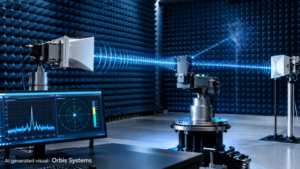
Cable-based measurements cannot answer every question about antenna performance. When engineers need to assess radiation patterns, beamforming, or wireless device behavior, OTA testing provides a way to evaluate a device without relying solely on direct cable connections.
However, the chamber and its measurement configuration introduce their own considerations. Antenna positioning, alignment, reflections, and chamber performance can all affect the result. Suitable OTA testing chambers must therefore be characterized for the intended frequency range and measurement task.
A calibrated instrument alone cannot guarantee an accurate over-the-air result. The complete setup, including the antenna positioner, reference antenna, signal path, and chamber environment, needs to be considered as one measurement system.
This engineering-led approach is reflected in companies such as Orbis Systems, where test system expertise supports demanding measurement and validation workflows. Planning for calibration, automation, and repeatable test configurations early can make later infrastructure upgrades easier to manage.
Making Existing Test Infrastructure Ready for What Comes Next
Not every laboratory needs to replace its entire test setup to prepare for 6G research. Some existing platforms may be suitable for expansion, provided their frequency coverage, instrumentation, and calibration capabilities meet the intended requirements.
The first step is to assess the limitations of the current system. Engineers should identify which components can be retained, where additional frequency conversion is needed, and which parts of the measurement chain require new calibration procedures.
This review also helps teams separate instrument calibration from system-level validation. A calibrated analyzer does not automatically account for losses or phase errors introduced by every adapter, converter, antenna path, or fixture. Those elements must be evaluated within the actual test configuration.
A modular approach can help organizations extend their capabilities without treating every new frequency requirement as a complete infrastructure replacement.
Building Confidence Before the Next Generation Arrives
The biggest calibration challenge is not simply reaching a higher frequency. It is proving that a measurement represents the device’s behavior rather than an error introduced by the test setup.
Teams that establish traceable references, document uncertainty, and verify their measurement paths will be better positioned to investigate new wireless designs. For organizations planning 6G development, calibration should be part of the initial test architecture, not a problem to solve after inconsistent results begin appearing.
This structured approach is aligned with the direction taken by companies such as Orbis Systems, where RF test and OTA capabilities are developed to support dependable measurements, modular expansion, and well-integrated instrumentation across evolving validation workflows.
Frequently Asked Questions
1. Why is Sub THz calibration important for 6G testing?
At sub-terahertz frequencies, signals are more susceptible to losses, phase variation, and measurement uncertainty. Careful calibration helps engineers compensate for these effects, which makes component characterization and system validation more trustworthy.
2. What causes errors during sub-terahertz measurements?
Common sources of error include connector tolerances, impedance mismatches, temperature fluctuations, instrument drift, and limitations in calibration standards. Variations anywhere along the signal path can affect the measured result.
3. How can engineers improve RF measurement accuracy?
Engineers can improve measurement accuracy by using traceable standards, characterizing the complete measurement path, and verifying the system after any configuration change. Automated reference measurements and consistent connection procedures also help reduce variation between results.
4. Can existing 5G test systems be used for 6G research?
That depends on the frequency range, bandwidth, and measurement capabilities of the existing system. Some setups can be adapted, while higher frequency operation may require additional frequency converters, higher performance components, and updated calibration techniques.
5. Why are OTA chambers important for advanced wireless testing?
OTA chambers allow engineers to evaluate antennas and devices under controlled over-the-air conditions. The chamber characteristics, antenna alignment, and overall setup must match the test requirements for the measurements to remain valid.