Table of Contents
- Why a Permanent Testing Environment Can Be the Right Choice
- Engineering Considerations Before Construction
- Define the Required Measurement Performance
- Plan Shielding and Facility Integration
- Account for Future Wireless Technologies
- Built In vs Modular Solutions: Making the Decision
- Designing for Reliable, Repeatable Measurements
- Planning the Investment Around Long Term Needs
- Frequently Asked Questions
Wireless engineering is moving toward more demanding validation requirements. With the growth of connected devices, advanced antennas, automotive radar, and next-generation communication systems, manufacturers need test environments that produce repeatable measurements without unwanted electromagnetic interference. For organizations running continuous research and development or high-volume product validation, a permanent facility can offer greater control over the testing process.
However, installing a permanent chamber is a major engineering decision. It involves careful planning for the facility itself, a clear understanding of measurement needs, equipment integration, and consideration of future product development plans. Understanding when a fixed installation is justified helps engineering teams invest in infrastructure that will support their long-term testing strategy.
Key Takeaways
- Permanent anechoic chambers suit organizations with recurring, high volume RF validation requirements.
- Absorber choice, antenna placement, shielding effectiveness, and room size all contribute to measurement accuracy.
- A fully integrated test environment supports repeatable testing and reduces setup variation between runs.
- Modular solutions may be more practical when testing needs, floor space, or product configurations change frequently.
- Early engineering coordination helps control installation complexity and future expansion costs.
- A permanent facility becomes more valuable when it is planned alongside automation, data integration, and future upgrade paths.
Why a Permanent Testing Environment Can Be the Right Choice
A built-in chamber is designed as part of a facility rather than installed as a largely self-contained enclosure. Its construction can incorporate structural requirements, cable routing, ventilation, access points, grounding, and connections to external instrumentation from the beginning.
This approach supports teams that regularly perform electromagnetic compatibility assessments, antenna characterization, or radiated performance measurements. Operators can follow established procedures without repeatedly reconfiguring the physical test space.
Sustained use of a permanent anechoic chamber is particularly valuable when test configurations stay roughly consistent across new product iterations. A carefully engineered facility also provides a foundation for automation, synchronized instrumentation, and centralized test data collection.
Engineering Considerations Before Construction
Before committing to a permanent installation, engineering teams should work through several considerations that shape both chamber performance and long-term usability.
Define the Required Measurement Performance
The first step in anechoic chamber design is translating the test program into measurable engineering requirements. These may include operating frequency, quiet zone dimensions, field uniformity, shielding effectiveness, permissible reflections, and antenna measurement accuracy.
The required performance depends on the device under test and the applicable test method. A chamber intended for antenna pattern measurements may need different absorber arrangements and geometry from an environment used for radiated emissions testing.
Engineers also need to define the RF testing chamber setup, including antenna supports, turntables, positioning systems, and measurement interfaces. Settling these details early helps reduce the risk of expensive modifications after construction.
Plan Shielding and Facility Integration
A permanent installation needs more than absorbers and a metal enclosure. The physical structure of the surrounding building, including penetrations, doors, power supplies, ventilation, and signal connections, all affects the level of electromagnetic isolation the system can achieve.
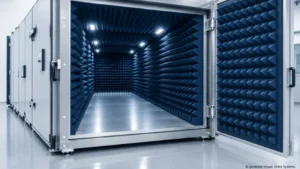
A properly specified RF shielded room helps control external interference and limits unwanted signal leakage. Shielding effectiveness and the chamber’s internal electromagnetic properties should be evaluated together, since isolation alone does not guarantee a suitable measurement environment.
Construction planning should also address structural loading, service access, equipment replacement, and maintenance. These considerations become especially important when the facility is expected to operate across multiple development cycles.
Account for Future Wireless Technologies
Wireless validation requirements continue to evolve. Industry standardization work has been progressing toward technical performance requirements for the framework associated with 6G, reflecting the growing need for structured evaluation of next-generation radio technologies.
This development does not prescribe a particular chamber architecture. Instead, it reinforces the value of planning test infrastructure around defined performance targets and potential changes in frequency coverage, antenna technology, and measurement methods.
An OTA testing chamber may support over-the-air evaluation of wireless devices without requiring direct RF connections to every antenna port. Depending on the chamber’s purpose, high-accuracy antenna positioning paired with a calibrated signal path and a well-defined quiet zone can be worth considering as part of the design.
Built-In vs Modular Solutions: Making the Decision
The choice between fixed construction and a modular enclosure depends on operational priorities, not simply the initial purchase price.
A permanent facility can make sense when an organization has a stable testing program, dedicated floor space, and a clear requirement for integrated infrastructure. It allows engineers to plan the enclosure, building services, and measurement equipment as a coordinated system.
By comparison, modular systems can be attractive when a laboratory must relocate equipment, accommodate changing device sizes, or expand capacity in stages. Their practical advantages depend on the enclosure design and the performance requirements involved.
When evaluating built-in vs. modular anechoic chamber options, compare the total lifecycle cost. Include site preparation, installation, calibration, maintenance, downtime, future upgrades, and the consequences of changing the test configuration. A lower initial cost may not translate into lower operating costs over the life of the facility.
Designing for Reliable, Repeatable Measurements
Long-term measurement consistency depends on the complete test system. Absorber performance, antenna placement, cable characteristics, equipment calibration, and environmental conditions all influence results. Standard operating procedures and regular verification are therefore essential.
Repeatable fixture positioning and controlled test geometry within a fixed RF testing chamber help produce more uniform results across repeated measurement cycles. Automated positioning and instrument control can also increase throughput once the complete system has been validated for its intended use.
Organizations should also consider whether the test environment can accommodate future automation, remote monitoring, and data integration. These capabilities make a permanent facility more useful as testing workflows become increasingly software-driven.
This engineering led approach is reflected in companies such as Orbis Systems, where RF test infrastructure and system integration are developed around measurement objectives rather than forcing the test program to fit a predefined enclosure.
Planning the Investment Around Long-Term Needs
A permanent chamber is most valuable when its capabilities align with a sustained engineering workload. Before committing to construction, teams should document test requirements, forecast likely product changes, evaluate available space, and involve facilities and RF engineers in the same planning process.
A detailed requirements review can establish whether the project needs a dedicated RF-shielded room, a purpose-built measurement facility, or a more adaptable enclosure. It should also clarify how the proposed system will be commissioned, verified, maintained, and upgraded.
This structured approach is aligned with the direction taken by companies such as Orbis Systems, where specialized RF test system requirements and the engineering coordination behind them are brought together through early discussions on interfaces, instrumentation, and future expansion. Addressing these points at the planning stage helps avoid costly design changes later.
Ultimately, a permanent installation is not automatically the best solution for every laboratory. Its value comes from matching the facility’s engineering capabilities to the organization’s real testing demands.
Frequently Asked Questions
1. What is a built-in anechoic chamber?
A built-in anechoic chamber is a permanently installed test environment engineered to control electromagnetic reflections and, where required, external interference. Its construction is coordinated with the facility and the associated test equipment from the start.
2. When should a company choose a permanent chamber?
A permanent chamber is a reasonable choice when testing is carried out regularly, measurement requirements remain relatively stable, and a dedicated laboratory space is available. The expected volume of use should also justify the installation and ongoing operating costs over the facility’s lifetime.
3. Can a permanent chamber support over-the-air testing?
Yes. A permanent OTA testing chamber can measure antenna and wireless device performance when the frequency range, quiet zone, and measurement performance match the intended application.
4. What affects the cost of a permanent installation?
Installation cost depends on chamber size, shielding, frequency range, absorber materials, building adaptations, instrumentation, automation, and commissioning. Ongoing maintenance and future upgrades should also be included in the lifecycle estimate.
5. Can a built-in chamber accommodate future technologies?
Yes, provided the design accounts for new radio bands, revised measurement specifications, different device interfaces, and potential expansion. A chamber cannot be designed to cover every possible future test method, so the specification should be revisited periodically as program needs evolve.