Table of Contents
- Why Global Sourcing Starts With the System Architecture
- Building Resilience Into Global Procurement
- From Requirements to Controlled Procurement
- Managing Movement, Integration, and Deployment
- Connecting Logistics With RF Test System Design
- Looking Beyond the Shipment
- Frequently Asked Questions
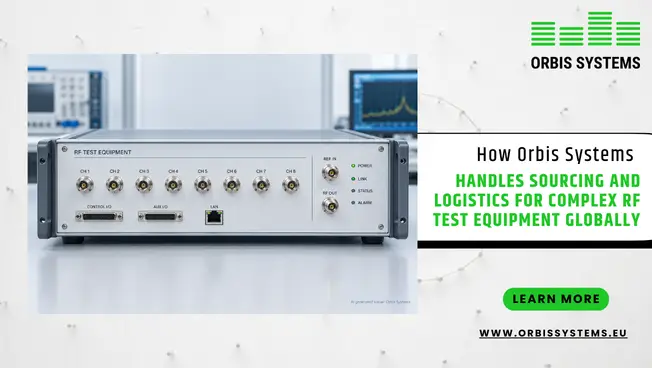
RF test environments are no longer isolated engineering islands. A production ready platform may combine RF instruments, switching units, fixtures, racks, cabling, automation, and software across several countries. That makes RF test equipment logistics part of the engineering lifecycle, not simply a shipping task.
For B2B manufacturers, the challenge is coordinating specifications, suppliers, documentation, customs, delivery, and site readiness. Orbis Systems connects sourcing, integration, validation, and deployment through an engineering led workflow.
Key Takeaways
- RF test equipment logistics is best managed as part of the engineering lifecycle rather than as a separate shipping function.
- Global sourcing services and supply chain management services connect supplier selection with technical requirements and system architecture.
- A controlled RF equipment supply chain improves visibility into lead times, revisions, and component dependencies.
- Global logistics management should connect shipping milestones with site readiness and validation.
- Test equipment sourcing and test system procurement work best when all teams share one technical baseline.
- Modular design and regional support make complex equipment logistics easier to scale across multiple markets.
Why Global Sourcing Starts With the System Architecture
Complex systems rarely come from one supplier. A program may require RF components, precision mechanics, instruments, cables, and control hardware. Effective test equipment sourcing therefore starts with the system architecture and the device under test.
Global sourcing services become most valuable when procurement is tied directly to engineering requirements. In this setup, teams can determine which components meet performance specifications, which are available in the market, which are compatible with the rest of the system, and which revision should be used. This supports test system procurement while reducing the risk of unplanned component changes later.
A controlled RF equipment supply chain improves visibility, while electronics sourcing services keep specialized components aligned with the architecture. Supplier approvals, specifications, quality checks, and delivery milestones can then be tracked together rather than in isolated systems.
Building Resilience Into Global Procurement
International manufacturing is shifting toward a more decentralized and technically sophisticated landscape, with programs operating across borders. For companies moving specialized hardware internationally, these conditions make global logistics management an engineering consideration rather than a purely commercial one.
Awareness of suppliers and supply chains is the first step toward resilience for complex equipment logistics. Supplier mapping makes it easier to spot components with long lead times, identify alternative sourcing routes, and align purchase timing with engineering milestones.
Electronics sourcing services connect specialized vendors, while supply chain management services link purchasing with manufacturing and deployment activities.
From Requirements to Controlled Procurement
A future ready procurement workflow begins before a purchase order is raised. Engineers define interfaces, signal requirements, mechanical constraints, environmental conditions, and compliance needs. Procurement teams can then manage test system procurement against a controlled bill of materials.
Alongside engineering support, Orbis Systems also connects test systems through test equipment development, prototyping, manufacturing, integration, and support. This covers RF and electrical systems, as well as fixtures, adapters, switching units, and automated test platforms.
The same principle applies to broader test equipment development programs. Sourcing alongside system architecture helps protect final platform performance. When custom test equipment design is undertaken, it is done with supplier capabilities, prototype validation, and manufacturing transfer taken into account from the start.
This reduces the gap between specifications and the production floor.
Managing Movement, Integration, and Deployment
Global test equipment deployment involves more than transportation. Systems may require protective packaging, shipment coordination, import documentation, installation, site acceptance, calibration, and operator training.
A mature global logistics management process therefore connects shipment milestones with engineering milestones. The destination site must be ready for connections, installation, environmental requirements, and DUT availability before equipment arrives.
Orbis Systems operates through regional capabilities covering manufacturing, assembly, shipping, support ramp up, commissioning, and localized technical assistance, with regional operations in Europe, the United States, India, and China.
Engaging local engineering to support installation helps reduce hand off gaps during commissioning and logistics work on equipment intensive projects. When logistics and engineering remain connected, technical issues can be addressed without unnecessary delays.
Connecting Logistics With RF Test System Design
Sourcing becomes more effective when it is connected to RF test system design from the beginning. Early design work can expose sourcing dependencies before procurement decisions are locked in.
This is also where custom test equipment design and test equipment development continue beyond initial engineering into manufacturing transfer. Prototype builds expose sourcing issues early, while validation checks confirm whether alternate components meet performance requirements. Test equipment development can then move into controlled manufacturing.
The engineering lifecycle spans requirements, concept design, prototyping, validation, Factory Acceptance Testing (FAT), Site Acceptance Testing (SAT), integration, and ongoing support. Deployment is traceable back through each of these stages.
For organizations managing multiple factories, global test equipment deployment can be built on a common technical baseline with local adaptations. A repeatable sourcing model strengthens the broader RF equipment supply chain. Orbis Systems applies modular architectures and regional support to make this kind of multi market deployment practical.
Looking Beyond the Shipment
Industrial test infrastructure is becoming more connected, modular, and distributed. Wireless, telecom, automotive, and electronics manufacturers need platforms that can be sourced, integrated, reproduced, and deployed consistently.
Orbis Systems brings engineering, manufacturing integration, sourcing, and deployment into a single coordinated workflow. For organizations planning RF infrastructure, this model turns procurement into an extension of engineering execution rather than an isolated purchasing activity.
Frequently Asked Questions
1. What does RF test equipment logistics include?
RF test equipment logistics covers sourcing, international transport, customs handling, installation at the destination site, commissioning, and ongoing technical support. It extends well beyond simple shipping and typically runs in parallel with engineering milestones.
2. Why is engineering input important in test equipment sourcing?
Engineers are the people best placed to validate that candidate equipment meets the required RF, electrical, mechanical, and performance parameters. Their involvement during sourcing helps avoid procurement of components that do not fit the intended architecture or that would require costly rework later.
3. How does logistics coordination reduce deployment risk?
When the team organizing delivery and the team preparing the site maintain an ongoing dialogue, including around Factory Acceptance Testing and Site Acceptance Testing, problems tend to surface earlier and are easier to prevent rather than fix on arrival.
4. What is the role of custom test equipment design in procurement?
Custom test equipment design shapes the procurement process by tailoring the equipment to the specific device under test. This helps teams avoid generic solutions that do not fully match the application and reduces the risk of specifying equipment that is not fit for purpose.
5. Can complex RF test systems be deployed across multiple sites?
Yes. A modular system designed with regional variation in mind can be deployed across different markets, particularly when local engineering support is available for installation, operation, and maintenance.