Table Of Content
- Where a Tunnel Configuration Fits
- Connecting RF Testing With Production
- Why Isolation Matters
- Engineering the Chamber Around the Test Line
- From a Test Station to Production Infrastructure
- Designing for the Next Generation of Wireless Manufacturing
- Frequently Asked Questions
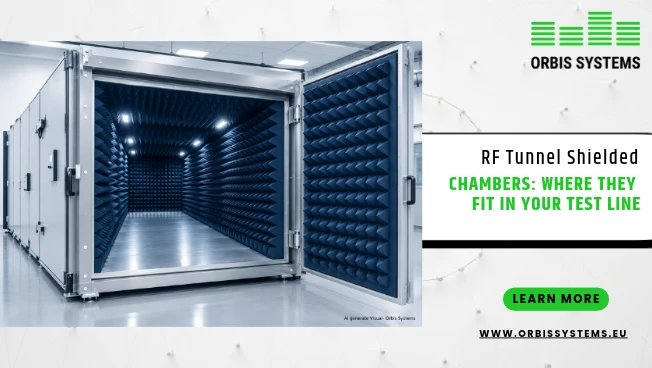 Wireless technology products are changing in a way that packs more functionality into less physical space, with wireless connectivity now built in by default. Whether the product is automotive electronics, telecom hardware, IoT devices, or consumer electronics, manufacturers need dependable RF validation while production is still running. An RF tunnel shielded chamber provides a controlled environment where wireless devices can be tested as part of a structured manufacturing workflow.
Unlike a conventional laboratory setup, this approach brings controlled RF testing closer to the production process. It creates a defined test zone where electromagnetic interference can be minimized, measurements can be repeated consistently, and automated testing can become part of the manufacturing sequence.
Key Takeaways
- An RF shielded tunnel brings controlled RF measurement closer to the manufacturing process.
- An RF tunnel chamber can allow products to move through a defined testing environment.
- An RF shielded test chamber should be designed around DUT characteristics, frequency requirements, throughput, and automation.
- RF production testing can become part of a connected manufacturing workflow.
- An RF test line should account for shielding, instrumentation, handling, software, and future scalability.
- An RF testing enclosure needs to support both measurement reliability and practical production requirements.
Where a Tunnel Configuration Fits
A conventional chamber creates an enclosed electromagnetic environment around a device under test. An RF shielded tunnel takes this principle further by creating a controlled pathway through which products, fixtures, or assemblies can move.
An RF tunnel chamber can therefore become part of a larger production architecture rather than operating as an isolated testing station. Devices can enter the controlled environment, undergo their required measurements, and continue to the next manufacturing stage.
This configuration is particularly useful when testing must be repeated across high production volumes. Shielding, absorber materials, antenna placement, DUT positioning, and instrumentation can all be engineered around the required measurement conditions.
The result is a test environment designed around the actual production process instead of forcing the process to adapt to a laboratory setup.
Connecting RF Testing With Production
The value of an RF shielded test chamber extends beyond electromagnetic isolation. Its real advantage appears when RF validation becomes part of the manufacturing workflow.
RF production testing can be positioned between assembly and final inspection, allowing manufacturers to verify wireless performance before a product reaches the next stage. Depending on the product type, measured characteristics may include transmit power, receiver sensitivity, data rate or bandwidth, RF behavior, connectivity, or other wireless parameters.
An RF test line can also connect testing equipment with manufacturing execution systems and automated handling equipment. Product identification, measurement results, pass or fail decisions, and traceability data can then be managed as part of the wider production system.
This creates a more connected test architecture where RF validation becomes a measurable production operation rather than a separate engineering activity.
Why Isolation Matters
A modern production floor contains numerous potential sources of electromagnetic interference. Wireless networks, switching power supplies, motors, controllers, and other electronic systems can introduce unwanted RF energy into an open testing area.
An RF isolation chamber or shielded room creates a controlled boundary between the device under test and external influences. These barriers help reduce outside disturbances and support a more reproducible measurement environment.
However, isolation alone does not determine test performance. Engineers must also consider internal reflections, absorber configuration, antenna characteristics, cable routing, DUT orientation, frequency coverage, and mechanical tolerances.
For this reason, an RF testing enclosure should be designed around the complete measurement methodology. The physical enclosure, RF components, automation system, and instrumentation all need to work together as one test environment.
Engineering the Chamber Around the Test Line
The design process should begin with the production requirement rather than the chamber itself. Engineers need to understand the DUT dimensions, operating frequencies, measurement sequence, required throughput, handling method, and available floor space.
The RF test line should then be treated as an integrated system. Conveyors, robotic handling, antenna positioning systems, instruments, power connections, data interfaces, and manufacturing software may all need to communicate with the test environment.
Automation can coordinate DUT identification, DUT positioning, measurement execution, and data collection. A modular, interchangeable unit approach also makes future upgrades easier when product designs, wireless technologies, or testing specifications change.
This engineering led approach is reflected in companies such as Orbis Systems, where RF test solutions for demanding production environments combine shielding, positioning, automation, and measurement requirements into a coordinated architecture.
From a Test Station to Production Infrastructure
When RF testing becomes a regular manufacturing operation, the chamber must satisfy more than measurement requirements. Accessibility, maintenance, cycle time, operator interaction, material handling, and data traceability become equally important.
An RF tunnel chamber can help address these requirements by placing a controlled RF environment directly within the production sequence. Depending on manufacturing needs, a single system can perform a focused validation step, while multiple stations can be integrated for different products or testing stages.
This architecture can also support different phases of manufacturing. Engineering teams may use the same basic concept during pilot production, while manufacturers can expand the configuration as production requirements increase.
Designing for the Next Generation of Wireless Manufacturing
As wireless technology continues to advance, manufacturers need to keep pace not only with the technology itself but also with the testing infrastructure that supports it, so that validation does not become a limiting factor in production. An RF isolation chamber can provide controlled electromagnetic conditions for repeatable measurements, with additional capacity or separate testing stages added when production demand grows.
The most important consideration is how the RF testing enclosure will interact with the DUT, measurement equipment, automation, and manufacturing workflow. A properly engineered system should not simply provide shielding. It should become a functional part of the production architecture.
This structured approach is aligned with the direction taken by companies such as Orbis Systems, where configurable RF test infrastructure is developed for current and emerging wireless applications. By combining RF engineering with automation and production integration, the test environment can be designed to remain useful as products and manufacturing requirements evolve.
Frequently Asked Questions
1. What is an RF tunnel shielded chamber?
An RF tunnel shielded chamber is a controlled testing environment that minimizes external electromagnetic interference while allowing a device or assembly to move through the enclosure along a defined test pathway. This supports accurate RF measurements as part of a production flow.
2. When should manufacturers consider a tunnel configuration?
A tunnel configuration is useful when RF testing needs to become part of a continuous or semi-automated manufacturing workflow, where devices move through the test environment rather than being tested as isolated units in a laboratory setup.
3. Can an RF tunnel chamber be automated?
Yes. Handling systems, positioning equipment, RF instruments, product identification, and software can all be combined to support automated testing, allowing the chamber to operate as part of a connected production line.
4. What factors influence chamber design?
Design is shaped by factors including operating frequency range, DUT dimensions, shielding effectiveness, absorber configuration, antenna mounting position, throughput capacity, conveying systems, and integration requirements with manufacturing equipment.
5. Can tunnel systems support future production changes?
Yes. A modular tunnel system can adapt to new products, revised testing requirements, additional frequency bands, new automation equipment, and higher production volumes without requiring a complete rebuild.