
We are creative, ambitious and ready for challenges!

Categories
Blogs

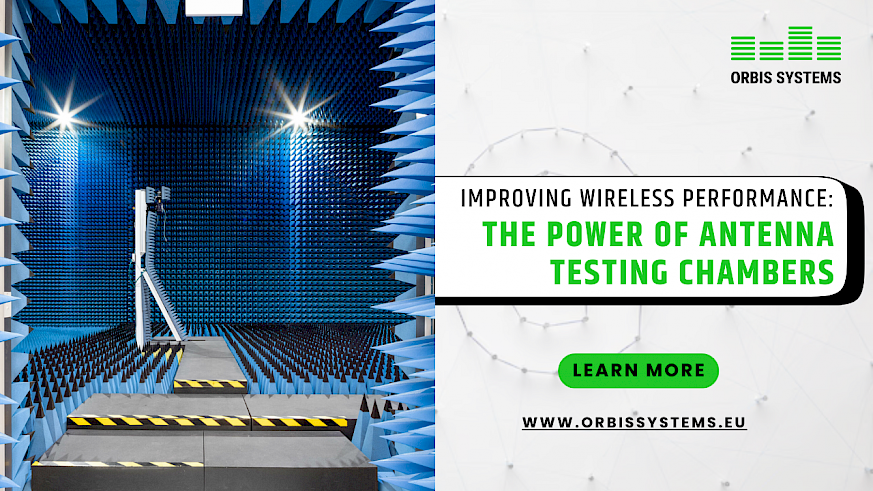
How Can an Antenna Testing Chamber Enhance Wireless Performance

As our world becomes ever more interconnected, wireless technology performance has never been more critical. Antenna design and testing are integral parts of developing effective communication systems from smartphones to IoT devices; an anechoic chamber provides an effective means of optimizing wireless performance. In this article we discuss how anechoic chamber testing improves wireless performance, its purpose in creating communication systems as well as some commonly asked questions regarding this technology.

An Antenna Testing Solution

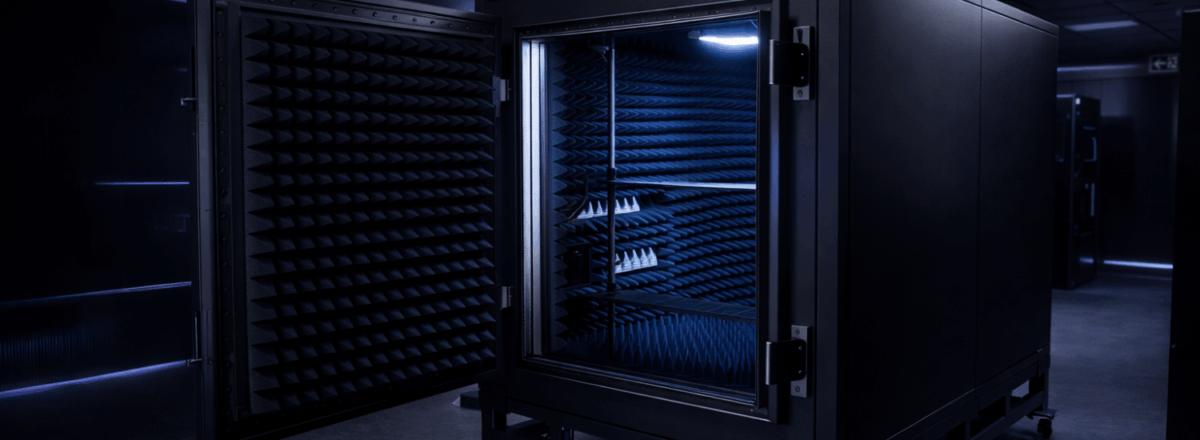
An antenna testing solution, also referred to as an anechoic chamber, is a facility specifically designed to assess antenna performance in an anechoic environment. Lined with materials designed to absorb reflections, these rooms enable precise measurements of radiation patterns, gain, efficiency and other metrics related to antenna anechoic chamber performance.

Definition and Role of Antennas in Wireless Applications

Antennas are devices designed to transmit or receive electromagnetic (EM) energy for specific applications. They act as the backbone of efficient wireless connectivity and data transfer. Conducting antenna tests provides valuable insight into their performance, enabling high accuracy and reliability levels to be met.

Key Features of an Anechoic Chamber for Antenna Testing

Measurement of the precise antenna pattern and characterization of performance

They particularly have anechoic chambers for measuring very high-accuracy antenna patterns by understanding radiation characteristics, gain, and beam width. Such precise measurement capability, they say, helps in proper antenna characterization to ensure that the gadgets meet the given specifications and can perform accurately depending on the applications.

Eliminate external disturbances

One of the significant functions of an anechoic chamber is that it blocks disturbances from the external environment likely to interfere with the testing of antennas. It achieves this by absorbing reflections and hence preventing unwanted electromagnetic interference so that the measurements reflect the true performance of the antenna under test in a controlled environment.

Analysis of Deeper Wireless Devices Performance

Anechoic chambers provide the detailed analysis of performance of wireless devices since they shield the devices from their surroundings and thus provide comprehensive testing. Advanced measurements within these chambers allow the engineer to understand the device’s behavior, diagnose its problems, and optimize its designs to provide better reliability and functionality in real-life situations.

How Anechoic Chamber Testing Improves Wireless Performance

Accurate Performance Measurement

  • Antenna measurement anechoic chamber offer a controlled environment in which antennas can be evaluated without interference from outside sources, making measurements precise and reflective of an antenna’s true performance in key areas such as:
  • Radiation Patterns: Anechoic chambers provide detailed measurements of how antennas emit energy in different directions – an essential factor when considering antenna design and placement.
  • Gain and Efficiency: These measurements assess antenna gain by showing how effectively an antenna converts input power into radio waves, while efficiency measurements enable users to assess performance at multiple frequencies.

Validating and Optimizing Designs

At the design stage, antenna testing solutions enable engineers to evaluate and refine designs before production begins. Testing prototypes in these chambers allows engineers to detect design flaws such as:

  • Frequency Response: Assuring efficient performance within an intended frequency range by identifying resonance frequencies and bandwidth limitations.
  • Impedance Matching: Testing helps achieve optimal impedance matching between antennas and transmission lines, minimizing reflections and optimizing power transfer.
  • Compliance With EMC Regs: Many countries enforce stringent regulations on electromagnetic emissions; antenna chambers can help manufacturers comply by performing functions like:
  • EMI and EMC Testing: These tests ensure devices do not interfere with other electronics and operate as intended in their target environments.
  • Safety Standards Testing: Testing verifies performance parameters necessary for certifications – an essential step toward market access.

Resemble Real World Conditions

Antenna testing solutions or chambers can simulate real world conditions, including:

  • Mobility Scenarios: Chambers recreate real-life usage scenarios where antennas experience various orientations and locations, like when used on vehicles.
  • Environmental Factors: Temperature and humidity control allows testing antenna performance under specific environmental conditions.

Antenna Testing Chambers for Wireless Technologies

Wireless technologies have become ubiquitous, from communication devices to medical equipment; thus making antenna testing chambers integral components of modern life. Antenna design chambers present several benefits when used within wireless communication systems:

  • Reliable Testing: Anechoic chambers provide a controlled environment that accurately represents device performance without external interference.
  • Quality Assurance: Manufacturers can utilize these chambers to assess product quality, leading to improved designs and enhanced user experiences.
  • Research and Development: Researchers can conduct groundbreaking wireless technology research within these chambers, pushing the limits of what is possible when it comes to communication.

Additional Advantages of Anechoic Chambers for Wireless Communication Testing

  • Improved Signal Quality: High-performance antennas minimize dropouts and boost signal strength to enhance user experiences.
  • Greater Coverage: Well-designed antennas extend wireless communication range, enabling devices to work effectively over longer distances.
  • Optimized antennas: It help optimize network efficiency by decreasing congestion and increasing data transmission rates, helping increase network performance overall.
AD_4nXeGJ54ZGpjFZo1TKSVVVxLEW_L0ikU4qNWLDhkFmgzpdJ4AdPilDnBhvRPCOiihbRvOX93j759Vgbe8M2aU7vqsCLstHRS7GDAGMXKAFzDSNqQBzlMNeaQcNFPS2vczwKUG7me8wwqaN-R3K_hpQ1fWJtqt?key=faxSu3ESWbnNjDuwo7CqVg

The Value of Antenna Testing for Wireless Technologies

Wireless technologies are now ubiquitous in almost every facet of everyday life. The dependability of communication devices and medical equipment is determined by the performance of their antennas. Using antenna testing chambers is crucial for ensuring that these devices work properly, resulting in:

  • Improved Signal Quality: High-performance antennas eliminate dropouts and increase signal strength, improving the user experience.
  • Greater Coverage: Well-designed antennas may increase the range of wireless communication, enabling devices to work more efficiently over longer distances.
  • Enhanced Network Efficiency: Optimised antennas improve overall network performance by lowering congestion and increasing data transmission.

AD_4nXeBfcqG_mpqxPXo-hoUmOYXBEOGMB5SB5oZ4gXFK8Fb7sQX8AHb-1DprV46amRPxjv7e8MxPCaXMs_hloankygFXTDQ1okPdz6sZEsd3gGEj8zsJPLlR9vxnlME1vROHSyEkWm4vvPhY4Pen2hgyfJ_9e-j?key=faxSu3ESWbnNjDuwo7CqVg

Conclusion

Antenna testing solutions help optimize wireless performance by creating a controlled environment for precise measurements, design validation, regulatory compliance and real-world scenario modeling. With the continual advancement of wireless technologies comes increased demand for optimized antenna design and testing; investing in quality antenna testing solutions from Orbis Systems ensures optimal device performance while increasing connectivity and user satisfaction across wireless environments.

At present, most smartphones and other devices rely on wireless technology. Utilizing an antenna test chamber is key to reaching peak performance as it helps identify any performance issues, strengthen networks and increase reliability – ultimately providing smooth communication and effortless operations in various applications.

Orbis Systems specializes in custom testing solutions tailored specifically for each project; visit us to discover how our services can optimize testing processes. Discover how we can help optimise your testing processes.

FAQ’s

1. What kind of antennas may be evaluated in an antenna testing chamber?

Antenna testing chambers may hold a broad range of antennas, such as dipoles, monopoles, patches, and phased array antennas. They may also be used to test antennas in a variety of frequency bands, such as cellular, Wi-Fi, and satellite communications.

2. How long does antenna testing take?

The length of antenna testing varies depending on the design’s complexity and the exact measurements needed. Simple tests may take a few hours, but extensive testing and optimisation might take many days.

3. What is the cost of employing an antenna testing chamber?

Costs vary greatly depending on the institution, the complexity of the tests, and the equipment employed. Some organisations may charge an hourly fee for chamber usage, while others may offer package offers for full testing services.

4. Should I test my antenna design in-house or at a professional testing facility?

While it is feasible to set up an in-house testing facility, professional antenna testing chambers are usually outfitted with modern measuring gear and anechoic designs that provide significantly more precise findings. It is advised that key applications be tested at a competent facility to guarantee accurate and consistent results.

Categories
Blogs

6G Challenges for Radio Testing

What should we expect to see in 6G radios?

Now that 5G deployments are well under way, eyes are turning towards the next steps. There are still plenty of open questions regarding full commercial exploitation of 5G capabilities, and we can expect lots of innovation on this field. On technical side current focus is on 5G Advanced which refers to the evolution of 5G in 3GPP releases 18-20.

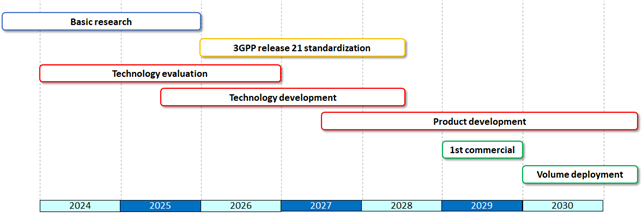
However, the next mobile generation – 6G – is also gaining momentum. Counting backwards from the anticipated commercialization in 2030 and 3GPP standardization roadmaps, we can sketch the following timeline:

Various 6G research programs have existed in leading research institutes for some years. Initially the focus has been on somewhat high level 6G drivers, motivation and targets. As the role of hard wireless technology research has increased other related topics such as Machine Learning/Artificial Intelligence and energy harvesting have also gained interest. On the industry front, the evaluation of implementation technologies is starting and will eventually lead to platform technology development.

However, currently there is limited understanding of the concrete nature and content of 6G. For obvious reasons, radio spectrum is among topical items. Discussion and actions center on the so-called Frequency Range 3 (FR3), which resides between 5G bands FR1 and FR2, that is 7-24 GHz. Within this range the lower part, roughly 7-12 GHz, has received most attention. Bands beyond FR2 which are also called FR4 and FR5 and which are above 71 GHz, have raised academic interest but they will most likely have limited usability for mobile applications. Other topics that have been addressed in academic white papers include combined sensing and communication as well as combating the scarcity of available radio spectrum by means of Dynamic Spectrum Sharing (DSS).

Can we make guesses as to what other developments to expect? It appears clear that the exploitation of massive antenna panels (MIMO) will continue and lead to an ever increasing number of antenna elements. It is also possible that the integration of antenna elements with transceivers will become more common, especially at the upper end of the FR3 spectrum. The drive for openness in Radio Access Network technology and business promoted in the Open RAN exercise is not disappearing. Virtualization and Cloudification are likely to enable diverse centralized distributed RAN implementations.

Other technical areas of recent attention include Reconfigurable Intelligent Surfaces (RIS) and full duplex operation. The former aims to improve coverage in cluttered environments, while the latter has the potential to improve spectrum efficiency, i.e. cell and network capacity. It remains to be seen which what role these technologies may have in 6G.

How shall testing solutions evolve?

Evidently new technologies and functionalities will introduce new challenges for test developers. The increase of system complexity is reflected in the amount of required testing. Open system architectures, such as Open RAN, also increase the need to ensure interoperability and system performance. These factors require the application of test automation. At the same time the cost of instrumentation as well as lab facilities rises and the demand for highly competent test personnel increases. These trends promote maximizing the utilization of equipment and supporting remote operation which are enabled through laboratory automation.

Regarding radio testing there are some clear directions. First, over-the-air (OTA) measurement becomes the base line. This is due to two factors: highly integrated radio units without connectors for test instruments and the expected prevalence of MIMO solutions.

Second, the frequency range of test facilities must be stretched to cover the FR3 band. Since the lower part of this band is of primary interest, the solutions will most likely be based on current FR1 test facilities. If at some point the upper part of FR3 is introduced, perhaps present FR2 test solutions will be extended downwards to cover this band. In practice, measurement instrument upgrades and re-design of measurement chambers will be necessary. The necessary changes will be quite drastic if verification of equipment for FR4/5 frequency bands is necessary.

Third, the potentially increasing size of MIMO antenna panels means that narrower antenna beams can be created and the capability for spatial multiplexing and multi-user MIMO is enhanced. Simultaneously the distance required for far-field measurements increases. These factors accentuate the need to re-design measurement chambers. It may also be that instead of far-field measurements the so-called mid-field range is optimal for some test applications. Another direction may be the increased use of Compact Antenna Test Ranges (CATR).

Various questions arise from the speculated new functionalities: combined communication and sensing, DSS and full duplex operation. It is yet unclear how these would be implemented and which supporting features would be needed. Hence it is difficult to assess the subsequent requirements for related testing solutions. Reconfigurable Intelligent Surfaces (RIS) technology may have different degrees of capabilities and dynamics. In the most advanced forms, testing and the necessary facilities could become extremely complicated. But at this point this is only speculation.

Finally, even today the range of mobile devices is quite wide. These include base stations, smart phones and various types of IoT nodes. In the future we can expect the selection to become even more diverse, with perhaps more varied verification needs.

Timeline for new testing needs

In reference to the picture above, certain stages can be identified. Current phase of basic research and technology evaluation involves mostly manual test arrangements with perhaps ad-hoc instrumentation and tuned-up facilities. In the period 2025-2026, as the content of 6G becomes more clear, testing technologies will be developed in a targeted manner and first versions of actual 6G test instruments and environments will be introduced.

R&D phase of 2027 and beyond sets the highest demands on the test coverage and capabilities. At this stage commercial 6G test equipment shall be available. Test volumes will also increase and automation will be necessary.

Finally starting in 2029, test solutions in 6G radio production are quite sensitive to cost, test time and production line throughput. In part, the R&D test arrangement may be reduced or optimized for production, but a great deal of production-specific test development will be required. High level of automation will also be essential.

To conclude

Much is already known about 6G radio testing or can be extrapolated from recent 5G experiences. Still many topics remain speculation or educated guesses, since standardization will not start for another two years or so. It is already clear that the need for extensive test technology development and competent test developers will not subside, quite the contrary. 6G also offers an opportunity for new players to enter the test development game.


Harri Posti
PhD Telecommunications
Business Development Manager
Orbis Systems

Are you interested in learning more about Orbis Systems? Feel free to contact us for further details.

Contact us

Categories
Blogs

The Ultimate Guide to 5G Measuring Equipment: Features, Uses, and Benefits

AD_4nXd1BwuJT2wmuQInvkGGAhuR1xxabx3V77cP-ivSdLNdCsC3pHDHSvb9BXiQaROmuKKe9Emqah9UtedC3Ue2bGsq-4Q8uKbXnertiVcR7ImEwuWVsL8Y1VwH0-cTTx4NWzwqIphoBzjYMLveryR9ds0?key=qwKfUY_XqamZfQXogR2aCKgI

Introduction

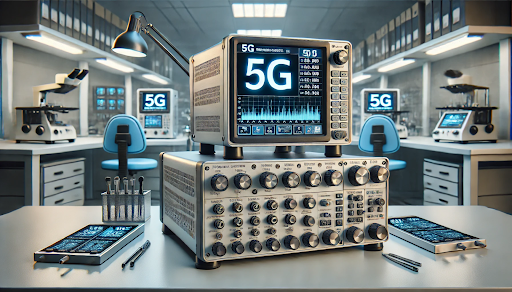
With the rise of 5G networks, there has been a significant increase in the demand for 5G measuring equipment. But why is that so? Well, it’s because these are used to analyze and optimize the 5G network so that it continues to provide high data transmission, low latency, and connection reliability.

Helping the 5G networks operate without interference.

These measuring tools have various features, uses, and benefits that help industries like telecom and broadcasting achieve higher customer satisfaction rates. In this blog post, we have discussed these aspects and also answered some frequently asked questions about the equipment in terms of 5G technology testing.

What Makes 5G Measuring Equipment Essential for the Future of Connectivity?

For seamless connectivity, it’s essential to ensure that 5G networks have optimal performance. This is analyzed by special tools known as 5G measuring equipment. They are designed to handle the parameters such as:

  • Ultra-high frequencies
  • Low latency
  • Device connectivity.

Some examples of this equipment are:

  1. Spectrum Analyzers: Used to check the frequency spectrum of 5G signals. This is done to ensure they work optimally by meeting regulatory standards.
  2. Signal Generators: Used to create test signals that help in stimulating 5G signals. As a result, their performance can be analyzed.
  3. Network Analyzers: Help in checking the performance of 5G components and systems such as antennas and transceivers.

    AD_4nXdTk8o0yD0u8JeaXSG9VK2oheMFnOzh7gAGzYtDeOVPOxioQh-a_6X63F51WjSu5PdcUR1hhSmG_Dqe_Bg6sw2C3cao-h9n6mrWfPsDPH7Io6X9CdqDGKmUSnVIIeK3EmYmdpvHZUT8pT8gKApsnA?key=qwKfUY_XqamZfQXogR2aCKgI

A Glimpse at the Key Features that Define 5G Measuring Equipment

5G networks need to be fast and reliable. That’s why measuring equipment for network device testing must have these features:

  1. High-Frequency Capabilities: 5G networks work on a higher frequency than previous generations (mmWave bands). Therefore, these tools must be able to handle these high frequencies with precision.
  2. Low Latency Measurement: 5G promises ultra-low latency. So, measuring equipment must be able to verify this low latency to ensure that video calls and online games are not lagging.
  3. Massive MIMO Support: Many 5G technologies use Massive MIMO (multiple input, multiple output), which means they use multiple antennas to boost signal strength and capacity. So, a measuring tool for 5G technology testing must be able to test complex antenna arrays.
  4. Beamforming Capabilities: Beamforming is a technique for accurately focusing 5G signals where they are needed. Thus, the right measuring tool can test the beamforming abilities of a 5G network.
  5. Interference Analysis: Nature is an unpredictable variable that can easily cause interference in signals. So, a 5G measuring tool must be able to detect these interferences.

Exploring the Uses of 5G Testing Solutions in Modern Networks

Network Device Testing

5G measuring tools play a crucial role in assessing the performance and connectivity of devices that support 5G, including wearables, smartphones, and IoT gadgets.

5G Testing Solutions for Infrastructure

Engineers employ measuring devices to confirm signal strength, coverage, and capacity both before and during the rollout of 5G infrastructure.

5G Technology Testing

5G networks must be extensively tested in order to serve high-demand applications like autonomous vehicles, smart cities, industrial IoT, and mission-critical communications. This is done by evaluating the network’s latency, throughput, and reliability.

5G Testbeds and Prototyping

In controlled environments, 5G testbeds and prototyping setups are used to show and validate key 5G features, including ultra-low latency and high-speed transmission.

The Powerful Benefits of 5G Measuring Equipment

5G measuring tools have various benefits, especially for service providers, device makers, and telecom operators, such as:

  1. Enhanced Network Reliability: These tools identify possible issues during 5G technology testing and ensure that 5G networks offer services without interruptions.
  2. Reduced Latency: When they identify the issue of high latency in 5G networks, it helps to ensure there is low latency to maintain user satisfaction.
  3. Efficient Network Deployment: By spotting potential problems in network optimization early, A 5G measuring device helps reduce operating costs and improve resource management.
  4. Cost Savings: By spotting potential problems in network optimization early, 5G testing solutions help reduce operating costs and improve resource management.
  5. Future-Proofing Networks: 5G measuring tools provide the required instruments for testing emerging technologies like network slicing, which segments 5G networks into virtual parts to meet specific service requirements.

Selecting the Right 5G Measuring Equipment for Your Network Needs

You need to consider these key factors to ensure you are choosing the right network device testing equipment:

  1. Ensure the equipment has frequency compatibility. It should be able to handle both mmWave and sub-6 GHz bands for testing.
  2. Choose equipment that provides accurate measurements of parameters such as throughput and latency.
  3. When selecting equipment for 5G technology testing, ensure it is user-friendly. It should be easy to operate.
  4. The equipment that provides regular updates and calibrations is a good fit.

Conclusion

With the help of 5G testing solutions, 5G networks can perform optimally without interruptions. These devices offer countless benefits and ensure that 5G networks provide what they promise by testing latency, throughput, signal interference, and more. As a result, Network engineers can analyze and optimize systems in real-time.

Consulting providers like Orbis Systems for assistance can help you find the ideal 5G measuring equipment for your organization. Their 5G testing solutions help improve network performance.

Contact Orbis Systems now to discover our premium equipment and services that enhance your 5G operations.

FAQs

  1. How can I ensure the long-term accuracy of my 5G measuring equipment?

You can ensure the long-term accuracy of your 5G measuring equipment by regular calibration. Also, ensure the software is updated regularly.

  1. Can 5G measuring equipment test devices in real-world environments?

While many measuring equipment is meant for laboratories, some can stimulate real-world conditions, such as dynamic movements and regular natural interference, which helps provide accurate results.

  1. What are the challenges in using network device testing equipment in remote locations?

When using network device testing equipment in remote locations, issues such as connectivity, limited access to power, or poor signal coverage can easily occur. That’s why, for accurate measurements, portable solutions and signal boosters are often necessary.

  1. What is network slicing, and how does it impact 5G technology testing?

Network slicing divides the 5G network into virtual segments designed for particular services. So, measuring equipment assed slice during 5G technology testing. This helps confirm whether the network is meeting the requirements of applications such as AR/VR.

  1. How do 5G measuring tools support the deployment of 5G infrastructure?

5G measuring devices ensure that the infrastructure components, such as antennas and base stations, are functionally optimal. This helps engineers to check signal strength and network coverage.

Categories
News

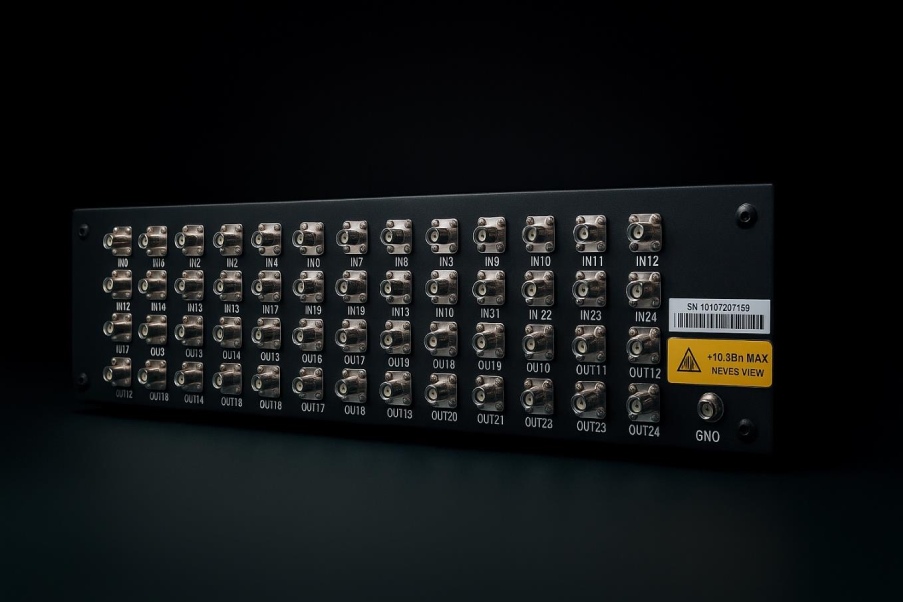
Enhancing modern testing with RF Signal Switching Units

Orbis Systems, an esteemed frontrunner in advanced 5G, RF and OTA testing solutions, sheds light on the merits of RF Signal Switching Units (SSUs) and their alignment with modern testing requirements – ultimately enhancing the professional journey of R&D engineers.


Efficient test equipment utilization

In testing, precision measurement equipment often comes at a premium cost. Traditional testing methods, especially in scenarios like radio testing that require distinct RX and TX testing equipment, lead to underutilization and financial inefficiency. Orbis Systems’ RF Signal Switching Units offer a practical solution by enabling multiple Devices Under Test (DUTs) to effectively share a single set of equipment. This allocation optimizes equipment utilization, streamlining costs and operational procedures.

Advantages of RF Signal Switching Units

Orbis Systems’ RF Signal Switching Units offer multiple advantages that refine the testing landscape:

Enhanced Utilization: A remarkable transition from an 8-hour utilization to a continuous 24-hour operation significantly enhances productivity.

Cost-Efficiency: By eliminating the need for redundant high-cost measuring instruments, overall investment in measurement equipment is effectively reduced.

Improved Throughput: In high-volume production environments, the throughput is amplified, leading to efficient operations.

Error Minimization: Eliminating human errors during testing ensures the precision and reliability of test outcomes.

Early Issue Detection: Quality concerns can be detected at an early stage, streamlining debugging processes and expediting development.

Accelerated R&D: The Research and Development project timeline is shortened, enabling expedited product development.

Customized automation and seamless integration

Orbis Systems’ RF Signal Switching Units seamlessly integrate with automated laboratory systems, enabling swift and effective configuration changes. The modular system architecture, comprising a main case, controller and plug-in modules, empowers users to build extensive test systems.

Simplified operation through software support

To streamline user interaction, Orbis Systems offers software support, featuring a configurator that simplifies test route definition. With this tool, users can swiftly adjust testing parameters, ensuring seamless transitions between different testing scenarios.

Real-time monitoring and maintenance

Orbis Systems provides monitoring software, offering users insights into the operational aspects of the switching units. This feature facilitates diagnostics and routine maintenance, ensuring continued efficiency and reliability.

Explore the potential of Orbis Systems RF Signal Switching Units

Are you ready to optimize your testing processes and harness unmatched efficiency? Connect with Orbis Systems to explore RF Signal Switching Units. Enhance your testing infrastructure, boost productivity and embark on a more efficient path forward.


Contact Orbis Systems to embark on a journey towards refined testing solutions tailored to your specific requirements.

Contact us

Categories
Blogs

Navigating the Complexity of Modern Mobile Networks

Navigating the complexity of modern mobile networks: Striving for excellence in performance and efficiency

In the continuous strive for higher speed, capacity, responsiveness, quality and efficiency, mobile networks grow increasingly complex. Each successive wireless generation introduces new functionalities and features subsequently demanding higher performance from the equipment.

There is also the added challenge of maintaining support for the earlier generation devices and services. To date, the combination has evolved to 2G-3G-4G-5G, although 3G is gradually being phased out.
At the radio interface, a significant complicating factor is the set of frequency bands to be supported. 2G standard is specified globally with four different bands. By the introduction of 5G we are moving towards hundred different band variants. And to make things even more challenging, new bands are being allocated at increasingly high frequencies, 71 GHz being the highest so far. Maintaining required high performance across the bands and at such extreme frequencies is a major headache for the radio engineers.

Radio complexities do not end there. From the simple two-way receiver diversity of early base stations, the evolution has led to current massive MIMO solutions, with tens or even hundreds of individual antenna elements. In addition to calling for a huge number of respective transmitters/receivers, such arrangements enable advanced techniques, such as multi-user MIMO for extreme efficiency.

Conquering complexity: Meeting the multi-faceted testing challenges of evolving mobile networks

These developments – growing number of radio features, multiple network generations, huge range of radio frequencies and extensive antenna configurations – ensure that test development engineers remain busy. It is not sufficient just to guarantee appropriate equipment functionality any more. As each new generation is expected to provide ever increasing performance, there must also be the capability to verify that this is actually achieved. That is not a straightforward or simple task to accomplish.

R&D testing is performed to guarantee excellent equipment design, whereas production testing validates the quality of the production process. Each domain calls for somewhat different testing strategy, methodology and technology.

Unveiling next-generation testing solutions: Orbis Systems leadership in 5G radio equipment validation

Being a leading global testing solution provider, Orbis Systems has invested heavily in creating platform technologies and system solutions for the validation of 5G radio equipment, addressing both R&D and production needs. Hence, we can provide the solution for diverse 5G testing challenges in various sizes and configurations. They range from compact rack-fitting set-ups to auditorium-sized environments, including a customized Sectored Multiprobe Anechoic Chamber (SMPAC) for massive MIMO products.

Harri Posti
PhD Telecommunications
Business Development Manager
Orbis Systems

Are you interested in learning more about Orbis Systems? Feel free to contact us for further details.

Contact us

Categories
News

Tailored world-class solutions for 5G, RF and OTA testing

In a fast-paced world where connectivity is paramount, engineers are at the forefront of revolutionizing 5G, RF and OTA testing technologies. As the demand for faster and more reliable wireless communication grows, recent developments in these areas have taken center stage. This article highlights the cutting-edge breakthroughs that are shaping the landscape of wireless technologies.

Orbis Systems: Your Strategic Testing Partner for 5G, RF and OTA Solutions

Orbis Systems is a strategic testing partner and test system provider specialized in 5G, RF and OTA testing solutions. Leveraging years of expertise and a commitment to innovation, Orbis Systems offers a comprehensive suite of testing solutions tailored to the unique needs of engineers in this dynamic industry.

5G: Paving the Way for the Future

As the 5G technology landscape evolves, Orbis Systems stands as a reliable ally in enhancing the reliability and coverage of 5G networks. Their cutting-edge solutions, including advanced beamforming and massive MIMO testing capabilities, empower engineers to optimize signal quality and network performance, even in the most challenging environments.

Radio-Frequency: Advancing the Spectrum Utilisation

Orbis Systems understands the significance of RF spectrum utilisation in meeting the growing demand for wireless communication. With cognitive radio systems and dynamic spectrum sharing testing solutions, engineers can maximize the usage of available spectrum resources efficiently, ensuring seamless data transfer and superior network performance.

Over-The-Air-Testing: Ensuring Seamless Connectivity

In an increasingly connected world, the OTA testing methodologies of Orbis Systems are indispensable in validating wireless device performance. Equipped with state-of-the-art OTA test chambers with automated positioners and expertise in anechoic materials, engineers can emulate real-world scenarios accurately. This enables a thorough assessment of device capabilities, ensuring a flawless end-user experience.

The Path Ahead: Collaborative Innovation

Orbis Systems is committed to fostering collaborative innovation within the industry. By working closely with industry stakeholders, Orbis Systems facilitates knowledge-sharing and helps drive the advancement of 5G, RF and OTA technologies. Together, they tackle challenges, set industry standards and push the boundaries of wireless connectivity.

Conclusion

In a landscape defined by constant progress, engineers need a testing partner that understands the complexities of 5G, RF and OTA technologies. Orbis Systems stands as a strategic global testing partner, providing specialized solutions tailored to the needs of engineers in the wireless communication industry. As they continue to innovate and collaborate along with Orbis Systems’ support, engineers are shaping a connected future that promises unprecedented possibilities for individuals and industries alike.

Interested in further information about Orbis Systems’ OTA solutions?

Find out more: here

Categories
News

Unveiling the distinctiveness of next-gen 5G OTA testing solutions


In 5G over-the-air (OTA) testing, the level of automation is the deal-braker between old and new generation solutions.

5G is currently transforming the world far beyond the telecommunications sector. Providing throughput speeds of up to 10 Gbps, frequencies that extend well into the mmWave territory and devices operating in multiple radio access technologies, Industries such as Robotics, Aerospace and Defense and Automotive are adopting new technologies at a rapid pace making over-the-air (OTA) testing an essential part of the product verification process.

New Generation of OTA chambers improves testing efficiency

What separates Orbis Systems’ 5G OTA solutions from the competition is the high level of pre-integration and automation that removes the need to build separate add-ons, accelerates the customers’ ramp-up times, improves testing capabilities, speeds and provides more reliable results.


Some of the most distinguishing features of Orbis Systems’ OTA chambers include the following:

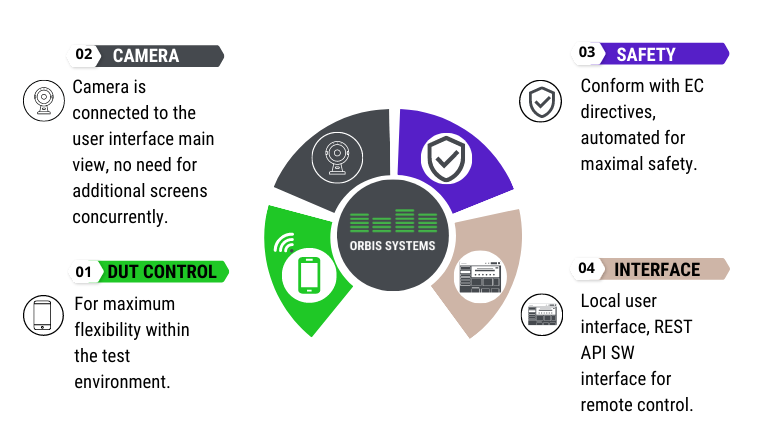
1. Device-under-test DUT control

Low reflection, vertical DUT positioners by Orbis Systems are unique in their ability to software emulate vertical sweeps of horizontal (also called “barbeque style”) positioners for maximum flexibility in the test environment. All automated positioners have a REST API SW interface for control and various positioner styles are available to cater to different testing needs.

The DUT positioner can be synchronized with the test equipment allowing continuous rotation with position synchronized measurement points. Not having to stop and wait for mechanical stabilization of the positioner for every measurement point provides a remarkable increase in testing speed.

2. Camera

Orbis Systems 5G OTA Chamber solution includes automated and fully integrated camera control. The IR camera is mounted onto the front door or inside the chamber and integrated into the chamber controller. Due to the integration, the camera is connected to the user interface main view, so there is no need for additional screens to be used simultaneously.

3. Safety Features

Naturally an integral part of any RF testing solution, the safety features of Orbis Systems’ OTA chambers conform with EC directives and are automated to ensure maximal safety under all circumstances. The features include an RF shielding door equipped with an automated safety switch. When the chamber door is opened, the door safety circuit will immediately switch off DUT power to prevent radiation and stop all positioner movement. The chambers also include automated smoke detection and sprinkler systems. Additional features, such as motion detectors, are easy to implement according to customer-specific needs.

4. Interface

For optimum usability, the OTA chambers are equipped with a local user interface as well as REST API SW interface for remote control. A remote-controlled PDU, Ethernet ports and switches and filters are located inside the chamber.

The Road Ahead: Even more flexibility and customization

In addition to their high level of automation, Orbis Systems’ chamber-based OTA solutions are adjustable and flexible to the user’s needs in several ways. The chambers are constructed from standard industrial components and delivered completely ready for use, so there is no need for expensive and time-consuming installation, which could possibly lead to on-site installation related quality and isolation issues. Compact and mobile, the chambers can be moved on rollers within the facility and multiple chambers can also be stacked in order to save valuable laboratory space. Alternatively, where customer facilities limit the deployment of pre-built chambers, Orbis Systems delivers modular chamber solutions.

According to Orbis Systems Sales Director Jukka Hieta, these qualities are well appreciated among customers who thanks to the high level of automation, are able to save resources and speed up their testing processes. “Already today customers are demanding for more customisation to chamber automation and device positioning systems to cater their specific R&D needs”, Hieta says, and ensures that the Orbis Systems is continuously developing not only the technology but also the usability, flexibility and cost-efficiency of its solutions.

Interested in further information about Orbis Systems’ OTA solutions?

Find out more: here

Categories
News

Looking for tailored 5G testing solutions? Check out how your business can benefit from our tailored solutions!

Unlock the potential of your testing capabilities with Orbis Systems. Watch our video to discover tailored solutions for complex networks, providing efficiency, cost-effectiveness and accurate results. Experience the power of innovation in testing.


Tailored Solutions for Complex Networks
Orbis Systems understands the challenges posed by today’s evolving wireless networks. Our solutions are tailored to address the complexities and demands of modern networks, ensuring precise and efficient testing that meets your unique requirements.


RF Shield Box – Simplified Testing for Wireless Devices & IoT Nodes
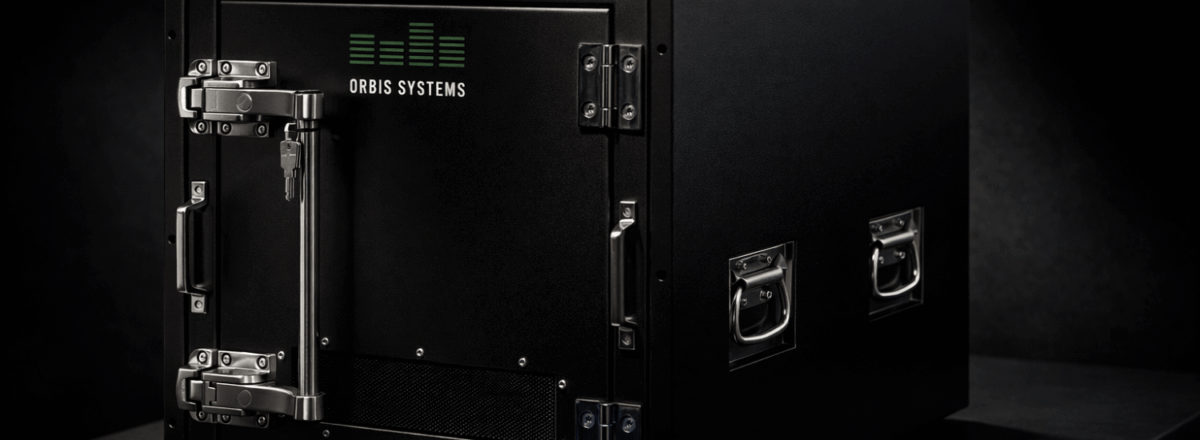
Simplify your testing process and reduce costs with our portable RF Shield Box. Benefit from its simplicity, cost-effectiveness and customization options providing you with an efficient solution for testing wireless devices and IoT nodes. With optimized space utilization this compact solution maximizes efficiency.


RF Shielded Containers – Ready-to-Use and Adaptable Testing Solutions
Experience convenience and flexibility with our ready-to-use RF shielded containers. These adaptable solutions simplify the testing process and seamlessly integrate into various scenarios. Benefit from their plug-and-play feature ensuring streamlined testing and transportability.

https://youtu.be/9j8dp3LQfFA

Anechoic Chambers – Realistic Testing Environments for Accurate Results
Achieve accurate and reliable results with our anechoic chambers. These chambers create realistic test scenarios allowing for precise emulation of real-world conditions. Benefit from their scalability, modular platforms and remote operation capability providing you with flexibility and convenience.


Modular Shielded Rooms – Versatile Solutions for Base Station Testing
Streamline your base station testing with our modular shielded rooms. These versatile solutions are built on-site and offer module-based flexibility. Benefit from remote operation and convenient testing even within office environments.


OTA Emulator Streamlined Testing for Wireless Devices & IoT Nodes
Experience streamlined testing with our compact OTA emulator. Benefit from its small footprint and solid phase shifter matrix solution ensuring fast and reliable testing for wireless devices and IoT nodes. Simplify your testing procedures and achieve efficient results.


Customer Focus
At Orbis Systems, understanding your unique needs is our top priority. We collaborate with you to provide personalized support and tailor our solutions to your specific testing requirements. Book a meeting with our experienced team to discuss how we can assist you in achieving your testing goals.

Categories
News

Orbis Systems’ Complete Anniversary Interview Released: “What is Really Interesting Is the Decade to Come!”


The full-length 10-year anniversary interview looks into the near future of RF testing technology with the insight of a global industry frontrunner.

Orbis Systems continues to celebrate the company’s 10-year milestone by releasing the full-length version of its anniversary interview! The 50-minute video interview is focused on the anniversary year’s selected themes like innovative technology, global presence and sustainability, and it offers a comprehensive view not only into the past ten years in Orbis Systems’ history but also on the development and near future of the entire telecom industry, as seen by the company’s global leadership team members from Finland, China and USA.

10-year Annivesary Interview – Orbis Systems’ First Decade of Knowledge

From 5G to 6G: Positioning for the Future
The anniversary interview naturally takes a look back at some of the highlights and lessons learned along the company’s 10-year journey so far, but the main focus is very much on what is to come. While the company is currently experiencing unprecedented growth in the midst of the current large-scale 5G ramp-up, it is also simultaneously keeping a close eye on the future. As described by Head of Global Sales at Orbis International Technologies Inc. Tuukka Jousmäki from Dallas, USA: “In 2-3 years, the deployment of 5G technology will still continue strongly. At the same time, the development of 6G will pick up to speed and working very closely with our customers’ R&D, we want to be in the frontline in developing whatever is required there. I believe that many of the technologies and solutions developed for 5G can be utilized in 6G, but there will definitely also be some new features that need to be taken into account and covered.” Key Account Manager Carlos Monero agrees: “Orbis Systems is very alert and aligned and following all the discussions to position itself for the future. For example, today we are investing a lot on robotics and cloud-based solutions, although not forgetting our core solutions like chambers and SSUs.”

More 10-year anniversary articles and video clips are available here.

Categories
News

From High Customer Satisfaction to Facilitating Sustainability: The Many Benefits of a Global Footprint

Global operations not only provide local support and assistance for the customers but also contribute significantly to the service provider’s sustainability and risk mitigation efforts.

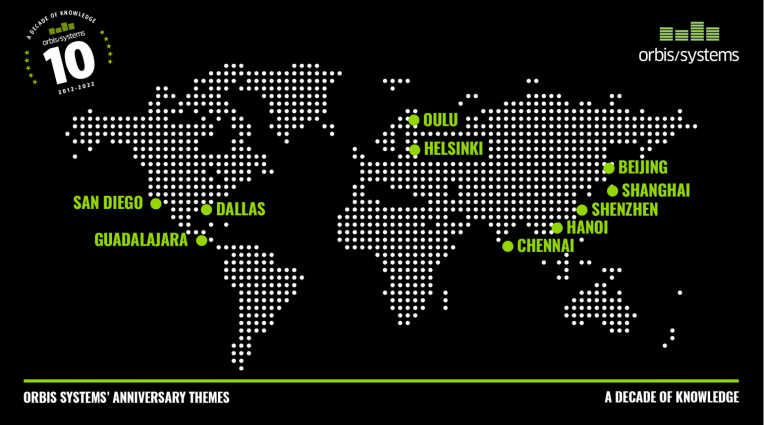
Although currently celebrating its 10-year anniversary as an independent company, Orbis Systems has in fact been providing high quality test solutions for the telecom and electronics industry for over 20 years. The company’s approach has always been based on deep-set customer intimacy and therefore its global footprint, today reaching all the way from Europe to Asia-Pacific and the Americas, has expanded hand in hand with customer needs. According to Orbis Systems’ CEO Eero Rossi, this strategy has become an important competitive advantage that is much appreciated by the company’s clientele. “Whenever a customer has opened a production or R&D site somewhere, we have followed them, which has enabled very close relationships. According to customer feedback our flexibility is highly valued for its many benefits and a clear differentiator compared to some other vendors”, he describes.

Local support on a global scale
CEO Rossi’s views are shared across Orbis Systems’ global organization. As Tuukka Jousmäki, Head of Global Sales at Orbis International Technologies Inc. in the USA puts it: “We have teams in all the time zones as well as dedicated teams to serve different customer needs locally all over the world. We are very close to our customers everywhere.” Local presence ensures fast response and support as well as reduced lead times and costs, which in turn lead to high customer satisfaction. “Being able to meet customer requirements locally on a global scale is one of Orbis Systems’ most critical competitive advantages”, confirms Edward Wang, Head of Beijing Orbis Electronics CO, Ltd in China. A global footprint also brings many benefits to the service provider, such as being able to speak the same language with the customer and understand each local decision-making culture. Global operations also contribute to mitigating the risks of delivery schedules and costs, political instability and crises like the COVID-19 pandemic, as well as support sustainability through reduced shipping needs.

10-year Anniversary Interview with CEO Eero Rossi and Key Account Manager Carlos Monero – Global Footprint

Local and global intertwine in innovative testing concepts
Rapid changes in the form of evolving standards, emerging market trends and new technologies are typical of the telecom industry. A recent emerging trend, no doubt generated by the relatively high cost of laboratory space and testing equipment, is the rise of testing hubs where joint testing facilities are used by big and small businesses alike. For instance in Finland, Business Oulu is planning to build Europe’s first 6G testing facility (local newspaper Kaleva’s article in Finnish behind paywall), a 35 000 square meter Radio Park, in Oulu. In addition to serving the testing needs of wireless technology companies on-site, the Radio Park aims to provide remote testing services for companies all across the globe. As an industry frontrunner headquartered in the Oulu region, Orbis Systems is naturally excited about the plans. “We welcome the idea of a large-scale testing hub in Oulu to cater to the needs of both local and global businesses”, CEO Eero Rossi says.