
Table of Contents
- What is an RF Shield Enclosure
- Why Multi-Device Testing is Important
- Challenges in Multi-Device RF Testing
- How RF Shield Enclosures Help
- Types of RF Testing Environment Solutions
- Choosing the Best RF Enclosure for Multi-Device Testing
- Supporting Reliable Multi-Device Testing
- Frequently Asked Questions
Wireless devices are now used across industries such as telecommunications, automotive, aerospace, and IoT. As device volumes increase, testing requirements have also grown significantly. In many production and validation environments, engineers must test multiple devices simultaneously to meet throughput demands.
However, multi-device RF testing introduces challenges such as signal interference, poor isolation, and inconsistent results if the testing environment is not properly controlled.
This is where RF shielding solutions play a critical role. However, you may ask, what is an RF shield enclosure? Then read on below.
Key Takeaways
- RF shield enclosures create a controlled testing environment
- Understanding what an RF shield enclosure is helps in selecting the right system
- Multi-device testing improves speed and productivity
- Signal interference and poor isolation are common challenges
- RF testing environment solutions help ensure accurate results
- Systems like Rf shielded chamber and RF isolation racks support different needs
- The best RF enclosure for multi-device testing depends on isolation and scalability
What is an RF Shield Enclosure
An RF shield enclosure is a specially designed structure that attenuates electromagnetic (EMI/RF) signals, creating a controlled environment for wireless testing.
Instead of completely blocking signals (which is practically impossible), these enclosures provide high shielding effectiveness, typically ranging from:
- 60 dB to 100+ dB isolation, depending on design and frequency
This means:
- External signals are significantly reduced before reaching the device under test (DUT)
- Internal signals are contained, minimizing leakage and interference
Key Functions
- Isolation from external RF noise
- Reduction of signal leakage
- Controlled and repeatable test conditions
These enclosures are widely used in:
- RF chamber testing
- OTA (Over-the-Air) testing
- Wireless device validation
Why Multi-Device Testing is Important
Testing one device at a time is no longer efficient in high-volume environments.
Benefits of Multi-Device Testing
- Increased throughput
- Reduced test time
- Better utilization of test equipment
- Lower cost per unit tested
This approach is commonly used in:
- Mobile device manufacturing
- IoT module validation
- Telecom product testing
However, scaling testing in this way requires careful RF design.
Challenges in Multi-Device RF Testing
Signal Interference
When multiple DUTs transmit simultaneously, signals can overlap (co-channel or adjacent-channel interference), making accurate measurements difficult.
Poor Isolation (Crosstalk)
Without sufficient isolation:
- Signals from one DUT can couple into another
- Measurement accuracy is compromised
Typical Requirement:
- Isolation between test ports/compartments: >50–80 dB (depending on frequency, application, and test standard)
Inconsistent Results
Variations in:
- Test environment
- RF reflections (multipath effects)
- External noise
can lead to poor repeatability and measurement uncertainty.
Complex System Integration
multi-device test setups require:
- RF routing (switches, combiners, attenuators)
- Proper antenna placement or conducted connections
- Shielding design (RF enclosures, absorbers)
- Automation and test software integration
Without proper system design, complexity can reduce test efficiency and increase error.
For these reasons, proper RF testing environment solutions are required.
How RF Shield Enclosures Help
RF shield enclosures are engineered to address the above challenges by combining mechanical design and RF engineering.
Key Advantages
- High Shielding Effectiveness
- Prevents external interference from impacting test results
- Controlled Internal Environment
- Ensures stable and repeatable measurements
- Reduced Crosstalk
- multi-compartment designs improve isolation between DUTs
- Support for Automation
- Compatible with robotic handling and automated test systems.
As a result, RF shielded enclosure multi-device systems are widely used in modern testing environments.
Types of RF Testing Environment Solutions
Different RF testing requirements demand different types of controlled environments. Understanding these options helps in selecting the right solution for a given application.
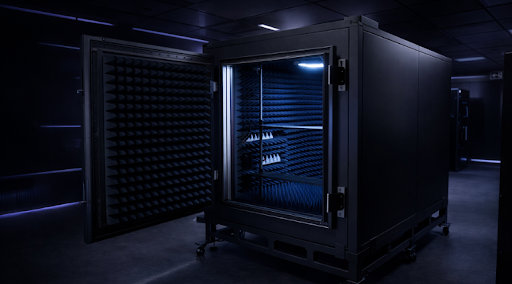
RF Shielded Chamber
An RF shielded chamber provides high shielding effectiveness (typically 80–100 dB), isolating the test environment from external electromagnetic interference. It is commonly used for precise RF measurements and general wireless device testing.
A shielded anechoic chamber combines electromagnetic shielding with RF absorbers to minimize internal reflections. This creates a free-space-like environment, making it ideal for OTA (Over-the-Air) testing, antenna measurements, and radiation pattern analysis.
RF Isolation Racks
RF isolation racks are modular, multi-compartment systems designed for parallel testing of multiple devices. Each compartment provides controlled isolation (typically >60 dB), reducing crosstalk and enabling efficient multi-device testing in production environments.
RF Enclosures and Shield Boxes
RF enclosures and shield boxes are compact shielding solutions widely used in manufacturing and validation setups. They offer a balance between cost, size, and performance, and are often integrated with automated test equipment (ATE) for high-throughput testing.
Each of these solutions serves a specific role within a broader RF testing environment, depending on accuracy, throughput, and application requirements.
Choosing the Best RF Enclosure for Multi-Device Testing
Selecting the best RF enclosure for multi-device testing requires careful evaluation of both RF performance and operational requirements.
Key Factors to Consider
Shielding Effectiveness and Isolation:
The enclosure should provide adequate shielding effectiveness across the required frequency range (typically 60–100 dB). For multi-device setups, isolation between compartments is critical and should typically exceed 60–80 dB to minimize crosstalk.
Frequency Range:
Ensure the enclosure supports the target frequency bands, such as:
- Cellular (4G/5G)
- Wi-Fi (2.4, 5, 6 GHz)
- Other wireless standards
Number of Devices (DUTs):
The enclosure design should support the required number of devices through multi-compartment architecture, enabling parallel testing without interference.
RF Design Considerations:
Performance depends on:
- RF absorber usage (to reduce reflections)
- Proper antenna placement or RF routing
- Low insertion loss and good impedance matching (for conducted testing)
Automation and Integration:
For production environments, the enclosure should support:
- Automated or pneumatic doors
- Shielded RF connectors and filtered interfaces
- Integration with automated test equipment (ATE)
Mechanical and Space Constraints:
The system should fit within available space while maintaining performance. Design aspects such as door sealing, RF gaskets, and filtered ventilation are critical to prevent leakage.
Scalability:
A modular and scalable design allows future expansion as testing requirements grow.
Supporting Reliable Multi-Device Testing
As wireless technologies evolve (especially with 5G and IoT), testing complexity will continue to increase.
A well-designed RF testing environment ensures:
- Accurate measurements
- Repeatable results
- Scalable production
By combining solutions such as:
- RF shielded enclosures
- Isolation racks
- Anechoic chambers
Engineers can build robust and efficient multi-device testing systems
Frequently Asked Questions
1. What is an RF shield enclosure, and why is it important
An RF shield enclosure is a closed system designed to attenuate electromagnetic signals. It reduces external interference and minimizes internal signal leakage, creating a controlled environment for accurate and repeatable testing of wireless devices.
2. How does multi-device testing improve efficiency
Multi-device testing allows several devices to be tested at the same time. Therefore, it reduces total testing time. It also increases throughput in production environments. In addition, it helps make better use of space and equipment.
3. What problems can occur without proper RF isolation
Without proper RF isolation, signals from different devices can interfere with each other (crosstalk). As a result, measurements may become inaccurate, and signal leakage can impact test reliability.
4. What is the role of a shielded anechoic chamber
A shielded anechoic chamber blocks external signals and minimizes internal reflections using RF absorbers. This creates a free-space-like environment, making it ideal for OTA (Over-the-Air) testing, antenna measurements, and radiation pattern analysis.
5. How to select the best RF enclosure for multi-device testing
To select the best RF enclosure for multi-device testing, key factors include shielding effectiveness, isolation between compartments, number of devices, and supported frequency range. In addition, scalability, automation support, and space constraints should be considered. A well-designed system ensures accurate, repeatable, and efficient testing.