Table of Contents
- Why Mesh Validation Matters for Modern Wireless Products
- What Is a Mesh Test System?
- How Does a Mesh Test System Work?
- Where OTA Chamber Testing Fits
- Mesh Test System vs OTA Chamber Testing
- Building a Future Ready Mesh Validation Architecture
- Preparing for the Next Layer of Wireless Validation
- Frequently Asked Questions
Wireless products are becoming more distributed, intelligent, and interconnected than ever before. Rather than communicating through a single direct connection, modern devices share data across networks of nodes that change dynamically. This shift creates a different validation challenge for engineering teams.
Mesh network testing focuses on the behavior of many wireless nodes working together as a system, while chamber based validation focuses on the radio and antenna performing correctly under specific, controlled conditions. Understanding the difference helps B2B engineering teams build test strategies that reflect how products will actually operate in the field.
Key Takeaways
- Mesh network testing evaluates behavior across interconnected nodes, routing, resilience, and network recovery.
- A mesh test system supports repeatable validation across multiple wireless nodes.
- An OTA testing chamber focuses on controlled radiated RF and antenna measurements.
- Over the air testing is valuable for characterizing device level wireless performance.
- Wireless device testing and network validation address different layers of the product.
- A complete RF testing system can combine device level and system level measurements.
Why Mesh Validation Matters for Modern Wireless Products
Connected technology continues to expand across industrial automation, automotive systems, smart infrastructure, consumer electronics, and telecommunications. As deployments grow across both short range and wide area wireless applications, engineering teams face increasing pressure to validate not just individual devices, but the networks they form.
That growth increases the need for reliable wireless mesh testing. The focus no longer is just signal levels engineers now also need to determine if network routing is correct, what recovery processes the network has, what is causing network interference, how many packets can be delivered by the network, what time intervals between packets, as well what kind of performance there could be if some nodes go offline.
This is where mesh network performance testing becomes important. It allows engineering teams to examine how a network responds when traffic, topology, RF conditions, or node availability changes.
What Is a Mesh Test System?
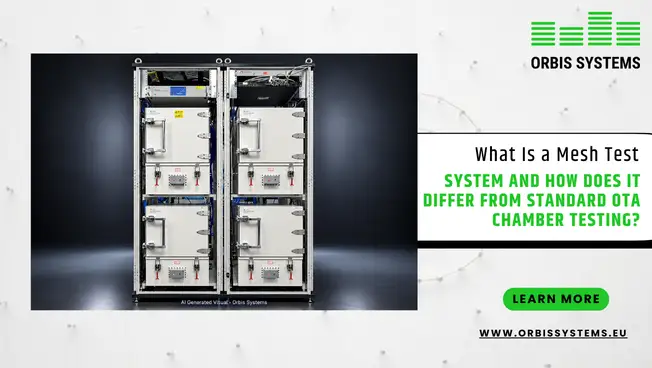
So, what is a mesh test system? In engineering terms, it is a controlled test architecture used to emulate, monitor, and measure communication between multiple wireless nodes.
A mesh network test system can combine RF switching, programmable attenuation, traffic generation, protocol control, measurement instrumentation, and automated test software. Instead of evaluating a device separately, engineers can create repeatable multi-node scenarios.
For example, a test sequence can simulate a node leaving the network, introduce controlled interference, change attenuation between links, or increase traffic across several paths. The resulting measurements can reveal packet loss, throughput degradation, latency changes, route recovery, and network convergence.
A well-designed mesh testing system therefore turns complex network behavior into measurable engineering data.
How Does a Mesh Test System Work?
So, how does a mesh test system work? A good starting point is making the environment as it should be, a fixed topology together with a controlled RF environment. Multiple nodes are configured according to the network architecture being evaluated.
The test platform then applies predefined traffic patterns and network events. RF conditions can be adjusted while software records system responses. To further analyze the effects of changing firmware, hardware or using different production samples, engineers are able to conduct similar tests.
This approach makes mesh network testing more consistent than relying only on field trials. It also enables controlled fault injection. A degraded link, unavailable node, congested channel, or changing route can be reproduced without depending on unpredictable environmental conditions.
For development teams, that repeatability is valuable because failures can be isolated, compared, and investigated using the same baseline conditions.
Where OTA Chamber Testing Fits
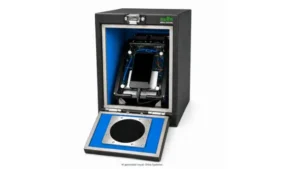
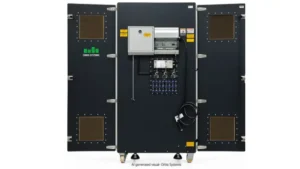
An OTA testing chamber addresses a different part of wireless validation. It creates a controlled electromagnetic environment in which engineers can measure the radiated behavior of a device.
OTA chamber testing helps evaluate different aspects of wireless performance including radiation efficiency of the antenna, power emission, sensitivity of the receiver, network speed and other wireless features. Positioning equipment and controlled RF conditions allow us to eliminate external factors which could influence the results of our measurements.
This makes over-the-air testing particularly useful during device-level RF characterization. It answers questions about how a specific product performs through its antenna and radio interface.
However, wireless device testing inside a chamber does not automatically reproduce the dynamic behavior of a complete mesh network. A device may demonstrate excellent RF characteristics while the overall network still experiences routing, congestion, or recovery issues.
Mesh Test System vs OTA Chamber Testing
The difference becomes clearer when considering mesh test system vs OTA chamber testing from a system-engineering perspective.
A mesh environment evaluates relationships between nodes. It can examine topology changes, traffic distribution, routing decisions, interference response, latency, resilience, and end-to-end connectivity.
On the contrary, an OTA chamber testing environment focuses on the controlled radiated RF behavior. Such a facility enables device wireless interface testing under repeatable physical conditions.
The two approaches should not necessarily be viewed as alternatives. A mesh network test system can validate network-level behavior after individual radios have been characterized. This creates a layered validation process in which device-level RF measurements support broader system-level analysis.
For companies building an RF testing system, that distinction is important. The architecture should reflect the measurements required at each stage rather than forcing every validation task into one environment.
Building a Future Ready Mesh Validation Architecture
Modern laboratories are moving toward modular and automated test environments. A flexible mesh testing system can integrate programmable RF paths, switching, instrumentation, traffic control, and software orchestration.
The same principle applies to an OTA testing chamber. A scalable chamber should accommodate repeatable positioning of the device, RF exposure in a controllable manner, automation of test interface systems, and a way to handle frequency changes with time.
For advanced wireless mesh testing, automation also reduces operator-dependent variation. Test cases can be executed repeatedly while collecting consistent measurements across different device configurations.
Mesh network performance testing can then become part of a broader validation pipeline instead of an isolated engineering activity.
Orbis Systems offers automated testing facilities for wireless, RF, and OTA validation, along with RF chambers, OTA systems, positioning equipment, and signal-routing solutions. Besides these, its engineering and integration capabilities are tailored for R&D and production environments that require accuracy, repeatability, and scalability.
Preparing for the Next Layer of Wireless Validation
As wireless architectures become more distributed, test strategies need to evolve alongside them. What is a mesh test system becomes a practical engineering question when device performance alone no longer explains system behavior.
A mesh network test system provides the controlled environment needed to study network interactions, while an OTA testing chamber establishes repeatable conditions for radiated RF characterization. Used together, these methods can provide a stronger foundation for product verification, troubleshooting, and production validation.
For organizations developing next-generation wireless products, the future of testing will increasingly depend on connected, automated, and scalable validation environments. Orbis Systems brings together RF, OTA, switching, positioning, and engineering capabilities to support that direction.
Frequently Asked Questions
1. What is a mesh test system used for?
It is for analyzing the behavior and capabilities of a wireless network with multiple wireless nodes. Mesh test system allows you to see how well your wireless devices communicate in various situations, like how your network will react (will it recover?) after changes in network conditions.
2. How does a mesh test system work with multiple devices?
The system creates an environment where all devices communicate on the predefined topology. Different levels of traffic are generated and RF conditions are manipulated, the system’s performance is recorded, and how each device responds in these situations is noted.
3. Can an OTA chamber replace mesh validation?
No. OTA chamber testing is done at a device level mainly to assess the device’s RF behavior when radiated, whereas mesh validation deals with the behavior of multiple network nodes when connected (interactions).
4. What does mesh network performance testing measure?
A typical performance test covers metrics like throughput, latency, packet loss, route recovery, convergence time, reliability, etc. The behavior when the network experiences disruptions or nodes fail will be also checked.
5. Why combine mesh and OTA testing?
By doing the combination, the engineers are able to not only check the RF performance of each device separately but also to understand how their combination (wireless system composed of multiple devices) works.