
Categories
Blogs

Integrating Robotic Arm Positioners for High Volume RF Test Automation

Table Of Contents

  1. What are Robotic RF Testing Solutions?
  2. Robotic-Assisted RF Test Solutions for Automating High Volumes
  3. Automated Positioners with Millimetre-Level Precision
  4. Positioner Features That Ensure Accurate RF Testing
  5. API and System Integration for Accurate RF Testing
  6. Automation of safety, tilt simulation, and RF testing
  7. Benefits at the System Level for High-Volume RF Test Lines
  8. Redefining Efficiency in RF Test Automation
  9. Frequently Asked Questions

Robotic RF test solutions accelerate high-volume testing and enhance accuracy and reliability through robotic arm positioners seamlessly integrated with modular RF test systems.

Key Points

  • Orbis Systems provides modular test platforms with robotic positioners, OTA chambers, and RF switching for automated RF testing.
  • Theta/Phi positioner is a sophisticated system that enables precise coordinate control with minimal reflections.
  • REST API integration allows seamless synchronization with RF switching units and test software.
  • Built-in safety features and tilt simulation enhance both operator safety and the realism of test scenarios.
  • Orbis solutions are applicable across a wide range of environments, from research and development to high-volume production.

What are Robotic RF Testing Solutions?

Robotic RF testing solutions represent a significant advancement in large-scale validation. Traditionally, RF testing required manual repositioning of devices and lengthy setup times. This process slowed production, introduced errors, and made repeatability challenging.

With robotic arm positioners, the operation becomes fully automated. During over-the-air (OTA) testing, devices can be rotated, pitched, and translated with high precision while measurements are captured in real time. The result is reduced cycle times and highly consistent data.

Orbis Systems offers modular test platforms that integrate robotic positioners, RF switching, and OTA chambers into a single workflow. This modularity enables seamless scalability, from early-stage R&D testing to high-volume production, without the need to redesign the test environment.

Robotic-Assisted RF Test Solutions for Automating High Volumes

Testing thousands of units under consistent conditions is essential for mass production. Variations can occur when devices are handled or measured differently. Robotic solutions eliminate these inconsistencies by executing standardized test routines with repeatable precision.

Orbis Systems provides modular platforms that can be adapted to different testing requirements.

  • RF Signal Switching Units (SSUs): Route signals across multiple testing paths.
  • OTA Chambers: Create controlled environments for accurate wireless performance testing.

Automated Positioners with Millimetre-Level Precision

These systems work together to create a fully automated workflow, minimizing the need for manual operator intervention at each step. This automation accelerates validation, reduces human errors, and improves repeatability. By automating RF component testing, companies can also reduce operational costs and increase overall throughput

Positioner Features That Ensure Accurate RF Testing

The reliability of RF testing largely depends on the consistency of device positioning during measurements. Even slight deviations in angle or orientation can lead to inaccurate results. Orbis addresses this challenge with advanced positioner designs, such as the Theta/Phi positioner.

This positioner enables continuous motion with minimal reflection, even within compact OTA chambers. It supports repeatable test geometries by simulating both horizontal and vertical sweeps, ensuring that all devices are tested under consistent conditions for predictable performance.

Low-reflection operation is a key feature, minimizing the influence of the positioner’s mechanics on measurement accuracy. Orbis positioners are designed to avoid interference with RF signals, providing trustworthy and reproducible test results.

API and System Integration for Accurate RF Testing

Automation is most effective when it integrates seamlessly with existing systems. Orbis systems positioners feature REST API interfaces, enabling full compatibility with test orchestration software.

Through the API, operators can:

  • Automatically move positioners.
  • Configure RF switch units to synchronize with positioner motion.
  • Record measurements automatically, eliminating manual data entry.
  • Adjust workflows for different device models.

This integration reduces downtime when introducing new devices and enables continuous or unattended testing, including overnight operation. Orbis ensures its systems provide scalable and flexible automation by simplifying software control.

Automation of safety, tilt simulation, and RF testing

Safety is critical in any automated system. Orbis systems Positioners include built-in safety features to protect operators. For example, multi-DUT systems automatically stop motion if someone enters the chamber, preventing accidents during automated operations.

In addition to safety, Orbis systems positioners offer advanced simulation capabilities. Features such as tilt simulation allow testing under conditions that closely mimic real-world scenarios, providing more accurate production testing and valuable data for product qualification.

These capabilities enable scalable RF test automation without compromising operator safety or test quality.

Benefits at the System Level for High-Volume RF Test Lines

Scalability: The same core system can support research and development, scale up for high-volume production, and be adapted for post-sale testing.

Flexibility: Testers can handle a wide range of devices and product families with minimal reconfiguration.

Efficiency: Automation eliminates manual setup, accelerating each test cycle and reducing operational costs.

These system-level advantages enable manufacturers to continuously capture performance data while transitioning to new technologies and product lines, reducing bottlenecks and accelerating time-to-market for high-volume production.

Redefining Efficiency in RF Test Automation

Robotic arm positioners are transforming high-volume RF test automation. They enable manufacturers to perform large-scale validation faster and more reliably through precise motion, API-enabled integration, and built-in safety features.

Orbis Systems delivers this capability with modular, extensible test platforms. Their solutions integrate positioners, OTA chambers, and RF switching systems into a streamlined workflow suitable for both R&D laboratories and manufacturing environments.

Now is the ideal time to explore Orbis systems solutions to make your RF test lines faster, more accurate, and safer. To learn more, schedule a demo or consult Orbis Systems for a custom robotic RF testing solution tailored to your needs.

Frequently Asked Questions

1. What does a positioner do in RF testing?

A positioner is a device that accurately positions DUTs (Devices Under Test) and antennas to replicate the geometries required for testing. Orbis systems positioners are designed to minimize reflections and ensure precise, reliable measurements.

2. Is it possible to include robotic positioners in software for test automation?

Yes. Orbis Systems positioners can be directly connected to orchestration software and RF switch hardware through their REST API interfaces.

3. Can robotic positioners test more than one device at a time?

Yes. Orbis Systems offers multi-DUT solutions that can test more than one device at a time, which cuts down on the time it takes to run tests.

4. How do robotic positioners make RF testing more accurate?

In OTA chambers, robotic positioners provide smooth, controlled motion, minimize reflections, and ensure repeatable test geometries, resulting in more accurate measurements.

5. How do robotic positioners and switching systems work together?

Orbis Systems integrates positioners with RF switching units and modular racks to enable fully automated test workflows.

Categories
Blogs

How Azimuth Positioner Solutions Elevate 5G and OTA Test Accuracy

Table of Contents

  1. RF positioner solutions for 5G labs
  2. High-accuracy RF positioning systems for OTA testing
  3. Azimuth-centric positioner designs for base-station verification
  4. Key Takeaways
  5. FAQs

In advanced 5G and OTA testing, device orientation is a critical factor. Even a small misalignment in rotation can cause significant variations in measured throughput, beamforming accuracy, and antenna gain. To address this challenge, Orbis Systems’ Azimuth Positioner Solutions provide precise, automated control that safeguards test integrity and ensures repeatable results.

When paired with the right OTA chamber, a high-precision azimuth positioner directly improves measurement accuracy, shortens test cycles, and delivers reliable outcomes. Orbis Systems designs turnkey OTA environments where 5G positioners integrate seamlessly with RF-shielded chambers, DUT handlers, and control software to create a fully automated and dependable testing setup.

These solutions support both Sub-6 GHz and mmWave frequencies, with absolute-sensor feedback on every axis and REST API control for efficient automation. Such capabilities are especially valuable in 5G FWA (Fixed Wireless Access) deployments, where antenna testing chambers validate performance and help ensure robust, high-quality network coverage before rollout.

Key Takeaways

  • Positioner and Chamber Integration: Orbis Systems combines RF-shielded chambers with precision azimuth and elevation positioners to deliver accurate, repeatable measurements across Sub-6 GHz and mm Wave frequencies.
  • REST-Based Automation: Absolute sensors on every axis, coupled with Ethernet/REST API control, eliminate the need for manual scales and accelerate automated testing.
  • Fast and Accurate Sweeps: Theta/Phi continuous-drive design enables synchronized antenna sampling while minimizing reflection effects for precise OTA measurements.
  • Compact Sub-6 GHz Chambers: ±90° rotation, ±30° tilt, and Y/Z positioning provide controlled, RF-safe environments for early RF and software verification.
  • FWA Testing: Our OTA chambers play a crucial role in validating 5G FWA antenna performance before field deployment, ensuring reliable network operation.

RF positioner solutions for 5G labs

At Orbis Systems, the positioner is the core of OTA measurement repeatability—not just an accessory. Our 5G OTA chamber combine precision antenna positioning, RF shielding, and customizable DUT interfaces, supporting both Sub-6 GHz (FR1) and mmWave (FR2) frequencies for accurate and controlled testing.

For Sub-6 GHz validation, Orbis offers a sea-container anechoic chamber with automated DUT rotation (±90°) and tilt (±30°). The measurement antenna moves automatically along the Y-axis and manually along the Z-axis, creating a compact free-space environment that isolates the test scene, ensures safe ventilation, and provides AC/DC/RF/data access. This makes it ideal for early RF and software verification.

Key Technical Advantages

  • High Accuracy: Rotation precision down to ±0.1° (model-dependent) for trustworthy data.
  • Smooth, Stable Motion: Engineered to avoid vibration and reduce artifacts in measurements.
  • Payload Flexibility: Scalable platforms support devices from small handsets to large automotive DUTs.
  • Long-Term Repeatability: Maintains accuracy over repeated test cycles, essential for extended campaigns.

Why azimuth accuracy in an antenna testing chamber matters

Azimuth accuracy inside an antenna testing chamber is critical because it determines how precisely engineers can measure an antenna’s radiation pattern, gain, and overall performance. Even minor deviations can lead to misleading results, which in turn affect device validation and network reliability.

To address this, Orbis Systems’ Theta/Phi positioner is built for both speed and precision. Its continuous-drive operation with position-synchronized measurement points minimizes stop-and-settle delays, delivering faster sweeps and higher-quality data.

The design also incorporates low-reflection mechanics, with metal parts placed behind the antenna to preserve the integrity of the radiation pattern. This ensures that azimuth sweeps remain accurate, while vertical cuts are handled through software-controlled interpolation, providing precise results without the need for oversized chambers.

High-accuracy RF positioning systems for OTA Testing

Accurate device positioning is one of the most important requirements in over-the-air (OTA) testing. Orbis Systems’ high-precision RF positioning systems provide programmable and repeatable control of both device and antenna orientation. This ensures that every measurement reflects the true performance of the DUT across Sub-6 GHz and mmWave frequencies.

Why High-Accuracy Positioning Matters

  • Reliable antenna characterization is achieved by precisely measuring beam patterns, gain, and MIMO behavior.
  • Consistent test data is maintained by reducing variability that arises from manual positioning errors.
  • Full angular coverage is possible by performing complete azimuth and elevation sweeps for thorough device validation.
  • Automation is simplified through seamless integration with REST API, SCPI, and LabVIEW for test sequencing.

Key Advantages of Orbis Systems’ Positioners

  • Ultra-fine resolution is delivered with sub-degree rotation for both DUT and probe antennas.
  • Multi-axis motion is supported with azimuth, elevation, and tilt adjustments for flexible testing setups.
  • Stability is maintained with vibration-free mechanics, ensuring accuracy during continuous measurements.
  • Modular and scalable designs allow support for devices ranging from smartphones to large automotive antennas.
  • Both production and R&D testing are supported, making the systems suitable for early-stage research as well as high-volume qualifications.

Azimuth-centric positioner designs for base-station verification

Accurate azimuth positioning is critical in verifying base-station performance. Orbis Systems’ azimuth-centric positioner designs provide precise, repeatable rotational control for antennas and devices under test (DUTs), ensuring reliable measurement of beam patterns, gain, and MIMO behavior across Sub-6 GHz and mm Wave frequencies.

Why Azimuth-Centric Positioning Matters

  • Beamforming Validation: Capture true directional performance of base-station antennas.
  • 360° Coverage: Full azimuth rotation for complete radiation pattern characterization.
  • Repeatable Measurements: Automated rotation minimizes human error and improves test consistency.
  • Seamless Automation: Integrates with REST API, SCPI, and LabVIEW for controlled, programmable testing.

Conclusion

Orbis systems Azimuth- positioners deliver precise, repeatable, and automated rotation, enabling engineers to obtain accurate, real-world performance data and accelerate both R&D and production verification processes.

Contact Orbis Systems to design an azimuth positioner tailored to your base-station verification needs.

FAQs

1. What is OTA testing in the context of an antenna testing chamber?

OTA (Over-the-Air) testing measures a device’s wireless performance in a controlled environment without using cables. Orbis OTA chambers use RF shielding and absorbers to block external interference, enabling repeatable, accurate measurements of radiated signals, beam patterns, and antenna performance.

2. How do Orbis positioners stay accurate during long azimuth sweeps?

Orbis positioners use absolute encoders on each axis combined with closed-loop feedback control for precise, repeatable motion. The Theta/Phi system supports continuous azimuth/elevation sweeps with synchronized measurement points, ensuring minimal error during long rotations. Positioners can be automated via a REST API, SCPI, or LabVIEW for seamless integration into test workflows.

3. Can a compact antenna testing chamber handle Sub-6 GHz base-station work?

Yes. Orbis’s Sub-6 container chamber supports automated DUT rotation (±90°) and tilt (±30°) with free-space distances that suit early RF and software verification.

4. Do these positioner systems support mmWave verification?

Yes. Orbis offers standard setups for Sub-6 GHz and mmWave OTA chambers with flexible antenna positioning and REST-based automation.

5. Why do FWA programs rely on an antenna testing chamber?

Fixed Wireless Access (FWA) programs depend on OTA chambers to validate beam quality, coverage, and link reliability before deployment. Chambers allow engineers to test 5G FWA devices in a controlled, interference-free environment, ensuring strong, stable connections and optimal real-world performance.

Categories
Blogs

The Future of Home Internet: Why 5G FWA Is Gaining Momentum

Table of Contents

  1. How to Understand Fixed Wireless Access in the 5G Era
  2. Why 5G-Based FWA Wireless Is Gaining Popularity
  3. Role of Antenna FWA 5G in Performance Delivery
  4. Importance of an Antenna Testing Chamber in Network Validation
  5. Moving Forward with 5G FWA
  6. A list of frequently asked questions (FAQs)

Key points

  • The rise of home internet through FWA solutions is a clear sign that people are moving away from traditional broadband. Here are some more in-depth points to remember:
  • 5G will change how people use the internet at home. FWA uses 5G technology to deliver high-speed internet comparable to fiber, especially in areas without cable infrastructure
  • The way the antenna is made is fundamental. How well antenna FWA 5G setups work determines how well networks can handle a lot of traffic.
  • Testing makes sure that everything is working well. An antenna testing chamber lets providers see how well an antenna works.
  • Scalability is essential. FWA is a faster, more flexible, and less expensive way to grow than wired broadband.
  • Businesses are adopting it more quickly. As operators see the benefits for the economy and performance, FWA is becoming a standard part of next-gen internet strategies.

5G Fixed Wireless Access (FWA) is transforming home and enterprise internet by delivering fiber-like speeds without the need for extensive cabling. This makes FWA a powerful alternative in areas where laying fiber is costly or time-consuming, and it’s one of the reasons why FWA is quickly gaining momentum as a future-ready connectivity solution.

Over the past few years, the global demand for high-speed internet has skyrocketed. The rapid growth of the Internet of Things (IoT), smart home devices, streaming services, and remote work has placed heavy pressure on traditional wired broadband networks.

5G-enabled Fixed Wireless Access offers a fast, reliable, and scalable way to deliver broadband services. Its performance is made possible by innovations in advanced 5G antenna technologies such as beamforming, massive MIMO, and dynamic spectrum utilization, which improve signal reach, speed, and stability.

To ensure that these systems perform consistently in real-world deployments, network equipment and customer-premises devices undergo rigorous evaluation in antenna testing environments, such as anechoic chambers. These controlled environments help validate signal strength, coverage patterns, and device interoperability ultimately ensuring a dependable user experience.

How to Understand Fixed Wireless Access in the 5G Era

Fixed Wireless Access (FWA) uses radio signals from cellular base stations to connect to customer premises equipment (CPE). Unlike fiber or DSL, it doesn’t require extensive long-distance cabling, making it a faster and more cost-effective way to deliver broadband connectivity. Inside the home or office, the CPE then distributes the connection via Wi-Fi or Ethernet to user devices.

FWA is especially valuable in areas where laying fiber is too expensive or physically impractical. With 5G radio access technologies, FWA can deliver high-speed, low-latency internet that enables smooth streaming, remote work, IoT applications, and even bandwidth-hungry services like cloud gaming and VR.

While fiber still provides the highest and most consistent performance, 5G FWA offers gigabit-class speeds under the right conditions, often making it comparable to fiber for many everyday applications.

To close the digital divide, operators worldwide are rapidly rolling out FWA as a scalable, flexible, and cost-efficient part of next-generation connectivity strategies.

Why 5G-Based FWA Wireless Is Gaining Popularity

There are both technical and economic reasons why Fixed Wireless Access (FWA) is becoming a leading connectivity choice. Unlike older 4G-based setups, 5G FWA leverages advanced technologies such as massive MIMO, beamforming, and a mix of sub-6 GHz and mmWave spectrum to deliver reliable high-speed broadband.

Key Benefits of 5G FWA

Scalability

Operators can expand coverage and capacity much faster, since they don’t need to dig trenches or lay long stretches of fiber cable.

Speed

5G FWA delivers hundreds of Mbps to gigabit-class speeds, often comparable to fiber for everyday applications like streaming, remote work, and cloud services.

Cost-Effectiveness

Lower infrastructure costs make it possible to bring high-speed internet to rural and suburban areas where fiber rollout would be too expensive.

Flexibility

FWA allows providers to adapt to changing demand, such as in business districts or tourist areas that see seasonal or peak traffic.

Together, these benefits make 5G FWA not just a short-term solution, but a strategic, long-term option for closing the digital divide and enabling next-generation connectivity worldwide.

Role of Antenna FWA 5G in Performance Delivery

The antenna is one of the most critical components of any Fixed Wireless Access (FWA) setup. In 5G FWA systems, antennas provide the wireless link between the network base station and the customer premises equipment (CPE), ensuring strong, reliable, and high-capacity connections.

Modern antenna technologies such as beam steering and phased array designs allow networks to cover larger areas, improve signal focus, and reduce interference. These innovations are key to delivering the consistent speeds and stability that users expect from 5G FWA.

The design, calibration, and testing of antennas have a direct impact on network performance. Factors such as frequency bands, polarization, and radiation patterns influence signal strength, coverage quality, and interference levels. These, in turn, affect the throughput and user-perceived latency of the connection.

By combining advanced design with rigorous testing, 5G FWA antennas play a central role in achieving dependable, high-speed wireless broadband

Importance of an Antenna Testing Chamber in Network Validation

Antenna testing chambers play a critical role in ensuring that 5G Fixed Wireless Access (FWA) networks deliver reliable and consistent performance. These specialized facilities create a controlled environment where antennas can be evaluated without interference or reflections from the outside world.

In these chambers, antennas are validated against international standards through measurements such as gain, efficiency, directivity, and radiation patterns. This testing provides valuable insight into how antennas perform in real-world conditions, helping engineers fine-tune designs for maximum coverage and stability.

Without careful testing and calibration, 5G FWA networks risk experiencing issues such as inconsistent speeds, reduced coverage, and higher interference levels. By eliminating these risks, antenna testing chambers are not only essential tools for engineers but also fundamental to ensuring dependable connectivity for end users.

Moving forward with 5G FWA

The future of connectivity is becoming increasingly wireless, and Fixed Wireless Access (FWA) powered by 5G is at the forefront of this transformation. By combining advanced antenna technologies with rigorous testing in antenna testing chambers, providers can ensure smooth, reliable, and high-performance experiences for end users.

Orbis Systems plays a vital role in this evolution by delivering state-of-the-art testing environments that help 5G innovators validate, optimize, and accelerate their solutions for real-world deployment.

As global demand for faster and more dependable internet continues to grow, 5G FWA is emerging as a cost-effective, scalable, and future-ready option for both homes and businesses. Now is the time to explore how FWA can transform connectivity and keep you ahead in the digital age.

A list of frequently asked questions (FAQs)

Q1: What is 5G Fixed Wireless Access (FWA)?

5G FWA sends high-speed internet to homes and businesses through wireless signals instead of cables.

Q2: How is FWA different from regular broadband?

FWA can deliver gigabit-class speeds comparable to fiber under the right conditions, but fiber still offers greater consistency and capacity

Q3: Why is it essential to test antennas for 5G FWA?

Testing in antenna chambers ensures antennas meet performance standards across frequency bands, supporting reliable coverage and minimizing interference.

Q4: Can FWA take the place of fiber internet completely?

FWA does not entirely replace fiber but complements it by providing connectivity in areas where fiber is too expensive or time-consuming to deploy.

Q5: What kinds of businesses benefit the most from FWA solutions?

FWA’s ability to grow and stay reliable helps more than just homes. For instance, it helps manufacturing, logistics, and smart cities.

Categories
Blogs

Inside Orbis Systems’ Sea Container Testing Chambers: Innovation on a Global Scale

Table of Contents

  1. Redefining 5G OTA Testing with Sea-Container Chambers
  2. Why Sea-Container Testing Matters in the 5G Era
  3. Inside the OTA Performance Test System
  4. Antenna Positioning System: Making Accuracy a Reality
  5. Driving the Future of Wireless Validation with Orbis Systems
  6. Frequently Asked Questions

Key Takeaways

  • Global Mobility- The chambers can be transported and deployed worldwide, allowing companies to avoid the expense of permanent labs and begin testing much sooner.
  • Integrated OTA Test Systems- Each chamber can be equipped with a fully automated OTA performance test system, ensuring consistent, reproducible, and reliable results.
  • Advanced Antenna Positioning- The integrated positioning system enables accurate testing of antenna radiation patterns, beamforming performance, and complex antenna behaviors across both Sub-6 GHz (FR1) and mmWave (FR2) frequency ranges.
  • Modular, Customizable Design- The container chambers can be tailored to specific devices, frequency bands, and testing conditions, providing maximum flexibility for evolving test requirements.
  • Accelerated Product Development- By enabling advanced testing at multiple global locations, Orbis Systems’ solution helps companies shorten development cycles and reduce delays in bringing new wireless products to market.

Orbis Systems has transformed standard shipping containers into mobile, RF-shielded 5G OTA chambers. Designed for both Sub-6 GHz and mmWave device validation, these modular chambers integrate advanced OTA performance systems with precision antenna positioning and remote automation. The result is laboratory-grade testing accuracy combined with the flexibility to deploy and operate anywhere in the world.

Redefining 5G OTA Testing with Sea-Container Chambers

With the rapid growth of the telecommunications industry, ensuring wireless devices are tested in a consistent and controlled environment has become a top priority. Orbis Systems addresses this challenge by integrating advanced 5G OTA (Over-the-Air) test chambers into standard sea containers.

These mobile chambers are fully RF-shielded, providing a controlled environment that prevents external interference and ensures reliable measurements. Designed for fast deployment in outdoor or remote locations, they enable businesses worldwide to test 5G and IoT devices with speed, accuracy, and flexibility.

Why Sea-Container Testing Matters in the 5G Era

Manufacturers, research centers, and network operators face growing pressure to deliver new devices and accelerate 5G rollouts. Traditional OTA test labs, while essential, are expensive and time-intensive to build. Orbis Systems addresses this challenge with sea-container-based testing chambers that provide a portable and rapidly deployable alternative.

Designed for fast setup, these chambers allow organizations to expand test capacity or relocate facilities without starting from scratch. This flexibility enables next-generation devices—from smartphones to automotive systems—to be tested closer to manufacturing sites or R&D hubs, reducing both cost and time to market.

Inside the OTA Performance Test System

Each chamber can be equipped with a complete OTA (Over-the-Air) performance test system. This setup includes an RF-shielded enclosure, high-precision measurement antennas, device holders with positioning capabilities, and a software control platform. By automating test procedures, the system minimizes human intervention and ensures consistent, repeatable, and reliable results.

One of the advanced features of these chambers is the use of Planar Wave Synthesis (PWS). PWS enables the system to create a controlled electromagnetic environment that simulates far-field conditions within a compact test space. This is particularly valuable for 5G, where accurate emulation of real-world signal propagation and beamforming behavior is critical.

A key advantage of the solution is the built-in REST API interface, which allows engineers to control and monitor tests remotely. Whether evaluating signal strength, throughput, or latency, the chambers, powered by automated testing and PWS, deliver precise performance insights that closely reflect real 5G network conditions.

Antenna Positioning System: Making Accuracy a Reality

A standout feature of Orbis Systems’ sea-container chambers is the advanced antenna positioning system, a true 3-axis motion controller. It precisely controls measurement antenna height, radial distance, and polarization/rotation, providing exceptional alignment for antennas and devices under test. Each axis integrates absolute position sensors, ensuring the system retains its alignment even after power interruptions. This eliminates the need for recalibration and saves valuable testing time.

The system also offers real-time position monitoring and control via Ethernet, leveraging a standard REST API interface for seamless automation and test integration. In the demanding scenarios of 5G and mmWave testing, where even minimal angular deviations can skew results, this level of precision and reliability is indispensable.

Driving the Future of Wireless Validation with Orbis Systems

Orbis Systems is redefining wireless testing by combining innovation, mobility, and precision in its sea-container-based 5G OTA chambers. Equipped with integrated OTA performance test systems and advanced antenna positioning, these chambers deliver the essential capabilities companies need to validate modern wireless devices quickly, accurately, and reliably.

Whether for 5G, IoT, or other next-generation technologies, Orbis Systems provides a faster, smarter, and more flexible approach to device testing. Partner with Orbis Systems to accelerate your product development and bring high-performance wireless solutions to market with confidence.

Frequently Asked Questions

1. What is a sea-container-based OTA chamber, and how does it differ from a traditional OTA lab?

A sea-container-based OTA chamber is a fully RF-shielded test environment engineered within a standard shipping container. Unlike fixed OTA labs, these chambers are mobile, modular, and globally deployable. They offer the same laboratory-grade testing conditions but with faster deployment, lower upfront costs, and the flexibility to scale or relocate testing capacity as needed.

2. In what ways does an OTA performance test system enhance 5G device testing?

An OTA (Over-the-Air) performance test system enables engineers to evaluate how devices behave in wireless conditions without using physical cables. For 5G, this includes assessing beamforming, signal coverage, data rates, and latency within controlled environments that replicate real-world network conditions. Integrated automation ensures reproducible, accurate, and efficient test results.

3. An antenna positioning system is crucial in OTA testing. Why?

The antenna positioning system allows the device under test to be rotated and aligned in any direction. This is critical in 5G testing—especially at mmWave frequencies—where signal performance is highly sensitive to angle and orientation. Without precise alignment, measurements can yield inaccurate results that do not represent real-world device behavior.

4. Are these rooms capable of hosting other types of testing besides 5G?

Yes. The chambers are flexible and support Sub-6 GHz and mmWave testing, automotive, and IoT use cases. This positions them as a future-proofed investment choice for businesses that play across several wireless technologies.

5. What are the strengths of sea-container chambers compared to fixed OTA labs?

Conventional OTA labs involve permanent infrastructure, high costs, and lengthy construction times. In contrast, sea-container chambers are more economical, quicker to deploy, and can be relocated as needed. For companies expanding internationally or requiring temporary or distributed test capacity, these mobile chambers provide a more versatile and scalable alternative.

Categories
Blogs

RAN: Interference analysis in the Radio Access Network

Table of Contents

  1. Understanding RAN Interference in the 5G Era
  2. A Deep Dive into Interference and RAN Analysis
  3. What Orbis Systems Offers to Ensure Accurate Control and Testing
  4. Advanced test considerations and technical terms
  5. Driving Reliable 5G Performance with RAN Interference Analysis
  6. Questions and Answers

Find out how RAN interference analysis gives you a more profound understanding of the 5G Radio Access Network performance and why this is important to advanced OTA testing and precise control.

Key Points

  • Without practical RAN interference analysis, networks face higher risks of dropped connections, reduced throughput, and unstable user experiences.
  • Orbis Systems’ antenna positioning system enables exact control of height, distance, and polarization, ensuring repeatable and precise test conditions.
  • REST API support and real-time monitoring simplify test execution, making interference detection and analysis faster and more reliable.
  • Absolute position sensors maintain alignment even after power loss, providing confidence in long test cycles and repeated measurements.
  • OTA chambers and calibration tools allow engineers to recreate interference conditions in the lab, helping identify, validate, and mitigate network issues before deployment.

Understanding RAN Interference in the 5G Era

Advanced RAN interference analysis is a critical component of Radio Access Network optimization, helping engineers understand how signals interact and affect performance in 5G deployments. You will learn how interference degrades performance and how controlled testing environments can help identify and mitigate these issues before live deployment

A Deep Dive into Interference and RAN Analysis

In contemporary cellular networks, interference between adjacent cells, out-of-sync timing, or improperly configured neighbor relationships can all significantly degrade throughput, reliability, and user experience. The 5G RAN environment is especially complex in Time Division Duplex (TDD) systems, where uplink and downlink share the same frequency band and depend on precise time-slot separation.

This makes proper synchronization and interference reduction techniques essential. Interference analysis is critical for detecting uplink timeslot issues and maintaining frame alignment, particularly in dense network deployments

What Orbis Systems Offers to Ensure Accurate Control and Testing

Orbis Systems leads the way in providing 5G OTA testing solutions that allow interference to be tested accurately in controlled environments. Their 5G antenna positioning solution uses absolute position sensors to keep antennas precisely aligned even after a power loss. Engineers can adjust height, distance, and polarisation in real time, enabling repeatable interference scenarios across multiple test conditions.

This level of precision is critical not only for standard testing but also for automated testing in modern telecom networks, enabling teams to systematically identify, validate, and mitigate interference before deployment

Advanced test considerations and technical terms

In radio testing, terms such as OTA (Over-The-Air), DUT (Device Under Test), and REST API integration are essential for enabling automated and repeatable test processes. Orbis Systems provides a complete solution that encompasses OTA chambers, DUT and antenna positioning, and calibration for accurate signal analysis.

The system’s ability to maintain antenna positions even after a power loss demonstrates its reliability during extended interference testing and analysis.

Driving Reliable 5G Performance with RAN Interference Analysis

Suffice it to say that knowing RAN interference analysis in the case of a 5G Radio Access Network is essential to making sure the network operates at its best and users are satisfied. Interference issues can be identified and resolved beforehand by engineers with the assistance of sophisticated OTA testing tools such as those offered by Orbis Systems.

These tools provide engineers with the precision and reproducibility they require. Get in touch with Orbis Systems to learn more about their OTA chambers and antenna positioners solutions. These will make your network more reliable today. Improve your RAN performance with precision, automated testing, and robust interference analysis

Questions and Answers

Q1: What is RAN interference analysis?

RAN interference analysis is the process of detecting, measuring, and evaluating unwanted radio signals that overlap or disrupt communication within a Radio Access Network (RAN). In 4G and 5G systems, interference can come from sources such as co-channel interference, adjacent channel leakage, timing misalignment (especially in TDD networks), or external signals.

By analyzing these interference patterns, engineers can identify performance issues like low SINR, reduced throughput, dropped calls, and poor coverage, and then apply mitigation techniques such as power control, beamforming, interference coordination, or advanced scheduling.

Q2: Why is frame synchronisation critical in 5G RAN testing?

Frame synchronization in 5G RAN testing is critical to avoid uplink/downlink conflicts, reduce interference, and ensure accurate performance measurements. Without it, both real-world networks and lab test environments would suffer from unstable and misleading results.

Q3: What are the building blocks needed for an OTA testing solution?

An OTA setup usually includes a chamber that protects RF signals, an antenna and DUT positioners, calibration equipment, and control interfaces like REST APIs through which you can make test scripts automated.

Q4: How does the antenna positioning system of Orbis Systems assist in interference testing?

The system provides precise control over three parameters, such as height, distance, and polarization and uses absolute position sensors to maintain alignment even after a power loss. This ensures repeatable and consistent measurements, which are essential for reliable interference analysis.

Categories
Blogs

Complete Guide to Mobile Network Testing: From Design to Deployment

Table of Contents

  1. Why Mobile Network Testing Is Important
  2. Design and Planning for Mobile Network Testing
  3. Lab & Bench Testing:
  4. Field Testing
  5. Network Optimization
  6. Pre-deployment Validation
  7. Post-deployment Validation
  8. Advanced Testing for 5G Networks
  9. Regulatory & Compliance Matters
  10. Take the Next Step in Mobile Network Excellence
  11. Frequently Asked Questions

Key Takeaways

• Early planning, with clearly established KPIs and the appropriate measuring tools, is the foundation for success.

• Laboratory testing confirms fundamental operations under controlled conditions—detection of defects before occurrence.

• Field testing reveals actual-world conditions such as interference and coverage variations.

• Optimization maximizes antenna configurations and spectrum use for enhanced coverage and capacity.

• Stress testing before deployment guarantees the network will support peak loads.

• Monitoring after deployment ensures quality assurance because usage and environment are changing.

• 5G requires special testing: beamforming, mmWave characteristics, and IoT density.

• Regulations demand compliance with RF safety, protocol requirements, emissions regulations, and security.

• Equipment varies from app-based capture of KPIs to commercial scanners and modular test platforms.

• Orbis Systems, as a strategic partner, provides adaptive, scalable test systems and engineering services expressly designed for every stage of testing—ensuring high-performance throughput from R&D to production

Learn how 5G test gear and 5G measuring equipment power trustworthy mobile network testing: from development through deployment and beyond.

Why Mobile Network Testing Is Important

Mobile network testing ensures that 2G, 3G, 4G LTE, and the latest 5G networks deliver high performance, broad coverage, reliable connectivity, and consistent quality. By adopting 5G testing tools early in the process, you create a strong foundation of trust that supports every stage of network deployment and operation.

Design and Planning for Mobile Network Testing

Begin with network key performance indicators (KPIs): throughput, latency, coverage, and call setup time are essentials. Layer on functional requirements such as connectivity, handover reliability, and call quality. Performance objectives such as peak data rate, mobility support, and practical spectrum usage complete the planning loop.

Lab & Bench Testing

Protocol testing in the lab verifies compliance with standards and essential functionality. RF performance testing measures signal strength, sensitivity, and emissions, while throughput testing ensures data transfer meets specifications. Interoperability testing confirms that devices from different vendors work seamlessly together. The controlled lab environment identifies issues before field deployment, keeping costs low and reliability high.

Field Testing: Real-World Validation

In the field, metrics such as throughput, call setup rate, and handover success directly reflect the user experience. LTE spectrum analyzers identify interference, channel loading, and coverage gaps that affect performance, particularly in challenging urban or rural environments. Drive and walk testing over a variety of locations captures real-world data that improves planning models and uncovers edge-case conditions that need to be addressed.

Network Optimization

Network optimization balances spectrum usage across bands, combining sub-6 GHz and mmWave channels for maximum efficiency. Antenna parameters—tilt, azimuth, and height—are adjusted based on measurement data to eliminate dead zones and expand overall coverage. These improvements depend on accurate, repeatable measurements enabled by calibrated equipment and high-quality field data.

Pre-deployment Validation

Before deployment, networks must undergo stress testing to simulate peak traffic, high mobility, and mixed traffic patterns that can expose weak points. End-to-end validation confirms that performance remains robust under heavy loads or unexpected conditions while maintaining quality of service. Catching issues early helps prevent costly outages and dissatisfied subscribers.

Post-deployment Validation

Even when networks are online, they must be constantly monitored for quality. Continuous tracking of KPIs, errors, coverage issues, and performance metrics enables quick detection and resolution of degradations. Networks change with new devices, new software releases, and shifting traffic profiles, so validation is never complete.

Advanced Testing of 5G Networks

5G testing introduces complex scenarios not seen in earlier network generations. Massive MIMO and beamforming require validation to ensure directional beams can adjust dynamically and manage multiple simultaneous signals. mmWave frequencies add challenges related to propagation, including line-of-sight limitations, reflection, and scattering.

Testing must assess network performance under real-world conditions. Massive IoT validation ensures that thousands of devices can connect simultaneously while keeping the network scalable and reliable.

Regulatory & Compliance Matters

Compliance with regulations affects multiple aspects of network operations. Networks must comply with 3GPP standards to remain protocol correct. SAR testing of devices and networks safeguards users by ensuring RF safety. Spectrum emissions must also meet FCC or ETSI regulations.

Finally, security testing, which covers encryption, data integrity, and vulnerability scanning, ensures that both networks and users remain protected.

Orbis Systems provides flexible test setups that can be scaled and adapted to diverse requirements. Their solutions include RF signal switch units, OTA chambers, test fixtures, and automated platforms for both production and R&D. They support testing from sub-6 GHz to mmWave and are already preparing for early 6G technologies.

Take the Next Step in Mobile Network Excellence

Thorough testing from design to deployment is essential for ensuring quality, compliance, and customer satisfaction. Orbis Systems can be your trusted partner, delivering modular, scalable solutions for every stage of the process.

Ready to elevate your network’s performance? Contact Orbis Systems today to arrange a customized testing plan. Accelerate deployment, reduce costs, and ensure your mobile network performs at its best, now and in the future.

Frequently Asked Questions

Which KPIs are most important in mobile network testing?

Throughput, latency, coverage, call setup, handover success rate, and spectrum efficiency are essential in network performance measurement.

In what way do LTE spectrum analyzers optimize?

They sense interference, detect over-subscribed channels, and discover coverage holes, information that helps improve spectrum usage and antenna tuning.

What are the unique tests required for 5G networks?

Beamforming testing, mmWave propagation research, and massive IoT scenario testing are needed for 5G to provide network resilience against sophisticated use cases.

Why is Orbis Systems a reliable test partner?

With global, flexible test infrastructure such as RF switching systems, OTA chambers, automated fixtures, and engineering services, Orbis Systems empowers testing requirements from R&D to production with local support globally.

Categories
Blogs

What Makes 5G FWA Ideal for Enterprise Connectivity

Table of Contents

  1. Introduction to FWA Fixed Wireless Access for Enterprises
  2. Why 5G-Powered Fixed Wireless Boosts Enterprise Connectivity
  3. Technical Benefits of Broadband Fixed Wireless Access
      3.1 High Spectrum Efficiency
      3.2 Improved Throughput and Low Latency
      3.3 Efficient Deployment and Scalable Design
      3.4 Robust Resilience and Business Continuity
  4. Enabling Businesses Through Fixed Wireless 5G
  5. Frequently Asked Questions

Key Takeaways

  • 5G Fixed Wireless Access delivers fast broadband without the need for physical cabling.
  • It enables quick deployment for remote, temporary, or hard-to-reach locations.
  • Supports enterprise-grade applications like cloud computing and IoT with low latency.
  • Provides reliable backup connectivity to keep operations running during outages.
  • Testing with Orbis Systems solutions ensures greater network performance assurance.

5G Fixed Wireless Access (FWA) delivers high-speed internet using 5G wireless signals from a cell tower directly to your business location. This is different from fiber internet, which requires physical optical fiber cables to be installed underground or along poles. With FWA, there are no cables to lay, no trenching, and no lengthy installation times. You simply connect through a receiver that communicates wirelessly with the nearest 5G tower.

Introduction to FWA Fixed Wireless Access for Enterprises

In today’s connected business world, speed is essential, but so is flexibility and reliability. 5G FWA offers a powerful way for enterprises to get broadband service without waiting for fiber construction. Since it uses wireless signals, it can be deployed quickly, even in places where digging or laying cables is not practical.

At Orbis Systems, we understand the need for dependable wireless performance. Our RF and over-the-air (OTA) testing solutions help ensure that 5G FWA networks deliver consistent quality, low latency, and strong coverage for enterprise needs.

Why 5G-Powered Fixed Wireless Boosts Enterprise Connectivity

5G FWA gives organizations the ability to set up connectivity wherever there is network coverage. It is beneficial for:

  • Remote offices and rural locations
  • Temporary setups like construction sites and events
  • Businesses needing fast connectivity without waiting for fiber installation

Because it operates on next-generation mobile infrastructure, FWA supports fast data transfer, improved signal quality, and broad coverage. These benefits are critical for industries where uptime is essential.

Technical Benefits of Broadband Fixed Wireless Access

High Spectrum Efficiency

5G FWA uses advanced technologies like Massive MIMO (Multiple Input Multiple Output) and beamforming. These allow signals to be targeted more accurately, which improves coverage and reduces interference. FWA can also operate across multiple frequency bands, balancing both capacity and reach.

Improved Throughput and Low Latency

With 5G FWA, businesses can experience multi-gigabit speeds and very low latency. This makes it possible to run demanding applications such as remote desktop access, real-time analytics, high-definition video conferencing, and automated industrial systems. As more workloads move to the cloud, this type of high-performance wireless connection is becoming essential.

Efficient Deployment and Scalable Design

Unlike wired broadband, which involves digging trenches and pulling cables, fixed wireless broadband can be installed by setting up a receiver and aligning it to the nearest cell tower. This cuts installation time from months to days. FWA is also easy to scale, making it ideal for seasonal operations or expanding businesses.

Robust Resilience and Business Continuity

Enterprises often use FWA as a backup to their main connection. If the primary network goes down, the FWA link can keep essential systems online. This is important for industries like healthcare, finance, and logistics, where downtime is not an option.

Enabling Businesses Through Fixed Wireless 5G

5G Fixed Wireless Access offers the flexibility and performance that modern enterprises need. It supports fast growth, easy integration with cloud services, and reliable service continuity. When combined with Orbis Systems’ advanced testing platforms, such as RF switching and OTA solutions, businesses can be confident in the quality and performance of their wireless networks.

Orbis Systems plays a key role in testing and validating these high-speed wireless systems under real-world conditions. This ensures that enterprises get not only speed but also the assurance of stable and dependable connectivity.

If you are ready to upgrade your enterprise connectivity with proven, high-performance wireless technology, contact Orbis Systems today.

Frequently Asked Questions

What is 5G Fixed Wireless Access?

5G Fixed Wireless Access (FWA) is a way to get high-speed internet using 5G signals instead of cables. It needs a fixed receiver or antenna at your location, usually placed outdoors, to connect wirelessly to the nearest 5G tower for the best performance.

Is FWA suitable for enterprise deployment?

Yes. It supports demanding applications like cloud access, IoT communication, video conferencing, and secure VPN connections.

Does fixed wireless broadband access need line-of-sight?

Not always. 5G FWA can work in non-line-of-sight conditions using beamforming and signal reflection.

Can fixed wireless access be deployed quickly?

Yes. Installation can often be completed in just a few days because there is no need for trenching or pulling fiber cables. It usually involves aligning the receiver to the serving 5G tower, which is much simpler than laying fiber.

Categories
Blogs

From Concept to Reality: The Journey of Developing Cutting-Edge Test Equipment at Orbis Systems

Table of Contents

  1. Transforming Concepts into Equipment
  2. Merging Test Architecture with Automated Design
  3. Tailored Design of Test Equipment in Conceptualization
  4. Electronic Test Equipment: Creating Solid Infrastructure
  5. Test Equipment Design Implementation and Deployment
  6. Begin Your Test Design Process
  7. Frequently Asked Questions

Key Takeaways

  • Orbis Systems incorporates automated test equipment design as part of the entire product validation process, from DUT analysis to production deployment.
  • In-house design of test equipment is viewed as a team engineering challenge, one that addresses customer-specified requirements in mechanics, electronics, and control logic.
  • Their electronic test equipment comprises advanced signal switching, modular racks, and high-isolation RF systems augmented with innovative software.
  • Orbis ensures reliable deployment and operation through FAT/SAT, comprehensive documentation, and global support across the US, EU, China, and India.
  • Test systems mature with your products, conserving time and money while maintaining quality and compliance.

Transforming Concepts into Equipment

At Orbis Systems, the automated test equipment design process is anything but linear it’s a technically choreographed approach driven by deep engineering collaboration. Orbis delivers scalable and customized test solutions across diverse industries, including telecom, automotive electronics, and power systems.

The development process integrates mechanical, electronic, and software engineering disciplines to create test systems that are efficient, scalable, and precisely tailored to each customer’s Device Under Test (DUT).

Whether it’s testing 5G antenna modules or power electronics, Orbis ensures that test equipment remains aligned with the product life cycle. Every automated system is engineered to perform reliably under real-world operating conditions.

Merging Test Architecture with Automated Design

While most vendors provide off-the-shelf tools, Orbis integrates automated test engineering into each phase of the design flow. It starts with requirements engineering, learning what’s distinctive about your DUT, what needs to be measured, switched, or verified, and what standards need to be complied with. Then, engineers design full test architectures:

  • Mechanical parts such as fixtures and enclosures
  • Electrical devices such as signal switching modules
  • RF components for low-loss routing
  • Control software that manages automated tests and operational flows

These are not block-level designs either. Orbis provides fully documented, tested systems with Factory Acceptance Testing (FAT), Site Acceptance Testing (SAT), and complete production line integration. Their services page explains how they do it all, from layout drawings and simulation to BOM management and procurement of parts.

This engineering-first mindset sets Orbis apart. It’s not automation itself; it’s precision-engineered automation.

Tailored Design of Test Equipment in Conceptualization

Each test setup is unique, and in-house test equipment design is critical at Orbis Systems. Orbis Systems collaborates closely with customers to convert test concepts into practical solutions via an iterative design process:

Concept Design: Design teams investigate mechanical design concepts, control layouts, and data acquisition requirements.

Prototyping: Orbis creates test fixture prototypes for testing and feedback prior to scaling.

Fixture Design: The test adapter and mechanical fixtures are designed to be identical to every DUT.

These factors are essential in high-mix or dynamically changing manufacturing, such as automotive electronics or network modules, where minor modifications in DUT structure require quick fixture redesign. Orbis is most appropriate for this type of responsive test design.

Electronic Test Equipment: Creating Solid Infrastructure

Technical integration is underscored in creating electronic design test equipment. Orbis uses in-house electronic designers skilled in RF routing, PCB layout, low-loss signal distribution, and isolation control. For RF, baseband, or power electronics applications, the test infrastructure includes:

  • RF Signal Switching Units
  • Modular Rack Systems
  • Power Distribution Layers and Safety Layers
  • API-Based Software Control

Orbis uses modular system design, and users are able to re-use, reconfigure, or upgrade test environments as the product changes. An RF test rack, for instance, intended for LTE can be reused for 5G bands or IoT protocols with minimal interruption.

The systems also ensure traceability, data logging, and complete automation, which are becoming indispensable in mass production environments where testing is as crucial as assembly itself.

Test Equipment Design Implementation and Deployment

The last piece of the puzzle in any test equipment development is implementation, where ideas, simulations, and prototypes are turned into fully functioning systems. Orbis delivers manufacturing, integration, and on-site deployment from its factories in Finland, the USA, China, and India.

Deployment includes:

  • Local production of test components and systems
  • FAT verification to confirm functional and performance compliance
  • SAT on customer premises using live DUTs
  • Operator training and user documentation
  • Maintenance, upgrades, and support

These services provide consistency worldwide. For clients operating across multiple regions, Orbis ensures consistent, traceable, and validated test procedures, thanks to its global presence and local support capabilities.

Even after deployment, they don’t sit back. Orbis’ support team handles upgrades, recalibration, and redesign reworks as required. This long-term association enables companies to remain compliant and running without successive in-house redesign investments.

Begin Your Test Design Process

Taking a test system from concept to reality takes more than off-the-shelf capabilities; it takes a master partner who knows the engineering, the market, and the product life cycle. For Orbis Systems, the combination of automated test equipment design, custom test equipment design, and electronic design test equipment leads to ATE systems that are customized to flex, grow, and deliver.

If your following product requires speed, reliability, and precision in testing, now is the time. Join forces with Orbis Systems and turn your test design ideas into production-ready solutions with unparalleled accuracy and efficiency.

Frequently Asked Questions

1. What are the steps that Orbis Systems takes to make automated test equipment?

Orbis Systems follows a structured and iterative process to develop Automated Test Equipment (ATE) tailored to customer-specific needs. The process typically includes:

  • Requirement gathering to understand the DUT and testing environment
  • Concept design to define the solution framework
  • Prototyping for early validation
  • Fixture and adapter design/manufacturing for reliable connections
  • Custom test software development
  • System integration and assembly
  • Factory Acceptance Testing (FAT) to ensure performance
  • Ongoing support and upgrades for long-term value

This comprehensive approach ensures each test system is fully aligned with the client’s product and production requirements.

2. How does Orbis design custom test equipment to meet the specific needs of each DUT?

At Orbis, custom test equipment is developed through a collaborative engineering process that involves designing precision fixtures, optimizing signal routing, integrating mechanical components, and implementing test automation, each tailored to the specific requirements of the Device Under Test (DUT).

3. What are the main parts of Orbis Systems’ electronic test equipment infrastructure?

Their test systems usually have RF signal switching, Measurement Instruments, and software-driven control systems. All of these things are meant to work together in a fully integrated test environment.

4. Does Orbis help with FAT and SAT when setting up a test system?

Yes. As part of the whole test equipment lifecycle, Orbis Systems does Factory Acceptance Testing (FAT) and Site Acceptance Testing (SAT) to make sure that systems meet all operational and functional requirements before they are used in production.

5. Can Orbis Systems make test equipment that can be used at more than one production site around the world?

Yes. Orbis Systems specializes in designing standardized, scalable test equipment that can be deployed consistently across multiple global production sites. With offices and operations in Finland, the USA, China, and India, Orbis provides localized support, rapid deployment, and seamless coordination. This global presence enables customers to implement uniform test strategies, maintain consistent quality standards, and optimize production efficiency across their multinational manufacturing facilities

Categories
Blogs

Enhancing Test Efficiency with Orbis Systems’ Signal Switching Unit

Table of Contents

  1. Signal Routing Solutions Using High-Power RF Switch Systems
  2. Advanced RF Switch Box Technology for Smarter Testing
  3. Integration of RF Switch Modules in Complex Test Systems
  4. High-Performance Signal Routing in High-Power RF Environments
  5. Why Orbis Systems?
  6. Enhance Your RF Testing Efficiency with Orbis Systems
  7. Frequently Asked Questions

Key Takeaways

  • Orbis Systems’ RF switch solutions are designed for high-frequency, high-volume RF testing applications.
  • The RF switch box streamlines signal paths and improves automation, making it more efficient and reliable for sophisticated test environments.
  • Every RF switch module is constructed for modular integration, designed for your test system architecture with complete support for automation and signal integrity.
  • With outstanding power handling, high isolation, and extended lifecycle performance, the SSU increases throughput in operation and decreases manual errors.
  • Orbis Systems provides unparalleled expertise in tailoring RF switch solutions for the telecommunication, aerospace, and defense industries.

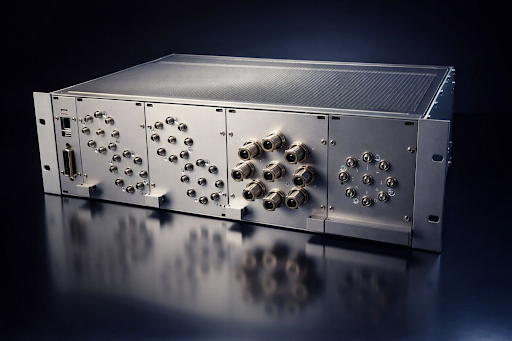
High power RF switch options such as Orbis Systems’ Signal Switching Unit (SSU) are transforming modern test environments by enabling automated, seamless routing of even the most complex RF configurations.

Engineered for precision and performance, the SSU enhances your test setup by improving:

Speed Drastically reduce test cycle times with fast and automated signal path switching.

Reliability – Minimize manual intervention and human error for more consistent test outcomes.

Accuracy – Preserve signal integrity with low insertion loss and optimized RF path design.

Signal Routing Solutions Using High-Power RF Switch Systems

In RF testing environments where precision, reliability, and speed are crucial, Orbis Systems’ high-power RF switch technology provides the necessary setup for flexible and effective signal routing. Whether you’re dealing with telecom infrastructure, aerospace systems, or RF validation labs, the high-power RF switch unit delivers optimal signal integrity under rigorous test conditions.

Orbis Systems’ Signal Switching Unit (SSU) is built as a module, allowing for easy expansion, automation, and consistent testing results, which are crucial for any advanced RF test system.

Advanced RF Switch Box Technology for Smarter Testing

Orbis Systems’ RF switch box is not merely a set of switches; it’s a complete solution designed to manage high-frequency signal distribution on complex networks. This system integrates signal paths into a single controllable platform, minimizing manual intervention and maximizing test automation.

This frequency range is supported in this test, switching hardware from DC through to 67 GHz, depending on the configuration. With high-isolation, low-insertion-loss components in place, the RF switch box minimizes signal degradation, even under high-power loads. The result is consistent with Orbis Systems’ emphasis on quality-inspired design and performance optimization specifically to meet customers’ requirements.

Integration of RF Switch Modules in Complex Test Systems

The RF switch module is an essential part of modular automated test environments. Orbis Systems provides adaptable modules for multiple-channel and switch-type configurations, whether you are using SPDT, SPnT, or transfer switches.

The SSU accommodates coaxial and waveguide signal paths and can be implemented as part of bigger switching matrices or automatic test systems. Every RF switch module is individually chosen and installed for thermal stability, power capability, and mechanical robustness.

In telecommunication and satellite component testing, smooth switching among test equipment and DUTs (Devices Under Test) is essential. Orbis Systems provides accurate timing control and rapid switching times, minimizing overall test cycle time considerably.

High-Performance Signal Routing in High-Power RF Environments

High-power conditions require more than ordinary switching. The RF switch architecture in Orbis Systems’ SSU is built to withstand high levels of RF power and remain signal linear and stable.

Some of the most significant design features are

  • Electromechanical switching with lifecycle ratings to 10 million cycles
  • Low VSWR and low signal reflection for broadband use
  • Self-monitoring provisions are built into the switch to check the switch status and control signal paths remotely.

These features enable RF switch boxes to control multi-channel test benches on a large scale without affecting the signal quality or test integrity.

Why Orbis Systems?

With more than two decades of domain experience in providing innovative RF test environments and merging hardware design and test automation software, Orbis Systems stands apart.

Here’s why the company is unique:

Architecture of your choice: From rack-mounted to benchtop to mobile test units, Orbis Systems customizes its Signal Switching Unit (SSU) to match your exact system architecture and workflow.

Global Engineering Presence- With development teams in Finland, the United States, and China, Orbis offers localized expertise, faster response times, and shorter deployment cycles across key markets.

End-to-End Solution Delivery- From initial system design and configuration to ongoing lifecycle management, Orbis Systems offers turnkey support—reducing your time-to-test and simplifying integration into your production or R&D environment.

Tailored for Modern RF Demands- The SSU is part of Orbis Systems’ broader commitment to excellence in 5G, satellite, and automotive RF validation, ensuring seamless signal routing and robust test automation in high-frequency applications.

Enhance Your RF Testing Efficiency with Orbis Systems

If you need a high-performance, scalable, and rugged RF switching infrastructure, Orbis Systems’ high-power RF switch solutions provide precisely that. With over a decade of experience in telecom and aerospace testing and a broad portfolio of flexible RF switch modules and boxes, Orbis Systems is your trusted partner in building a test environment that’s ready for tomorrow’s challenges.

Are you prepared to optimize your testing process? Call Orbis Systems today to find out how their Signal Switching Unit can revolutionize your RF validation setup.

Frequently Asked Questions

1. What is the application of a high-power RF switch?

A high-power RF switch is used to route radio frequency signals between multiple signal paths in environments where higher RF power levels are present than in standard test systems. These switches are essential in both testing and live communication systems, where durability, signal integrity, and power handling are critical.

2. What is the difference between an RF switch module and a typical switch?

RF switch Module: It routes high-frequency RF signals in test or communication systems. It is used in RF testing, telecom, satellite, defense, etc.

Typical switch: It routes low-frequency electrical or digital signals. It is used in basic electrical control or digital circuits

3. What is the advantage of employing an RF switch box in telecom testing?

An RF switch box plays a crucial role in modern telecom testing environments, especially with the increasing complexity of 5G, mmWave, and high-frequency systems. Here are the key advantages:

• Faster Test Cycles

• Improved Signal Integrity

• Test Automation & Remote Control

• Increased Throughput

• Consistency & Repeatability, etc

4. What factors affect the performance of a high-power RF switch?

The performance of a high-power RF switch depends on several factors, including frequency range, power handling capacity, insertion loss, isolation, and switching speed. High-quality switches, like those from Orbis Systems, are engineered to maintain signal integrity and durability even under demanding test conditions.

5. Why is modularity necessary in RF switch system design?

Modularity enables flexible configuration, easier upgrades, and streamlined integration into different test environments. It allows engineers to adapt quickly to new testing demands, reduce downtime, and maintain cost-efficiency, making it a critical feature for industries with evolving RF validation needs.

Categories
Blogs

Orbis Systems Opens New Facility in China to Power Next-Gen Telecom Testing

Table of Contents

  1. A Strategic Leap: Why Shenzhen Matters
  2. Infrastructure Designed for Agility
  3. A Facility That Builds the Future
  4. People at the Forefront of Precision
  5. Elevating Global Reach
  6. Conclusion: Expanding Horizons with Smarter Telecom Testing

Key Takeaways

  • Strategic Location: Shenzhen facility puts Orbis Systems in direct contact with one of the world’s most critical telecom markets.
  • Purpose-Built Facility: With scalable infrastructure and 760 square meters of highly optimized production space, the facility is designed for efficiency and innovation.
  • End-to-End Capabilities: From prototyping to delivery, it provides the full lifecycle of advanced telecom test tools.
  • Expert Team: A trained team of 30 professionals provides agile operations and precision engineering.
  • Global Reach: This expansion strengthens Orbis Systems’ global presence and its leadership position in telecom automation test solutions.

A Strategic Step: Why Shenzhen Matters

Shenzhen is not merely a manufacturing center. It is one of the world’s most rapidly expanding technology corridors. With an innovation-driven ecosystem and access to key telecom OEMs, having operations here enables Orbis Systems to move faster and with more intention.

Selecting Shenzhen’s Bao’an District was a strategic decision. It puts Orbis Systems in the vicinity of some of the most vibrant telecom firms in the area. This location enhances the company’s capability to listen, bend, and work closely with customers. It also drives development cycles for test automation, line verification, and prototyping.

In an industry where timelines condense and complexity increases, being on the ground allows Orbis Systems to assist clients not only better, but also smarter.

Infrastructure Designed for Agility

The new Shenzhen plant measures 1,085 square meters, of which 760 is designed for high-efficiency production, testing, and collaboration. Each facility was built for scalability and speed.

This is not a cookie-cutter arrangement. It is a modular, flexible environment that accommodates changing project demands in real time. Whether a generic RF test solution or a completely bespoke telecom automation testing platform, the facility is designed to perform with precision and speed.

Telecom test tools and systems have to accommodate higher data rates, broader frequency ranges, and more intelligent layers of automation. Orbis Systems has met the challenge with a facility capable of doing it all, high-frequency RF chambers, through fully integrated test lines for 5G components and network modules.

A Facility That Builds the Future

What sets this facility apart from being merely a location is that it functions as an entire launchpad for innovation. With its capabilities in concept design and simulation to the delivery of full-scale systems, the Shenzhen team can manage the entire telecom testing solutions lifecycle.

Customers need better than off-the-shelf solutions. They need end-to-end solutions that can match ongoing developments in wireless, data, and telecom infrastructure. This facility helps make that possible by allowing fast prototyping and tailored engineering, without compromise or delays.

For R&D centers looking for early-stage test environments or telecom majors searching for mass production verification, the Shenzhen facility provides flexibility and speed. It offers effortless implementation of telecom automation testing tools that are designed to replicate real-world network performance, reliability, and scalability.

People at the Forefront of Precision

Behind the cutting-edge infrastructure lies an equally impressive staff. The plant runs on 30 seasoned experts, each trained to handle intricate systems and high-speed project demands.

It is the individuals who turn vision into reality. With a resolute customer-first philosophy, the Shenzhen team is adept at adapting fast to customer requirements and delivering each solution with precision.

Their experience ranges across RF integration, automation, test fixture design, and system-level testing. They collaborate with Orbis Systems’ worldwide engineering groups to provide global thinking with local execution and ensure technical consistency while providing locally optimized performance. This combination of local execution and global thinking is what makes the operation agile and reliable.

Elevating Global Reach

Orbis Systems has established a reputation for technical depth and reliability in Europe and North America. With this new facility, the company makes an assured move to extend its influence deep in the Asia-Pacific region.

The vision of the company is to deliver unparalleled telecom test tools, not only cutting-edge but also tailored to meet local markets’ demands. Through the opening of a China production and innovation center, Orbis Systems is more apt to cater to local telecom operators, industrial integrators, and multinational OEMs.

This expansion also provides quicker turnaround times, more customization possibilities, and direct customer interaction. It is a natural next step for a company that continues to break new ground in 5G, RF, and telecom test system design.

Conclusion: Expanding Horizons with Smarter Telecom Testing

The Shenzhen plant marks a new, bold chapter for Orbis Systems. It’s not merely expanding geographically. It’s about keeping up with the evolving telecom industry and being ahead of what comes next.

From RF test tools to end-to-end telecom test automation systems, Orbis Systems now offers quicker, smarter, and closer to the customer than ever. This is not growth. It’s a transformation, engineered to fuel the telecom testing future.

Want to innovate with precise testing solutions? Connect with Orbis Systems and see how we can co-create the future.