Table of Contents
- Why Massive MIMO Creates a Signal-Routing Challenge
- How Signal Switching Units Manage Multiple RF Paths
- Maintaining Accuracy Across Multiple Signal Paths
- Combining Switching With Attenuation and Phase Control
- Scaling RF Routing for Automated Test Systems
- Building an Integrated RF Test Environment
- Keeping Multi-Channel RF Testing Under Control
- Frequently Asked Questions

Massive MIMO and beamforming test systems can involve dozens of RF signal paths between test instruments and Devices Under Test (DUTs). As the number of channels increases, manually connecting and disconnecting RF cables becomes difficult to manage and repeat consistently.
A programmable SSU provides a controlled way to route signals between multiple instruments and DUTs, making complex test sequences easier to automate. However, switching more paths is only useful when the system also maintains low insertion loss, high isolation, repeatability, and reliable signal integrity. These factors make RF switching architecture an important part of multi-channel wireless testing.
Key Takeaways
- More RF channels create greater routing and test-configuration complexity.
- A programmable SSU can automate signal routing between instruments and DUTs.
- Low insertion loss, high isolation, and repeatability are important for maintaining measurement consistency.
- Programmable attenuation and phase control can complement RF signal routing in beamforming and MIMO testing.
- Modular switching architectures can support changing test requirements without requiring a complete redesign.
Why Massive MIMO Creates a Signal-Routing Challenge
Massive MIMO testing requires control of multiple RF channels rather than a single signal path. Beamforming validation can add further requirements because individual channels may need controlled amplitude and phase conditions during a test sequence.
The resulting challenge is not simply the number of cables. Every connection becomes part of the RF measurement path. Repeated manual changes can increase setup time and introduce differences between test configurations.
A programmable SSU addresses this by allowing predefined routing configurations to be selected without physically changing the RF connections. The same test setup can therefore support different combinations of instruments and DUTs while keeping the physical configuration intact.
This approach becomes increasingly valuable as test systems move from a few RF paths to larger multi-channel architectures.
How Signal Switching Units Manage Multiple RF Paths
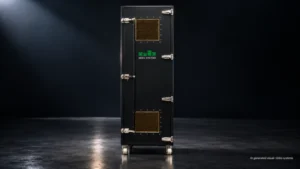
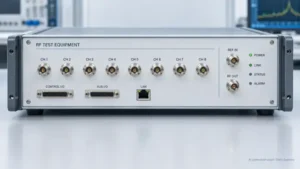
Signal switching units provide the routing layer between RF test instruments and DUTs. Programmable SSUs typically automate RF signal routing and support different matrix sizes, port counts, and frequency ranges.
Instead of manually reconnecting cables for every measurement, the switching configuration can be changed through the control interface. One routing state can connect an instrument to a particular DUT path, while another can select a different path for the next test.
This makes the switching system part of the test sequence rather than a separate manual operation.
SSU configurations can include blocking and non-blocking matrices, variable attenuator matrices, and phase-shifter matrices. This provides flexibility when the test architecture requires more than simple path selection.
For larger systems, a modular approach also provides a way to expand the switching architecture as channel and test requirements change.
Maintaining Accuracy Across Multiple Signal Paths
As the number of switched RF paths increases, the characteristics of those paths need to remain predictable. Three considerations are particularly important.
Insertion Loss
Every component in an RF path can affect the signal reaching the DUT or measurement instrument. Excessive insertion loss can change signal levels and influence measurement results.
Well-designed RF switching solutions treat minimal or low insertion loss as a key characteristic. Modern switching platforms typically support frequencies from DC to millimetre-wave ranges, with configurations using coaxial and waveguide links up to 67 GHz.
Isolation
High isolation helps separate active and inactive signal paths. This is particularly important when several channels are being handled within the same switching architecture, since unwanted coupling can affect the test conditions.
Repeatability
A measurement should remain comparable when the same test is repeated. Automated routing removes repeated cable changes from the workflow and helps establish consistent switching states.
For this reason, low insertion loss, high isolation, and repeatability are not secondary specifications when designing a multi-channel RF test system. They directly affect confidence in the resulting measurements.
Combining Switching with Attenuation and Phase Control
Beamforming testing may require more than routing a signal from one point to another. Engineers may also need to control signal power and phase across individual channels.
This is where programmable attenuator models can complement an SSU. Programmable attenuation provides software-controlled adjustment of RF signal levels, supporting repeatable conditions across different test scenarios. Programmable attenuator solutions can also integrate into modular RF switching architectures and support multi-path testing.
Phase control is another consideration for beamforming and MIMO validation. Phase shift matrix modules are used in applications including 5G and beyond-5G MIMO verification, OTA chamber testing, and antenna array calibration.
The roles are therefore complementary: the SSU manages signal routing, while attenuation and phase-control modules modify signal characteristics according to the requirements of the test.
Scaling RF Routing for Automated Test Systems
A switching architecture needs to remain useful as the test environment evolves. Additional DUTs, instruments, frequency ranges, or test conditions can increase the number of required signal paths.
A programmable SSU with modular architecture can provide a more flexible foundation for these changes. Modern SSUs are available in different matrix configurations, port counts, and frequency ranges, suitable for applications ranging from R&D and validation to production testing.
Automation is equally important. Programmable control software and automation-ready interfaces allow switching operations to become part of the wider test sequence. This reduces the need for manual intervention and allows routing states to be controlled consistently.
For larger RF test environments, this can simplify the management of multiple DUTs and instrument combinations while improving test throughput and repeatability.
Building an Integrated RF Test Environment
Signal routing is only one part of a complex RF test architecture. A complete environment may combine SSUs, automated test equipment (ATE), OTA chambers, attenuation modules, positioners, and other test hardware.
This engineering-led approach is reflected in companies such as Orbis Systems, where complete test systems integrate signal switching units, ATE, and OTA chambers into a cohesive test environment designed for accurate, repeatable, and consistent RF testing.
This is where integrated RF test solutions become relevant. Rather than treating signal routing as an isolated function, the switching architecture can operate alongside other elements of the test system.
For Massive MIMO and beamforming validation, this approach helps manage growing RF path counts while keeping routing, measurement, and automation within a structured test environment.
Keeping Multi-Channel RF Testing Under Control
Massive MIMO and beamforming systems increase the number of RF paths that need to be managed during testing. Without an effective switching architecture, manual routing can increase setup complexity and make repeatable testing more difficult.
A programmable SSU provides automated control over multiple signal paths while supporting the requirements of complex RF test architectures. When low insertion loss, high isolation, repeatability, and scalable configuration are considered together, switching can support larger channel counts without becoming a source of unnecessary measurement variation.
This structured approach is aligned with the direction taken by companies such as Orbis Systems, where signal switching technologies are combined with other RF test modules and automated test equipment to support integrated test environments.
Frequently Asked Questions
1. What is a programmable SSU?
A programmable SSU is a Signal Switching Unit that controls RF signal routing between test instruments and one or more DUTs. It allows different signal paths to be selected through programmed control instead of requiring repeated manual cable connections.
2. Why are signal switching units important in Massive MIMO testing?
Massive MIMO systems can require multiple RF paths to be controlled within the same test sequence. Signal switching units provide programmable routing between instruments and DUTs, helping reduce manual intervention and maintain repeatable test configurations.
3. Can programmable attenuators be used with an SSU?
Yes. Programmable attenuator models can complement RF switching architectures by providing controlled RF signal levels across multiple paths. They can be used where repeatable attenuation is required as part of an automated test sequence.
4. What should be considered when selecting an RF switching system?
Key considerations include frequency range, matrix configuration, port count, insertion loss, isolation, repeatability, and automation requirements. The architecture should also allow sufficient flexibility for future changes in DUTs and test requirements.
5. How do integrated RF test solutions support beamforming validation?
Integrated RF test solutions can bring signal switching units, automated test equipment, OTA chambers, and other RF test modules into a coordinated test environment. This can simplify complex test configurations while supporting accurate and repeatable measurements.