Table of Contents
- Why ISAC Changes Wireless Validation
- What the 2026 Standards Work Means for Test Labs
- Sensing Accuracy and Resolution
- RF Performance and Interference
- Over the Air Measurements
- Changing Environmental Conditions
- Equipment Integration and Data Analysis
- Preparing the Laboratory for Future Requirements
- Making Complex Wireless Tests More Meaningful
- Frequently Asked Questions
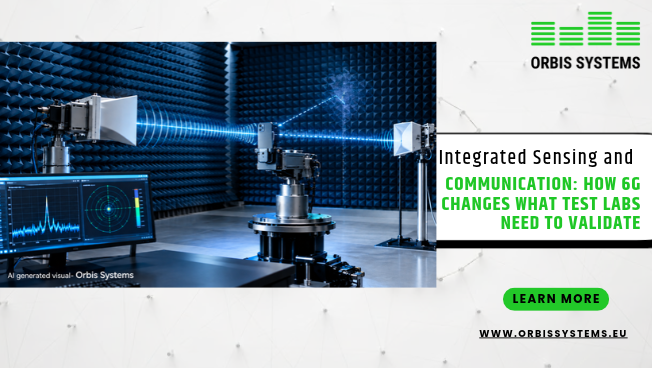 A wireless system may soon need to do two jobs at once: carry information and detect what is happening around it. That is the idea behind Integrated Sensing and Communication (ISAC), an emerging capability being explored for sixth generation wireless networks.
Consider a production floor where connected machines exchange data while the network also detects nearby moving objects. Both capabilities need to work together even as radio waves reflect off surfaces, interference arrives from other machines, and object positions keep changing. A reliable connection alone cannot prove that the sensing function is accurate.
This creates a different challenge for test engineers. ISAC testing must establish how well both functions perform under the same conditions, where their interaction causes problems, and whether the results remain repeatable. For laboratories preparing for 6G, that means looking beyond conventional RF measurements and planning for more complex validation scenarios.
Key Takeaways
- ISAC combines wireless communication with radio based sensing in a single system.
- Future validation needs to cover detection accuracy, interference behavior, and communication quality together.
- 6G RF testing should be performed in controlled environments with repeatable measurement procedures.
- International standards activity provides direction for test labs planning future measurement capabilities.
- Flexible equipment integration helps laboratories keep pace as 6G requirements continue to develop.
- Modular test architectures reduce the effort needed to adapt as new ISAC scenarios emerge.
Why ISAC Changes Wireless Validation
Traditional wireless tests examine parameters such as throughput, latency, signal quality, and reliability. ISAC adds another layer: can the system detect an object, estimate its distance, or distinguish movement when several objects reflect the signal?
The answers depend on antenna behavior, propagation conditions, signal processing, and interference. Testing each component separately may not reveal what happens when sensing and communication operate simultaneously.
A useful ISAC testing plan therefore needs scenarios that exercise both functions together. Engineers should compare sensing outputs against known reference conditions while monitoring communication performance. If detection accuracy drops when data traffic increases, for example, the test should help identify the underlying cause rather than simply record a failed result.
What the 2026 Standards Work Means for Test Labs
Industry standardization efforts have been progressing toward technical performance requirements for the framework associated with 6G. These requirements describe the capabilities expected of 6G networks, with ISAC identified as one of the main usage scenarios.
For laboratories, this development provides direction for planning measurement capabilities. The draft requirements are not a guarantee of real world performance or a finalized specification, but they offer a reference point for scoping future test infrastructure.
The practical response is to review existing equipment now. Teams can check which measurements their current setup supports, where additional capability may be needed, and whether specific processes should be automated or integrated into a wider system.
Sensing Accuracy and Resolution
Can the system distinguish two nearby targets? Does its distance estimate remain consistent when a target moves? These are practical questions that need measurable answers.
With known reference points, controlled motion, and consistent test conditions, engineers can compare system output against reference measurements. Recording the radio environment during testing is also useful, since this makes it easier to distinguish discrepancies caused by the algorithm from those caused by the RF environment.
RF Performance and Interference
6G RF testing should also consider how the coexistence of sensing and transmitting functions influences each. Shared radio resources may create trade offs involving bandwidth, transmit power, interference, and processing requirements.
A useful test sequence varies signal levels and channel conditions while both functions remain active. Engineers can then see whether data transmission is affected by sensing activity, or whether communication traffic reduces the detection rate.
Results like these provide much more insight than simply passing or failing each function independently in separate checks.
Over the Air Measurements
Conducted measurements cannot capture every effect introduced by antennas and propagation paths. Radiated measurements become important when the complete device or antenna system needs to be evaluated.
6G OTA testing should consider antenna coverage, target positioning, multipath propagation, and measurement repeatability. The exact setup will depend on the application and the sensing range being evaluated.
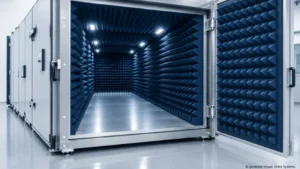
A controlled OTA testing environment also helps engineers distinguish genuine device limitations from unwanted reflections or errors caused by test geometry. Calibration and consistent positioning matter when results from different development stages need to be compared.
Changing Environmental Conditions
A stationary target in a controlled setup is a useful starting point, but it tells only part of the story. Real environments contain moving objects, changing reflectors, and varying propagation conditions.
Laboratories can reproduce relevant scenarios using controlled target movement and programmable channel conditions. Line of sight and non line of sight conditions should be included where the intended application requires them.
This approach makes 6G testing a more accurate reflection of industrial surveillance and other use cases where the sensing function needs to remain reliable even as environmental conditions fluctuate.
Equipment Integration and Data Analysis
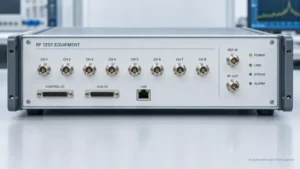
An ISAC setup may include RF generators, analyzers, antennas, channel emulators, and measurement software. Poor synchronization between these components or inconsistent configurations can make results difficult to reproduce.
To function as an effective 6G test system, the setup should support coordinated measurement, automated sequence execution, and traceable outputs. Acceptance criteria should cover sensing and communication individually, followed by an assessment of how their performance relates.
Good test equipment engineering starts with these requirements before instruments are selected. This helps teams identify timing, compatibility, and measurement gaps early in the development process.
Preparing the Laboratory for Future Requirements
Start with the application rather than the equipment catalogue. A laboratory validating an industrial sensing system may need different target scenarios from one assessing a mobile wireless device. Define the intended operating conditions, identify the required measurements, and establish reference values before building the test sequence.
Next, review existing RF instruments, antenna measurement facilities, automation, and analysis workflows. Some components may already be suitable; others may need to be upgraded or integrated differently.
This engineering led approach is reflected in companies such as Orbis Systems, where RF test equipment and system integration capabilities are developed to connect individual instruments into a coherent measurement architecture. A modular approach can also make later changes easier as standards continue to develop.
Making Complex Wireless Tests More Meaningful
ISAC changes the evidence a laboratory needs to collect. Showing that a radio link performs well is only part of the task. Engineers must also establish whether sensing remains dependable when communication traffic and environmental changes enter the picture.
Well planned 6G test systems bring these measurements together and help teams investigate problems before deployment. With flexible infrastructure and repeatable procedures, laboratories can prepare for emerging requirements without treating every new test scenario as a separate project. This structured approach is aligned with the direction taken by companies such as Orbis Systems, where RF test solutions and integration capabilities support laboratories working toward evolving validation requirements.
FAQ’s
1. What is ISAC in 6G?
ISAC combines wireless communication with radio sensing in a single system, allowing a device to transmit information and gather data about its surrounding environment at the same time. It is one of the capabilities being explored for 6G networks.
2. Why does ISAC need dedicated validation?
Engineers need to measure both communication quality and sensing accuracy simultaneously to identify interference effects and resolve performance trade offs that would not appear when each function is tested in isolation.
3. What does 6G OTA testing evaluate?
6G OTA testing focuses on radiated performance under controlled environmental and spatial conditions. This includes antenna characteristics, radio wave propagation patterns, and target positioning, all of which influence sensing and communication results.
4. What equipment may be needed for ISAC validation?
Depending on the system type, laboratories may require RF source and measurement equipment, channel emulators, antenna measurement chambers, and software for automated test execution. The exact combination will depend on the sensing range and application.
5. How can test laboratories prepare for 6G?
Laboratories can start by reviewing existing equipment, identifying missing measurement capabilities, defining standardized test cases, and planning for infrastructure that can accommodate emerging requirements as 6G standards continue to develop.