Table of Contents
- Why RF Test System Maintenance Is Becoming More Complex
- What Are AI-Driven Diagnostics
- How AI Can Support RF Test System Maintenance
- AI and Scheduled Maintenance
- Connecting Diagnostics With Spare Part Management
- AI-Driven Diagnostics in RF Chamber Testing
- The Importance of Commissioning and Baseline Data
- Why Engineering Expertise Remains Essential
- Building More Connected RF Test Solutions
- Toward More Data-Driven Maintenance
- Frequently Asked Questions
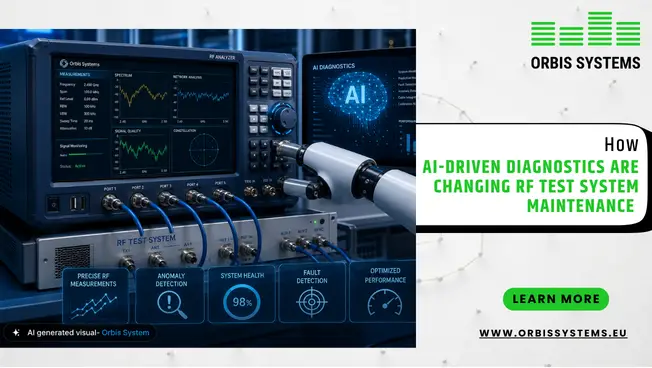 RF test systems today combine measurement equipment, signal routing, automation, software, positioning hardware, and controlled test environments. As these systems grow more integrated, maintenance teams need practical ways to spot unusual behavior and investigate faults before they cause downtime.
This is where AI-driven diagnostics come in, giving engineers another source of information across scheduled maintenance, spare part management, repair and maintenance, advanced support services, commissioning services, RF chamber testing, and integrated RF test solutions. None of this replaces engineers. The goal is more information when accuracy, reliability, and system availability are on the line.
Key Takeaways
- AI-driven diagnostics can analyze system data to identify abnormal patterns and support fault investigation.
- AI can complement scheduled maintenance by providing additional information about equipment behavior between planned service activities.
- Diagnostic information can support spare part management by helping maintenance teams identify recurring component-related issues.
- RF chamber testing requires controlled conditions, calibration, and engineering verification even when advanced diagnostic tools are used.
- AI works most effectively as part of a broader lifecycle approach that includes commissioning, maintenance, repair, calibration, and technical support.
Why RF Test System Maintenance Is Becoming More Complex
A modern RF test environment brings together several interconnected elements that must work in sync to deliver accurate, repeatable results, including RF instruments, switching units, positioning equipment, test fixtures, software, controllers, and RF chambers.
When one component changes, effects can ripple through the entire result. An issue with a connector or calibration condition might not show up as an obvious failure right away, and often appears first as an odd or inconsistent measurement. This is why systematic troubleshooting matters across R&D, validation, and production environments.
Structured repair and maintenance for test and measurement equipment typically follows a documented path of fault diagnosis, component replacement, functional testing, and calibration.
What Are AI-Driven Diagnostics
AI-driven diagnostics is the use of artificial intelligence and data-analysis methods to identify patterns, anomalies, or shifts in equipment behavior, drawing on historical test results, error logs, maintenance records, and performance trends. When current behavior diverges from an established pattern, the system flags it for an engineer to review.
This shifts maintenance toward trends across the wider dataset rather than single failures viewed in isolation. Even so, AI-driven diagnostics should support engineering judgment, not stand in for it. Any flagged anomaly still needs to be weighed against system requirements, calibration records, and equipment condition.
How AI Can Support RF Test System Maintenance
AI can contribute at several stages of the maintenance process. A diagnostic model compares current system activity against historical patterns, and a recurring deviation or gradual performance shift can point toward the need for further inspection, especially for problems that are intermittent or hard to reproduce.
Diagnostics can also support fault investigation. An integrated RF test system may have many possible sources for an abnormal result, and diagnostic analysis can help narrow down where to look by identifying relationships between test outcomes and system behavior. The engineer confirms the cause, but the process offers a more focused starting point.
Monitoring performance trends helps as well, since not every issue shows up as a sudden failure. Tracking gradual shifts gives maintenance teams more to go on when deciding whether equipment needs inspection, calibration, or repair.
AI and Scheduled Maintenance
Scheduled maintenance continues to play a central role in keeping test systems reliable and measurements accurate. Periodic scheduled maintenance programs typically include regular inspections, cleaning, firmware updates, calibration, and checks on critical components, often coordinated with production schedules to limit disruption.
AI-driven diagnostics add to this approach rather than replace it, filling in the picture of how equipment performs between service intervals. A recurring deviation gives engineers a reason to look at a component more closely during the next scheduled visit.
Connecting Diagnostics With Spare Part Management
Component availability matters when maintaining test systems. If a needed part is not on hand when a fault occurs, downtime can extend considerably.
Diagnostic data can help identify recurring component issues, supporting more structured planning. This is where spare part management becomes part of the larger picture.
Structured spare part management typically covers compatibility checks, supplier validation, lifecycle documentation, and traceability. Connecting diagnostic information with these processes gives maintenance teams better visibility when planning future service needs.
AI-Driven Diagnostics in RF Chamber Testing
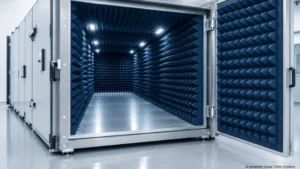
RF chamber testing depends on controlled conditions and dependable measurement performance. An RF test environment typically includes chambers, positioning equipment, signal paths, measurement equipment, and automated test sequences, and a change anywhere in that chain can affect the measurement.
An unexpected result does not automatically point to a problem with the device under test. Engineers may also need to check the test environment, signal path, or calibration status.
AI-driven diagnostics can help by identifying unusual patterns across repeated measurements and flagging changes that call for further investigation. Even so, this technology does not remove the need for proper calibration or controlled test conditions, which remain the foundation of reliable RF and OTA testing.
The Importance of Commissioning and Baseline Data
Good diagnostics depend on good reference data, which is why commissioning matters in the test-system lifecycle. Commissioning services generally cover installation, signal routing verification, calibration, configuration validation, and functional and safety checks.
These activities create a documented record of system readiness and performance, a baseline useful later. If system behavior shifts, engineers have something concrete to measure against. Commissioning, maintenance, and diagnostics work together as one connected lifecycle rather than separate activities.
Why Engineering Expertise Remains Essential
AI can process large volumes of data quickly, but RF test-system maintenance still relies on engineering judgment. A diagnostic tool might flag an unusual pattern, but it takes an engineer to work out what it means, weighing calibration, signal paths, and physical components before deciding on corrective action.
This engineering-led approach is reflected in companies such as Orbis Systems, where advanced support services combine in-depth diagnostics with expert troubleshooting, performance optimization, and preventive maintenance for complex system challenges. AI-driven diagnostics work best as an additional tool, helping organize information while engineers retain responsibility for verification, repair, and validation.
Building More Connected RF Test Solutions
How useful AI-driven diagnostics turn out to be depends on the quality and availability of the underlying data. A fragmented test environment makes it harder to connect information across components and processes.
An integrated RF test solution brings these elements together under one structure. A connected setup makes it easier to keep a running record of performance and repairs, which is a stronger foundation for diagnostics over time. This kind of integration typically covers maintenance, repairs, spare parts, and documentation as part of one broader lifecycle rather than separate activities.
Toward More Data-Driven Maintenance
AI-driven diagnostics are opening up new ways to maintain complex RF test systems. Analyzing system data and supporting fault investigation gives maintenance teams more to work with when making engineering decisions.
The approach works best when paired with established lifecycle practices. Scheduled maintenance, spare part management, repair and maintenance, calibration, commissioning, and advanced technical support all continue to play important roles in keeping test systems reliable over the long run. This aligns with the lifecycle-focused approach seen in companies such as Orbis Systems, where integrated test equipment and automated systems are supported through structured maintenance, repairs, spare parts, and documentation. The direction forward is not simply more automation, but better integration of data, expertise, and lifecycle management working together.
Frequently Asked Questions
1. What are AI-driven diagnostics in RF test system maintenance?
AI-driven diagnostics use artificial intelligence and data analysis to identify unusual patterns in test-system data, helping engineers spot areas worth investigating. They work best as an additional source of information rather than a replacement for engineering judgment.
2. Can AI replace scheduled maintenance for RF test systems?
No. AI-driven diagnostics add useful information to scheduled maintenance but do not replace routine inspection, cleaning, calibration, and component checks. Both continue to serve different roles within a broader lifecycle approach.
3. How can AI support spare part management?
Diagnostic data can help identify recurring component-related issues, supporting more informed planning around replacement components and service scheduling. This makes it easier to align inventory decisions with actual equipment behavior over time.
4. How can AI be used with RF chamber testing?
AI-driven diagnostics can flag unusual measurement patterns across repeated tests, though reliable RF chamber testing still depends on controlled conditions and calibration. The technology supports investigation rather than replacing the underlying test environment requirements.
5. Why is commissioning important for AI-driven diagnostics?
Commissioning documents the expected operating conditions of a test system, creating baseline information engineers can later use to evaluate changes in behavior. Without a well-documented starting point, diagnostic comparisons become harder to interpret reliably