Connected vehicles continuously send and receive data. They must maintain reliable communication with other vehicles, roadside infrastructure, mobile networks, pedestrians, and cloud platforms. This connectivity supports critical functions such as safety alerts, traffic updates, remote diagnostics, infotainment, and navigation services. However, reliable communication cannot simply be assumed. These systems must be validated under realistic RF and mobility conditions. That is why V2X connectivity testing is an essential part of modern connected vehicle development.
In addition, most modern connected vehicles now rely on 5G networks to enable higher data throughput, lower latency, and more reliable communication. These capabilities are especially important for time-sensitive applications such as autonomous driving assistance, collision avoidance, and real-time traffic coordination. However, integrating 5G hardware alone does not guarantee reliable performance.
Factors such as antenna efficiency, RF signal quality, network stability, handover performance, and interference behavior must all be carefully evaluated.
That is where 5G vehicle communication testing becomes critical. It enables engineering teams to verify wireless performance, validate antenna and RF behavior, and ensure stable connectivity before the vehicle is deployed in real-world driving conditions.
Key Takeaways
- V2X connectivity testing evaluates how reliably a vehicle communicates with other vehicles, infrastructure, pedestrians, and networks.
- Connected car OTA (Over-the-Air) testing measures wireless performance in a controlled RF environment.
- Automotive wireless validation includes radiated RF testing for antennas, telematics systems, GNSS, Wi-Fi, Bluetooth, C-V2X, and cellular connectivity.
- 5G connected vehicle testing verifies communication performance, latency, throughput, and reliability on advanced 5G networks.
- C-V2X RF testing evaluates antenna performance, signal quality, radiated sensitivity, and link reliability.
- An automotive OTA chamber provides a controlled and repeatable RF environment to ensure accurate wireless performance measurements.
Why Traditional RF Testing Falls Short
For many years, RF testing was primarily performed using conducted measurements through cables and connectors. In this method, the device is directly connected to test equipment to measure parameters such as transmit power, receiver sensitivity, and signal quality. While conducted testing remains useful for component-level validation and debugging, it does not fully represent real-world wireless performance.
Modern vehicles rely heavily on integrated antenna systems, and antenna behavior is influenced by several real-world factors. Antenna placement, vehicle body structure, cable routing, nearby electronic systems, and signal reflections from surrounding surfaces can all affect wireless performance. These effects are not accurately captured in conducted cable-based testing alone. As a result, traditional RF measurements cannot replace full automotive wireless validation for connected vehicle platforms.
C-V2X RF testing is a strong example of this requirement. C-V2X systems must be evaluated using radiated OTA (Over-the-Air) testing, where RF signals propagate through free space just as they would in actual driving environments. This allows engineers to assess real antenna performance, radiation patterns, signal propagation, interference effects, and overall link reliability. If testing is limited only to conducted cable methods, important wireless performance issues may remain undetected until real-world deployment.
That is why OTA testing has become a standard and essential part of connected vehicle validation.
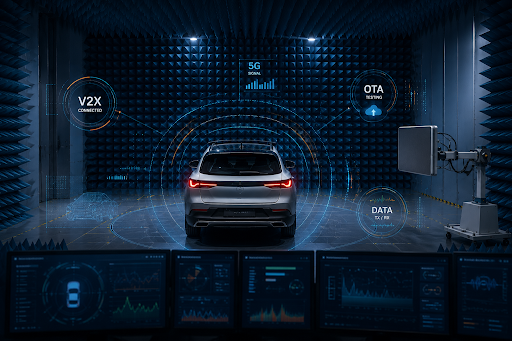
What Is Inside an Automotive OTA Chamber
An automotive OTA (Over-the-Air) chamber is a specialized RF test environment designed for wireless performance validation. It isolates the test area from external RF interference and provides a controlled, repeatable environment for accurate wireless measurements.
Inside a typical automotive OTA chamber setup, you would commonly find:
- RF-shielded enclosure walls
- RF absorber materials to minimize signal reflections and multipath effects
- Measurement and communication antennas
- Vehicle positioning systems or turntables
- Channel emulators and signal simulation systems
- RF measurement instruments and network analyzers
- Test automation and control software
Each component plays an important role in maintaining a stable and repeatable RF test environment. Together, these systems enable accurate evaluation of antenna performance, wireless communication reliability, radiated sensitivity, and overall connected vehicle functionality.
Companies such as Orbis Systems develop advanced OTA and RF test environments that support controlled wireless validation for connected vehicles and V2X applications.
How Connected Car OTA Testing Works
The process behind connected car OTA (Over-the-Air) testing is relatively straightforward. The vehicle, wireless module, or test device is placed inside the OTA chamber. Engineers then configure the RF test environment to simulate the wireless conditions and network scenarios required for validation.
From there, various wireless performance measurements are performed. Engineers evaluate parameters such as signal quality, antenna efficiency, radiated performance, connection stability, data throughput, latency, and overall communication reliability. Because the OTA chamber provides a controlled and repeatable RF environment, the same test conditions can be reproduced consistently, allowing accurate comparison of results across multiple test cycles.
Detecting wireless performance issues during this stage is far more effective than discovering them after product deployment. Connected car OTA testing enables engineering teams to identify antenna, RF, and connectivity problems early in the development cycle, reducing the risk of communication failures in real-world operation.
Why 5G and C-V2X RF Testing Both Matter
The wireless systems used in modern connected vehicles are more advanced and complex than ever before. They must support high data throughput, maintain stable connectivity under changing environmental conditions, and communicate reliably with other vehicles, roadside infrastructure, cloud platforms, and mobile networks. As a result, comprehensive wireless validation has become critical.
C-V2X RF testing evaluates how effectively vehicle-to-everything communication systems perform within a controlled RF environment. This includes assessing antenna performance, radiated signal strength, receiver sensitivity, communication range, interference behavior, and overall link reliability. These tests help verify that the vehicle can maintain dependable direct communication with surrounding vehicles and infrastructure.
Meanwhile, 5G vehicle communication testing focuses specifically on cellular network performance over 5G infrastructure. It evaluates parameters such as network connectivity stability, data throughput, latency, handover performance, and communication reliability under different network conditions. This testing helps ensure that connected vehicle services can operate effectively across advanced 5G mobile networks.
Together, C-V2X RF testing and 5G vehicle communication testing provide a complete view of connected vehicle wireless performance. They validate both direct V2X communication and high-speed cellular connectivity, which are essential for modern connected and autonomous vehicle applications.
Companies such as Orbis Systems focus on advanced RF and OTA testing solutions designed to support connected vehicle validation and next-generation automotive wireless technologies.
Building Better Automotive Validation Labs
Testing requirements are evolving alongside connected vehicle technology. As automotive wireless systems become more advanced, validation laboratories must also adapt to support increasingly complex RF and connectivity testing. Engineering teams need flexible test environments that can support emerging wireless technologies while still delivering accurate, repeatable, and standardized results.
More laboratories are now adopting modular and scalable OTA testing platforms to improve testing efficiency and simplify validation workflows. In addition, advanced automotive RF testing solutions help engineering teams build reliable validation environments capable of supporting V2X, 5G, GNSS, Wi-Fi, Bluetooth, and other connected vehicle technologies.
A well-designed automotive OTA chamber setup supports not only current wireless validation requirements, but also future testing needs as automotive communication technologies continue to evolve. This long-term approach helps engineering teams remain prepared for next-generation connected and autonomous vehicle development.
Companies such as Orbis Systems contribute to this evolution by developing advanced RF and OTA validation environments for connected vehicle applications.
Conclusion
Connected vehicles rely heavily on wireless communication for safety systems, navigation, real-time data exchange, infotainment, and vehicle connectivity services. However, reliable wireless performance cannot be assumed. These communication systems must undergo thorough validation before deployment. V2X connectivity testing, connected car OTA (Over-the-Air) testing, and automotive wireless validation all play critical roles in ensuring that connected vehicle systems perform reliably under real-world operating conditions.
With a properly designed automotive OTA chamber, engineering teams can perform testing in a controlled and repeatable RF environment, enabling accurate evaluation of antenna performance, wireless connectivity, and communication reliability. This helps ensure that the wireless systems integrated into modern vehicles will perform consistently when reliability and safety matter most.
Frequently Asked Questions
What is V2X connectivity testing?
V2X (Vehicle-to-Everything) connectivity testing is the process engineers use to verify whether a vehicle can reliably communicate with other vehicles, roadside infrastructure, mobile networks, pedestrians, and cloud-based systems. The goal is to evaluate signal quality, communication reliability, latency, and overall wireless performance before the vehicle is deployed in real-world driving environments. It is a critical part of ensuring connected vehicle safety and reliability.
Why is connected car OTA testing important?
Connected car OTA (Over-the-Air) testing is important because it evaluates wireless performance through radiated testing in a controlled RF environment. Unlike conducted cable-based testing, OTA testing measures how antennas and wireless systems actually behave when RF signals propagate through free space. This provides engineers with a more accurate understanding of antenna performance, signal propagation, interference behavior, and overall communication reliability before production deployment.
What does an automotive OTA chamber do?
An automotive OTA chamber provides a controlled and RF-isolated environment for testing wireless communication systems without interference from external signals. The chamber creates repeatable test conditions, allowing engineers to generate consistent and reliable measurement results. It is used for radiated testing of antennas, telematics systems, communication modules, GNSS, Wi-Fi, Bluetooth, C-V2X, and other connected vehicle technologies.
Why is 5G vehicle communication testing needed?
5G vehicle communication testing is necessary because integrating 5G hardware alone does not guarantee reliable wireless performance. Engineers must verify that the vehicle can maintain stable communication under real network conditions. This includes evaluating signal quality, data throughput, latency, network stability, handover performance, and communication reliability. Without proper validation, wireless performance issues may only appear during real-world operations.
What is the role of C-V2X RF testing in connected vehicles?
C-V2X RF testing evaluates the radiated wireless performance of vehicle communication systems in controlled RF environments. The testing measures parameters such as antenna performance, radiated signal strength, receiver sensitivity, communication reliability, and interference behavior. Identifying RF and connectivity issues during validation is far more effective than discovering them after deployment, which is why C-V2X RF testing is a key part of connected vehicle development and automotive wireless validation.