We are creative, ambitious and ready for challenges!

Categories
Blogs Resources

How RF Test Automation Enables Enterprise 5G Use Cases (FWA, IoT, Industrial 5G)

Table of Contents

  1. Understanding Enterprise 5G Use Cases
  2. Why RF Test Automation Is Needed
  3. Core Parts of RF Test Automation
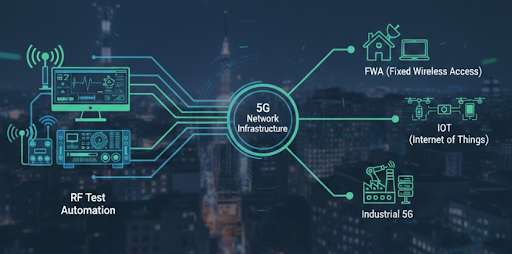
  4. How Automation Supports FWA, IoT, and Industrial 5G
  5. Challenges in Enterprise 5G Testing
  6. Linking RF Automation with Enterprise Workflows
  7. Key Takeaways
  8. Frequently Asked Questions
  9. Conclusion

How RF Test Automation Enables Enterprise 5G Use Cases (FWA, IoT, Industrial 5G)

Enterprise 5G is now widely deployed in real business environments, supporting use cases such as fixed wireless access, private networks, industrial systems, and large-scale IoT deployments. These networks are expected to operate continuously with high reliability. As a result, thorough testing has become a critical step before any system is put into operation. Even small testing gaps can lead to performance degradation, deployment delays, or system downtime.

To address these challenges, RF test automation has become essential. It enables engineers to validate devices and networks in a controlled and repeatable manner. Rather than relying solely on manual testing, automation uses software-driven test sequences to execute identical test steps consistently. This ensures stable, accurate, and easily comparable results across different test cycles.

Organizations such as Orbis Systems emphasize structured RF testing, controlled test environments, and repeatable measurement methodologies. This technical approach highlights the growing importance of RF test automation in enterprise 5G validation.

Key Takeaways

  • RF test automation improves accuracy and repeatability.
  • It reduces manual errors and saves time.
  • It supports FWA, IoT, and industrial 5G use cases.
  • It is essential for scalable enterprise testing.
  • Orbis Systems emphasizes structured RF test methods.

1. Understanding Enterprise 5G Use Cases

Enterprise 5G is designed to meet business requirements, focusing on stable performance, low latency, and secure communication. Unlike consumer networks, enterprise networks are expected to operate continuously with high reliability.

Fixed Wireless Access (FWA)

FWA uses 5G radio signals to deliver broadband internet without physical cables. It is particularly useful in areas where fiber deployment is difficult or costly.

Testing FWA systems involves checking signal strength, measuring throughput, and verifying coverage stability.

IoT in Enterprise Networks

IoT systems connect sensors, machines, and controllers that exchange data continuously. Any interruption in communication can directly impact business operations.

Testing ensures stable connectivity, power efficiency, and reliable data transfer.

Industrial 5G

Industrial 5G enables automation in factories, ports, and warehouses. These environments require ultra-low latency and high reliability.

Testing focuses on MIMO performance, beamforming behavior, and signal stability in noisy or reflective environments.

2. Why RF Test Automation Is Needed

Manual RF testing is time-consuming and often produces inconsistent results depending on the engineer performing the test. Differences in setup procedures and execution can introduce variation in test outcomes over time. This highlights the limitations of manual testing compared to automation in terms of accuracy, speed, and repeatability within enterprise 5G environments.

RF test automation addresses these challenges by executing the same test steps in a defined order every time. As a result, test results become consistent, repeatable, and easy to compare. Automation also reduces errors caused by manual handling and configuration.

In addition, automation significantly increases testing speed. Once a test script is developed, it can be reused across multiple devices and repeated after design or software changes.

This is especially important for

  • Enterprise 5G
  • Private 5G,
  • Industrial 5G testing

By using automation, teams can expand test coverage without increasing engineering workload.

3. Core Parts of RF Test Automation

RF test automation systems are composed of multiple technical components that operate together to enable consistent and repeatable testing. These typically include RF signal generators and analyzers, RF switching units for automated signal routing, OTA chambers for radiated measurements, positioners for precise antenna alignment, and automation software for overall test control.

Each component has a specific function, and together they create a stable and controlled RF testing environment. Orbis Systems emphasizes the importance of controlled RF conditions and accurate measurement setups to ensure that every test follows the same standard.

4. How Automation Supports FWA, IoT, and Industrial 5G

RF test automation improves both test quality and efficiency. First, it increases testing speed by enabling continuous, unattended test execution. As a result, more test scenarios can be completed in less time.

Second, automation improves accuracy by ensuring that test settings and procedures remain consistent for every test run. Third, it enhances traceability, as each test result is automatically recorded and stored for future analysis and comparison.

For example, in enterprise 5G testing, automation verifies that devices meet defined performance targets. In private 5G network testing, it validates coverage and throughput. In industrial 5G testing, automation helps ensure low latency and high reliability.

Orbis Systems promotes automation to keep RF testing predictable and repeatable in enterprise environments.

5. Challenges in Enterprise 5G Testing

Enterprise 5G systems are complex, operating across multiple frequency bands and using advanced antenna systems such as MIMO and beamforming.

Common challenges include:

  • handling different frequency bands,
  • managing complex antenna patterns,
  • processing large volumes of test data,
  • integrating various RF instruments

In addition, real-world environments are inherently unstable. Reflections, interference, and physical obstacles significantly affect RF behavior. As a result, test systems must represent real-world conditions as closely as possible. Automation helps address these challenges by ensuring consistent test procedures and repeatable measurement results.

6. Linking RF Automation with Enterprise Workflows

RF test automation is most effective when integrated with broader enterprise engineering workflows.

Many modern RF test setups use RESTful APIs to enable

  • remote test control,
  • automatic test scheduling,
  • centralized storage of test results.

This allows engineers to manage and monitor tests even when they are not physically present in the lab.

Scalability is another key requirement. As testing demands grow, additional instruments or OTA chambers can be integrated without redesigning the entire test setup.

This approach supports long-term enterprise 5G testing, the expansion of private 5G network validation, and continuous industrial 5G testing programs. Orbis Systems supports structured and modular test environments designed to scale with evolving testing needs.

Building Strong Enterprise 5G Networks

Enterprise 5G transforms how businesses operate by enabling automation, advanced connectivity, and real-time communication. However, these benefits depend on careful and consistent testing.

RF test automation provides the structure required for accurate validation. It ensures stable measurements, repeatable results, and faster testing cycles, supporting enterprise 5G, private 5G, and industrial 5G testing in a reliable manner.

By adopting structured RF testing practices, as emphasized by Orbis Systems, organizations can build dependable 5G networks that perform reliably in real-world environments.

Frequently Asked Questions

1. What is RF test automation?

RF test automation uses software to control RF instruments and run test sequences automatically. It ensures that each test follows the same steps. This improves consistency and measurement accuracy.

2. Why is automation important for industrial 5G testing?

Industrial systems require reliable and low-latency communication. Automation ensures stable test conditions and repeatable measurements, which are critical for safety and control systems.

3. How does automation help in private 5G network testing?

Automation allows structured testing of coverage, throughput, and interference. It helps engineers compare results and verify performance levels.

4. Can RF test automation support large IoT deployments?

Yes. It allows many devices to be tested using the same workflow. This is necessary when IoT systems scale to hundreds or thousands of devices.

5. How does automation improve traceability?

Each test run is logged. Engineers can review results, compare past data, and verify compliance with standards.


Categories
Blogs Resources

How MU-MIMO Affects Spatial Multiplexing and Test Requirements in 5G Devices

Table of Contents

  1. Understanding Multi-user MIMO Technology
  2. What Is MU-MIMO Spatial Multiplexing
  3. How MU-MIMO Changes 5G Device Test Requirements
  4. Parameters That Must Be Verified
  5. The Role of OTA Testing in MU-MIMO
  6. Challenges in Building MU-MIMO Test Systems
  7. Building Strong Test Methods for MU-MIMO in 5G
  8. FAQs

5G has changed how wireless communication works. It is designed to support high data rates, low latency, and many connected devices. One of the key technologies enabling this is Multi-User MIMO (MU-MIMO). MU-MIMO allows a base station to serve multiple devices simultaneously by spatially separating their signals while using the same time and frequency resources.

In earlier wireless systems, testing mainly focused on single-user performance, since users were largely separated in time or frequency. This made device testing more straightforward, as engineers could evaluate one device in a controlled and static environment. With the introduction of MU-MIMO, multiple devices now operate concurrently, and their signals interact through the spatial domain.

As a result, 5G device testing has become more complex and demanding. Testing must now demonstrate how a device performs in realistic multi-user scenarios, including its ability to maintain stable throughput while sharing radio resources. This involves validating beamforming behavior, signal separation, and interference management.

At Orbis Systems, technical discussions often emphasize the importance of controlled RF environments and repeatable measurements. These factors are critical, as accurate and stable test conditions are essential for reliable MU-MIMO performance evaluation.

How MU-MIMO Affects Spatial Multiplexing and Test Requirements in 5G Devices

Key Takeaways

  • MU-MIMO increases network efficiency but also increases testing complexity.
  • MU-MIMO spatial multiplexing must be validated in real multi-user RF conditions.
  • 5G device test requirements now include multi-user performance and beam accuracy.
  • OTA testing is essential for antenna and beam validation.

Repeatable and stable test setups are necessary for reliable 5G device testing.

Understanding Multi-user MIMO Technology

Multi-user MIMO technology allows a base station to transmit different data streams to multiple devices at the same time. Instead of relying only on time or frequency separation, the system also separates users in the spatial domain.

This is achieved using multiple antennas together with beamforming techniques. Each user is served using a distinct spatial direction or spatial signature, allowing the system to reuse the same radio resources efficiently. As a result, network capacity and spectral efficiency are significantly improved.

While this improves overall network performance, it also increases testing complexity. Devices must be evaluated not only in isolation but also under active multi-user conditions where signals interact. This is one of the key reasons why 5G device test requirements are more advanced compared to earlier generations.

What Is MU-MIMO Spatial Multiplexing

MU-MIMO spatial multiplexing refers to transmitting multiple data streams simultaneously over the same frequency and time resources by exploiting different spatial paths. Beamforming is used to direct energy toward each device while minimizing interference between users.

For effective spatial multiplexing, several factors must be accurately controlled. Antenna patterns must remain stable, beamforming must be precise, channel state information must be accurate, and inter-user interference must be kept low.

If these conditions are not met, overall system performance degrades. Therefore, testing must verify that spatial separation is maintained and that devices continue to perform reliably in shared multi-user RF environments.

How MU-MIMO Changes 5G Device Test Requirements

MU-MIMO introduces a new level of complexity in wireless device testing. Traditionally, engineers focused on signal quality, throughput, and stability for a single device. With MU-MIMO, testing must also evaluate how multiple devices perform simultaneously and interact within the same radio resources.

As a result, 5G device test requirements now include validation of multi-user throughput, beam stability over time, interference management, and result consistency across repeated test runs.

High repeatability is especially critical for MU-MIMO testing. If results vary between measurements, it becomes difficult to draw reliable conclusions about device performance. This makes controlled RF environments essential for accurate testing.

At Orbis Systems, technical materials emphasize the importance of structured test setups that deliver stable and repeatable measurement capabilities that are critical for reliable MU-MIMO validation.

Parameters That Must Be Verified

When testing devices that support MU-MIMO, certain parameters become especially critical. Key metrics include beamforming accuracy, spatial separation between users, SINR, per-user throughput, EVM, and packet error rate.


Together, these measurements indicate how effectively MU-MIMO spatial multiplexing is implemented and help determine whether the device can sustain reliable performance under realistic multi-user network conditions.

The Role of OTA Testing in MU-MIMO

Over-the-air testing is a core component of modern wireless device validation. Because MU-MIMO performance depends heavily on antenna characteristics and beamforming behavior, OTA testing becomes even more critical.

OTA testing is used to measure antenna radiation patterns, verify beam directions, evaluate spatial separation between multiple users, and confirm stable RF performance under realistic conditions.

In addition, OTA environments must accurately represent real radio conditions by allowing signals to arrive from multiple angles, while maintaining a controlled and repeatable test setup.

Within structured 5G device testing workflows, OTA testing supports both early-stage design validation and final product qualification. Orbis Systems emphasizes the importance of stable RF environments that enable accurate and repeatable OTA measurements.

Challenges in Building MU-MIMO Test Systems

Designing a test system for MU-MIMO is inherently complex and requires careful planning and precise control. Key challenges include synchronizing multiple RF paths, creating accurate and repeatable channel conditions, supporting scalable test configurations, maintaining long-term measurement stability, and ensuring traceable calibration.

To meet evolving 5G device test requirements, test systems must remain flexible. As standards and features continue to expand, new test cases must be supported without redesigning the entire setup. For this reason, modular system architecture is essential.

Orbis Systems emphasizes the importance of modular and repeatable test environments in advanced RF testing, as these principles are fundamental to managing the complexity of MU-MIMO validation.

Building Strong Test Methods for MU-MIMO in 5G

MU-MIMO is a fundamental feature of modern 5G networks, enabling simultaneous multi-user communication and improved spectral efficiency. While these capabilities enhance network performance, they also significantly increase the complexity of device testing.

To meet current 5G device test requirements, validation must closely reflect real network behavior. Devices need to be evaluated in shared radio environments where beamforming, inter-user interference, and spatial separation directly affect performance.

By employing controlled RF environments, repeatable test workflows, and robust OTA testing, engineers can achieve consistent and reliable validation results. Orbis Systems continues to emphasize these testing principles in its technical discussions, supporting a deeper understanding of advanced RF and MU-MIMO validation challenges.

FAQs

1. Why does MU-MIMO make testing more complex than earlier technologies?

MU-MIMO allows multiple devices to use the same frequency at the same time. This creates interactions between signals. As a result, testing must check how a device performs not only on its own but also when other users are active. This adds more test cases and more parameters to verify.

2. How does MU-MIMO spatial multiplexing affect device performance checks?

MU-MIMO spatial multiplexing requires that each user’s signal remain separated in space. Testing must confirm that beams are correctly formed and that interference stays within acceptable limits. Without this, throughput and stability can drop.

3. Why is OTA testing necessary for MU-MIMO validation?

OTA testing evaluates real antenna behavior. Since MU-MIMO depends on beam direction and radiation patterns, OTA testing shows how the device will perform in real wireless conditions. It is not enough to test only through cables.

OTA testing evaluates real antenna behavior. Since MU-MIMO depends on beam direction and radiation patterns, OTA testing shows how the device will perform in real wireless conditions. It is not enough to test only through cables.

4. How do 5G device test requirements change because of MU-MIMO?

5G device test requirements now include multi-user throughput, beam stability, interference control, and measurement repeatability. These areas were less important when devices operated mainly in single-user modes.

5. Why is automation important in 5G device testing for MU-MIMO?

Automation helps keep results consistent. MU-MIMO testing includes many steps and configurations. Automated workflows reduce human error and make results easier to compare. This improves reliability in 5G device testing and supports long-term quality control.