Table of Contents
- Why Interference-Free RF Testing Matters
- Understanding RF Tunnel Shielded Chambers
- How Tunnel-Style RF Shielding Supports Reliable RF Testing
- Applications of RF Tunnel Shielded Chambers
- Key Factors When Selecting an RF Tunnel Shielded Chamber
- Key Takeaways
- Conclusion
- Frequently Asked Questions
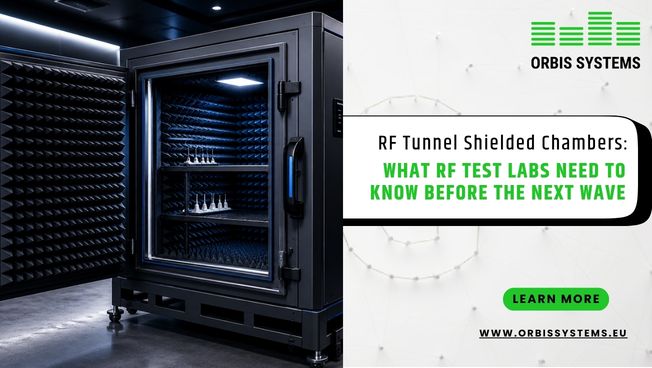
Wireless technology moves fast, and testing has to keep pace with it. An RF Tunnel Shielded Chamber gives engineers a way to test devices in a controlled RF environment without slowing down the flow of equipment through a lab or production line. The chamber blocks outside electromagnetic signals from entering the test area, so measurements stay accurate and repeatable from one test run to the next. Teams working on 5G, IoT, Wi-Fi, and automotive wireless systems often need this kind of setup, since it combines strong shielding with a layout that fits real-world workflows rather than forcing devices to sit in one fixed spot.
Key Takeaways
- Tunnel-style RF shielding creates a controlled pathway that supports reliable wireless testing while reducing external electromagnetic interference.
- An RF isolation environment improves measurement repeatability for OTA, antenna, and wireless device validation.
- A walk-through shielded chamber can support production-oriented workflows where products move through multiple testing stages.
- Proper chamber design, absorber configuration, and shielding effectiveness contribute to accurate and repeatable RF measurements.
- Orbis Systems offers RF Tunnel Shielded Chambers as part of its RF chamber solutions for controlled wireless testing environments.
Why Interference-Free RF Testing Matters
Radio frequency bands are busier today than they used to be. A nearby Wi-Fi network, a piece of industrial equipment, or even another lab bench running its own tests can quietly distort a measurement if the testing space isn’t properly shielded.
This is where a controlled RF isolation environment earns its value. It limits what reaches the device under test, which means engineers can trust that what they’re measuring reflects the device itself and not some outside signal bleeding into the results. This becomes especially important during antenna work, OTA validation, and throughput testing, where a small amount of stray interference can change how a result reads.
New standards keep entering the picture, too. Wi-Fi 7 and private 5G deployments are two recent examples. Each one adds pressure to keep test conditions steady across long development cycles, not just for a single test session.
Understanding RF Tunnel Shielded Chambers
At its core, an RF-shielded chamber keeps testing activity separate from the outside electromagnetic environment. A tunnel-style version stretches that idea into a longer shielded path, one that a product or piece of equipment can travel through while staying inside a shielded zone the entire time.
That’s a meaningful difference from a chamber that’s fully closed off. A walk-through shielded chamber suits teams whose devices need to keep moving, whether between test stations or through stages of a manufacturing line. The tunnel shape keeps the shielding intact while leaving room for larger devices or a direct connection to production equipment.
Many of these chambers also include RF-absorbing material inside, which cuts down on internal reflections that would otherwise interfere with a clean reading. Shielding keeps outside noise out; absorption keeps the inside quiet too, and together they create the stable conditions RF measurement depends on.
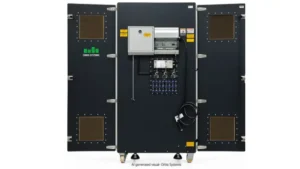
Orbis Systems builds its RF Tunnel Shielded Chamber around this idea. It’s a fully shielded, configurable enclosure meant for dependable over-the-air testing, and it sits within a broader lineup of chamber solutions built for wireless testing at different scales. The chamber is built on Orbis’ existing OTA and shielding platforms, with antenna positioning and DUT interfaces already worked into the design so automated validation doesn’t require a separate setup. It covers both Sub-6 GHz (FR1) and mmWave (FR2) ranges, which makes it a fit for full 5G device and base station testing
Curious whether a tunnel-style chamber would work for your test floor?
[Request a Consultation with Orbis Systems ]
How Tunnel-Style RF Shielding Supports Reliable RF Testing
The point of tunnel-style RF shielding is to hold RF isolation steady through the whole testing process, not just while a device sits still. Rather than depending on one sealed room, the tunnel design creates a shielded path so a device stays protected from outside interference, whether it’s being evaluated or simply moving through.
A few things make this work in practice. The shielded construction stops outside RF signals from getting in. The absorbing material inside cuts down on reflections that could otherwise throw off a reading. The layout itself can be adjusted to fit different device sizes or different testing workflows, so one chamber design doesn’t have to be replaced every time requirements shift. And where automated positioning or production systems are already in place, the chamber can work alongside them to keep testing consistent over time.
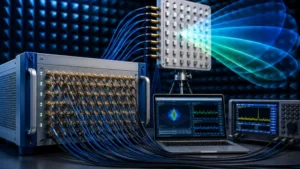
Orbis Systems adds another layer here through its own antenna positioners and DUT controllers, which connect through standard REST API support. That means antenna alignment, beamforming, MIMO, and throughput testing can run with far less manual setup than they otherwise would. The chamber also comes in a few different formats, including tunnel-style shielded rooms, container-based OTA chambers, and smaller shielded boxes, so a lab can start small and scale up toward a full production deployment without switching platforms.
Put together, this is what engineers usually mean when they describe a chamber as EMI-free: one that keeps producing results they can trust, test after test. For OTA work, antenna evaluation, or general wireless validation, steady shielding conditions cut down on variability and give engineers more confidence in what they’re seeing.
Applications of RF Tunnel Shielded Chambers
An RF isolation chamber built this way tends to show up across a wide range of testing work. OTA testing for wireless devices is a common use. Antenna performance evaluation is another. Beyond that, these chambers support wireless module validation, production-line RF testing, IoT device verification, automotive wireless system testing, and validation of industrial wireless equipment.
A walk-through shielded chamber tends to be the more practical choice in settings where products move between several testing stations, since it keeps the RF environment controlled without forcing a stop-and-start process. As wireless products keep adding complexity, holding an interference-free test environment through the full validation process makes a real difference in how consistent the results end up being.
Orbis Systems positions its RF Tunnel Shielded Chamber as part of a larger set of chamber solutions, covering everything from smartphone OTA validation to automotive and defense testing to on-site verification using container-based chambers that can be deployed where needed.
Key Factors When Selecting an RF Tunnel Shielded Chamber
Picking the right chamber usually comes down to a mix of technical requirements and day-to-day workflow needs. Engineers tend to look at shielding performance first, then work through how well a given design fits into their existing process.
Shielding effectiveness across the frequency range being tested is typically the starting point, alongside the chamber’s dimensions relative to the device under test. From there, the internal absorber setup affects how well reflections are managed, and whether the chamber can connect with automation or production systems often shapes how well it fits into a larger test line. How easily equipment can move in and out, and how well the chamber connects with existing RF measurement systems, round out the rest of the decision.
The specific application usually points toward the right choice, whether that’s a standard chamber, an RF-shielded test enclosure, or a tunnel-style setup. Teams handling large devices or running continuous production tend to lean toward the tunnel design, while smaller validation projects are often served well enough by a more compact shielded setup.
Not sure which configuration fits your production line?
[Talk to an Orbis Systems Engineer]
Conclusion
Wireless technology isn’t slowing down, and neither are the demands placed on RF testing. An RF Tunnel Shielded Chamber offers a practical alternative to a fully enclosed room by pairing solid shielding with a layout that works with real production and lab workflows instead of against them. Through tunnel-style RF shielding, engineers get an RF isolation environment that supports interference-free testing while keeping results consistent across a wide range of wireless applications.
Anyone reviewing their current RF testing setup will likely find that understanding the differences between chamber types makes the decision easier. Orbis Systems offers configurable RF Tunnel Shielded Chambers as part of a wider chamber portfolio, all built around the same idea of controlled, repeatable wireless testing.
Frequently Asked Questions
What is an RF Tunnel Shielded Chamber?
An RF Tunnel Shielded Chamber is a shielded testing environment designed to keep wireless testing isolated from outside electromagnetic interference while still letting devices or equipment move through a tunnel-style layout. It supports controlled RF measurement across a wide range of wireless applications.
How does a tunnel-style RF shielding design differ from a conventional RF shielded chamber?
A conventional RF shielded chamber is usually a fully enclosed space. A tunnel-style design instead offers an extended shielded path, one that works better with continuous workflows, larger equipment, or production-line testing, all while keeping the RF isolation intact.
What types of testing can be performed inside an RF isolation chamber?
An RF isolation chamber supports OTA testing, antenna evaluation, wireless device validation, RF performance measurement, throughput testing, and other verification work that depends on controlled electromagnetic conditions.
Why is interference-free RF testing important?
Interference-free RF testing keeps outside electromagnetic signals from skewing measurement results. That leads to more consistent testing, more repeatable measurements, and a more reliable read on how a wireless device actually performs.
Where can I learn more about RF Tunnel Shielded Chambers?
You can learn more about RF Tunnel Shielded Chambers and other RF testing solutions by visiting Orbis Systems’ RF Tunnel Shielded Chamber page: https://www.orbissystems.eu/solutions/rf-tunnel-shielded-chamber/