Table of Contents
- Limits of Traditional Test Systems
- Co-Development in Test Engineering
- Customer-Driven Design Approach
- Value of Modular Test System Architecture
- RF and Wireless Testing Requirements
- Impact on Validation and Time-to-Market
- A Clear Path to Better Test Systems
- Frequently Asked Questions
Testing has become a central part of product development. As systems become more complex, testing requirements also evolve, demanding higher accuracy, repeatability, and automation.
However, many companies still depend on traditional fixed testing setups. These systems often struggle to efficiently support rapidly evolving technologies. Therefore, there is a clear need for more flexible and scalable approaches. This is where custom test system development and co-development methods become important.
Orbis Systems follows a collaborative approach, working closely with customers to design solutions that align with real-world test requirements and use cases. As a result, systems achieve improved measurement accuracy, enhanced repeatability, and greater adaptability to changing test needs.

Key Takeaways
- Co-development improves system accuracy and alignment
- Custom test system development supports flexibility and growth
- Modular test system architecture allows long-term use
- Co-development test solutions reduce delays and improve efficiency
- Customer-driven test system design ensures better performance
- RF testing systems support reliable wireless validation
Limits of Traditional Test Systems
Traditional test systems are often designed for fixed use cases. While they may perform well initially, they begin to show limitations as product requirements evolve.
Common issues include:
- Limited flexibility to support new test requirements
- Delays when system updates or modifications are needed
- Difficulty in scaling for high-volume or parallel production testing
- Gaps between lab testing conditions and real-world operating environments
Because of these limitations, engineering teams spend more time modifying and troubleshooting test systems. As a result, product validation testing slows down, and overall operational efficiency is reduced.
Co-Development in Test Engineering
Co-development in test engineering refers to close collaboration between the solution provider and the customer throughout the entire system development lifecycle, from requirement definition to system validation. Instead of developing a system independently, both parties contribute inputs and feedback at each stage.
In co-development test solutions, this approach provides several benefits. It improves clarity and alignment of requirements, enables faster design iterations when changes are needed, and helps identify potential issues early in the development cycle.
Key advantages include:
- Better alignment with technical and application-specific requirements
- Faster response and iteration during development
- Improved measurement accuracy and test repeatability
- More consistent and reliable test results
As a result, co-development supports a smoother development process and reduces the risk of major changes in later stages.
Customer-Driven Design Approach
A key aspect of co-development is a customer-driven test system design approach, where user requirements guide the entire system development process.
Orbis Systems follows this method by maintaining close collaboration with customers. Each stage of development includes feedback and review, ensuring that the system closely replicates real-world operating and test conditions.
This approach provides:
- Clear definition of testing goals and requirements
- Improved test system performance, including measurement accuracy and throughput
- Reduced development risk through early validation and feedback
- Better integration with existing workflows and processes
As a result, systems are easier to use and maintain while delivering consistent and repeatable results across varying test conditions.
Value of Modular Test System Architecture
Modern testing requires flexibility, as systems must evolve alongside changing product requirements. Therefore, a modular test system architecture is essential.
A modular design allows systems to scale and adapt over time. Instead of replacing the entire system, individual modules or components can be upgraded or expanded as needed.
Key benefits include:
- Easy expansion as testing requirements grow
- Faster integration of new test capabilities and instruments
- Reduced system downtime during upgrades and maintenance
- Extended system lifecycle and improved return on investment
In custom test system development, modular architecture also supports seamless integration with instruments, software, and custom test fixtures for different devices.
As a result, systems remain relevant for longer periods while staying aligned with evolving testing needs.
RF and Wireless Testing Requirements
Wireless systems require highly accurate testing, as even small measurement errors can significantly impact RF performance and compliance results. Therefore, testing must ensure high precision, repeatability, and proper calibration.
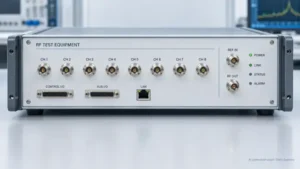
Orbis Systems supports this need through RF test system development, focusing on building systems capable of handling complex RF signals, multiple frequency bands, and varying test conditions.
Their work with bespoke wireless test platforms supports:
- Controlled and interference-free testing environments
- Support for multiple device types and standards
- Accurate and repeatable RF signal measurements
- Reliable RF performance testing across different scenarios
These systems help ensure that products meet required industry standards. In addition, they improve confidence in overall system performance and validation results.
Impact on Validation and Time-to-Market
Co-development improves development efficiency and reduces time-to-market. When test systems are designed with user input, fewer changes are required in later stages.
Key outcomes include:
- Faster system integration, setup, and deployment
- Reduced need for rework and redesign
- More efficient and reliable product validation testing
- Better consistency across development, validation, and production stages
In addition, early testing helps identify issues at an early stage. As a result, companies can reduce the risk of delays during production ramp-up.
Orbis Systems supports this process by aligning system design with real-world usage requirements. Therefore, both development and production stages benefit from improved efficiency and reliability.
A Clear Path to Better Test Systems
Testing is now a continuous part of product development. It requires systems that are reliable, flexible, and easily adaptable to evolving test requirements.
Through custom test system development, companies can build solutions that closely match their application needs. When combined with co-development, this approach improves development speed and overall test quality.
Orbis Systems applies this model by working closely with customers, focusing on practical design, modular architecture, and accurate, repeatable testing methodologies. As a result, systems remain scalable and relevant for both current and future testing demands.
As technology continues to evolve, this approach will remain essential. It supports faster innovation and more consistent, reliable product performance.
Frequently Asked Questions
1. What is custom test system development, and why is it important?
Custom test system development involves creating testing solutions tailored to specific product requirements. It is important because standard systems may not support advanced or application-specific needs. A custom system improves measurement accuracy, flexibility, and lifecycle scalability. It also enables better integration with existing processes, ensuring consistent and reliable testing performance.
2. How do co-development test solutions help reduce development time?
Co-development test solutions involve close collaboration between the solution provider and the customer. This approach helps define requirements early and enables faster design iterations. As a result, fewer changes are required in later stages, reducing rework and overall development time while accelerating system readiness.
3. What is customer-driven test system design?
Customer-driven test system design ensures that the system is built based on real user requirements. Continuous feedback is incorporated at each stage of development, ensuring alignment with actual testing conditions. This reduces design mismatches and validation issues, leading to improved reliability, better performance, and easier system usability.
4. Why is modular test system architecture useful?
A modular test system architecture allows systems to be built in independent sections or modules. Each module can be upgraded or replaced without affecting the entire system. This supports scalability, easier maintenance, and faster integration of new features, while reducing downtime and overall cost.
5. Why is RF test system development important in modern industries?
RF test system development is essential because many modern devices rely on wireless communication. These systems must be tested under controlled and real-world-like RF conditions. Accurate and repeatable RF performance testing ensures compliance with industry standards and verifies correct device operation, supporting reliable product performance in real-world use.