Table of Contents
- Why Accurate Wireless Testing Requires RF Isolation
- What Are RF Shielded Enclosures
- How RF Shielded Enclosures Work
- Types of RF Test Enclosures
- Key Benefits of RF Shielded Enclosures
- Use Cases Across Industries
- Why Scalable and Modular Design Matters
- Supporting Reliable Wireless Testing
- FAQs
Wireless devices require a controlled electromagnetic environment for accurate testing. However, in real-world conditions, signals from nearby systems such as Wi-Fi networks, cellular transmissions, and other electronic devices are always present. These unwanted signals can interfere with the testing process, leading to inaccurate or inconsistent measurement results.
To address this, engineers use RF shielded enclosures to create an isolated and controlled test environment. These enclosures block external electromagnetic interference (EMI) and prevent signal leakage, allowing precise evaluation of the device under test. As a result, measurement accuracy and reliability are significantly improved.
In addition, controlled conditions ensure repeatability across multiple test cycles, which is critical during product development, validation, and quality assurance. For this reason, RF shielded enclosure testing is widely used in modern wireless testing applications.
Key Takeaways
- RF shielded enclosure testing removes outside interference during testing
- EMI shielding test chambers provide stable testing environments
- Anechoic RF test enclosures reduce reflections inside the enclosure
- Wireless device testing enclosures support repeated and consistent testing
- RF isolation chamber and RF shielded box provide flexible testing options
Why Accurate Wireless Testing Requires RF Isolation
Wireless testing depends on signal stability and a controlled electromagnetic environment. However, in real-world conditions, unwanted signals from nearby devices, wireless networks, and electronic systems can easily interfere with measurements.
Without proper isolation, this interference can lead to:
- Variations in measurement results
- Poor repeatability
- Errors during validation and performance testing
To overcome these challenges, RF isolation is essential. It creates a test environment where external interference is highly attenuated, allowing only the intended signals to be measured accurately.
RF shielded enclosures provide this level of control by minimizing external EMI and preventing signal leakage. In addition, they enable consistent test conditions across multiple test cycles. As a result, engineers can obtain reliable, repeatable, and accurate measurement results.
What Are RF Shielded Enclosures
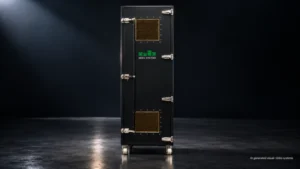
RF shielded enclosures are enclosed systems designed to attenuate external electromagnetic interference (EMI) and prevent unwanted signal leakage. They provide a controlled electromagnetic environment, allowing accurate testing of wireless devices without external disturbances.
These enclosures are available in different forms depending on the application:
- EMI shielding test chambers are used for detailed and advanced testing, such as EMC and RF performance evaluation
- Wireless device testing enclosures (shielded boxes) are used for compact, repeatable testing in R&D and production environments
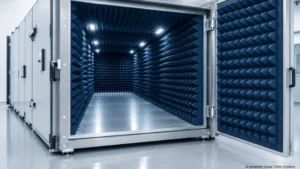
- Anechoic RF test enclosures incorporate RF absorber materials to reduce internal reflections and multipath effects
In addition, RF isolation chambers and RF shielded boxes are designed for different testing setups, ranging from large-scale systems to benchtop solutions. Each type supports specific testing requirements. Therefore, the selection depends on the device under test, frequency range, and the level of accuracy required.
How RF Shielded Enclosures Work
RF shielded enclosures create a controlled electromagnetic environment by attenuating external interference and managing internal signal behavior. They prevent unwanted signals from entering or leaving the test space, ensuring accurate measurements.
This is achieved through several key mechanisms:
Conductive shielding: Metallic walls (such as steel or aluminium) act as a Faraday cage, significantly attenuating external electromagnetic signals
Sealing and filtering: Doors, seams, and cable entry points are specially designed with RF gaskets and filters to prevent signal leakage
Internal surface treatment:
- Reflective metal surfaces contain signals within the enclosure
- RF absorber materials (in anechoic enclosures) absorb signals to reduce reflections and multipath effects
Isolation: The enclosure maintains a stable electromagnetic environment with a consistent noise floor
As a result, EMI shielding chambers provide controlled and repeatable testing conditions. In addition, anechoic RF test enclosures minimize internal reflections, allowing accurate measurement of the device under test without unwanted interference or distortion.
Types of RF Test Enclosures
Different testing requirements demand different types of RF enclosures. Selecting the appropriate system depends on the device under test, frequency range, and level of measurement accuracy required.
RF Shielded Box (Benchtop Enclosure)
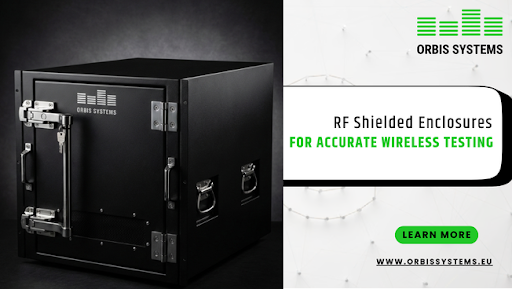
RF shielded boxes are compact enclosures used for testing small wireless devices. They are ideal for quick measurements, early-stage development, and production testing where repeatability is important.
RF Isolation Chamber
RF isolation chambers are larger enclosures designed for detailed and high-accuracy testing. They provide higher shielding effectiveness and support complex test setups, including multiple instruments and over-the-air (OTA) configurations.
Anechoic RF Test Enclosures
Anechoic enclosures are equipped with RF absorber materials to reduce internal reflections and multipath effects. They are commonly used for antenna measurements, OTA testing, and radiation pattern analysis.
Wireless Device Testing Applications
RF shielded enclosures are widely used for repeated and consistent testing of wireless devices across development, validation, and production stages. The choice of enclosure depends on the specific testing requirements.
Key Benefits of RF Shielded Enclosures
RF shielded enclosures enhance measurement accuracy and repeatability by providing a controlled electromagnetic environment. They offer several key benefits for engineering and testing teams:
- Improved accuracy through attenuation of external electromagnetic interference (EMI)
- Consistent and repeatable results across multiple test cycles
- Reliable data for device validation and performance evaluation
- Greater control over testing conditions, including a stable noise floor
In addition, RF shielded enclosures reduce measurement uncertainty and minimize errors caused by external interference. As a result, testing becomes more efficient and dependable.
EMI shielding test chambers help maintain stable and consistent conditions, enabling seamless testing across development, validation, and production stages without variation in performance.
Use Cases Across Industries
RF shielded enclosures are widely used across industries where wireless performance, signal integrity, and electromagnetic compatibility are critical.
Telecommunications: Testing of wireless devices, base stations, and network equipment for RF performance and OTA validation using advanced telecom testing equipment
IoT (Internet of Things): Evaluation of connected devices such as sensors, smart modules, and wireless products using Wi-Fi, Bluetooth, and other protocols
Automotive: Testing of in-vehicle wireless systems, including V2X communication, radar systems, keyless entry, and infotainment modules
Aerospace and Defense: Validation of avionics, radar, and communication systems to ensure signal stability and reliability in critical environments
For example, RF shielded boxes are commonly used for compact device testing and production environments, while RF isolation chambers support larger systems and more complex test setups. Therefore, different industries select enclosure types based on device size, frequency range, and testing requirements.
Why Scalable and Modular Design Matters
Testing requirements evolve over time as products move from development to validation and production. A test setup used in the early stages may not be sufficient for later phases.
For this reason, scalable and modular RF shielded enclosures are essential. These systems allow:
- Easy reconfiguration based on changing testing requirements
- Integration with existing instruments and test setups
- Expansion in size or capability as testing complexity increases
As a result, RF shielded enclosures can support both small-scale and large-scale testing while maintaining consistent and repeatable test conditions. In addition, modular designs help standardize the test environment across different stages of development.
This flexibility improves overall efficiency by reducing the need for system replacement, minimizing downtime, and lowering long-term costs.
Supporting Reliable Wireless Testing
Wireless testing requires a controlled electromagnetic environment to ensure accurate measurements. Without proper isolation, external signals can introduce interference, making it difficult to maintain measurement accuracy and consistency.
RF shielded enclosures provide a stable and controlled test environment by attenuating external electromagnetic interference (EMI). This enables accurate, repeatable, and reliable measurement results. In addition, EMI shielding chambers and anechoic RF test enclosures further enhance measurement quality by minimizing interference and reducing internal reflections.
As wireless technologies continue to evolve, the need for controlled testing environments will remain critical. RF shielded enclosures will continue to play a key role in supporting reliable, efficient, and scalable wireless testing processes.
Frequently Asked Questions
1. What is RF shielded enclosure testing, and why is it needed?
RF shielded enclosure testing is used to evaluate wireless devices in a controlled environment where external electromagnetic interference is highly attenuated. This is needed because outside signals can affect measurements. Reducing interference improves accuracy, reliability, and repeatability of test results.
2. How do EMI shielding test chambers help in testing?
EMI shielding test chambers attenuate unwanted electromagnetic interference (EMI), creating a stable and controlled test environment. This improves measurement accuracy, reduces variation between tests, and helps identify the true performance of the device without external influence.
3. What is the difference between an RF shielded box and an RF isolation chamber?
An RF shielded box is a compact enclosure used for testing small devices in basic or production environments. An RF isolation chamber is larger and designed for advanced testing, offering higher shielding effectiveness and support for complex setups such as multi-antenna or OTA testing. The choice depends on device size, frequency range, and testing requirements.
4. When are anechoic RF test enclosures used?
Anechoic RF test enclosures are used when internal reflections need to be minimized. These enclosures use RF absorber materials to absorb signals instead of reflecting them, reducing multipath effects. They are commonly used for antenna measurements, OTA testing, and RF performance evaluation.
5. Why are wireless device testing enclosures important in production?
Wireless device testing enclosures are important in production because they provide consistent and controlled testing conditions. This ensures product quality by enabling accurate and repeatable measurements. In addition, they support high-volume and automated testing with minimal variation, improving efficiency and reducing errors.