
Table of Contents
- What Changes When RF Isolation Becomes a Requirement?
- Standard Rack vs. Shielded Rack: The Engineering Difference
- Why RF Isolation Matters for Modern Test Programs
- What Makes an RF Shielding Enclosure Effective?
- When Standard Racks Still Make Sense
- Designing for Future RF Test Architectures
- When the Rack Becomes Part of the RF Environment
- Frequently Asked Questions
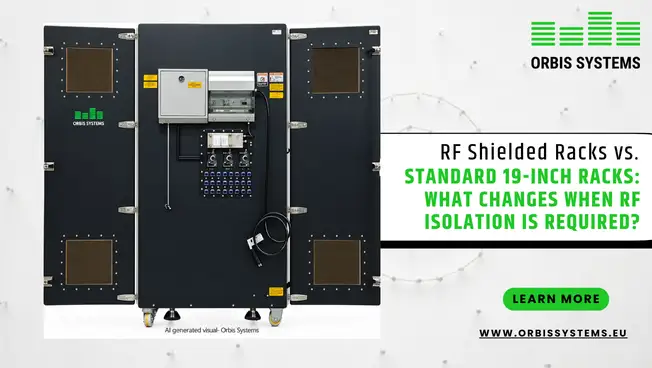
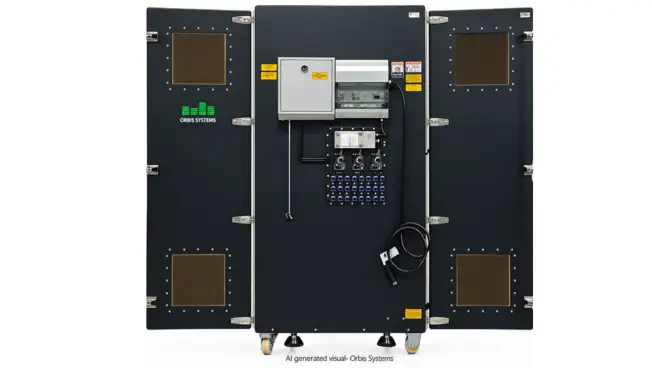
Modern wireless validation uses higher frequencies, wider bandwidths, dense channels, and increased automation. In this environment, a shielded equipment rack becomes part of the electromagnetic architecture, while a conventional cabinet mainly provides mounting and cable management. An RF shielded rack helps control unwanted RF energy around sensitive equipment, keeping the test environment predictable.
For B2B engineering teams, the distinction matters when measurements depend on repeatability, low noise floors, sensitivity, or controlled emissions. The core question is whether the rack itself needs to participate in RF isolation, or only in equipment support.
Key Takeaways
- A standard rack supports equipment mechanically; an EMI shielded rack adds electromagnetic containment.
- An RF isolation enclosure requires controlled seams, doors, vents, cable entries, and interfaces.
- A 19-inch RF rack can retain standard equipment compatibility while adding shielding features.
- RF signal isolation helps suppress unwanted coupling between transmitters, receivers, and measurement instrumentation.
- Effective RF interference protection depends on the complete enclosure, not just conductive panels.
What Changes When RF Isolation Becomes a Requirement?
The key change is straightforward: a standard rack treats boundaries as mechanical surfaces, while an RF shielding enclosure treats them as signal-control surfaces.
An RF test rack must be evaluated for joints, door contacts, ventilation, filtering, connectors, and cable routing. At higher frequencies, small gaps can become leakage paths. A properly engineered RF isolation enclosure needs electrical continuity across all interfaces.
The same principle applies to any shielded equipment rack: panels, doors, filters, vents, grounding, and cable penetrations all need to work together for reliable rack-level RF shielding.
Standard Rack vs. Shielded Rack: The Engineering Difference
A conventional 19-inch rack is optimized for density, access, cooling, and serviceability. Open ventilation supports thermal performance but can compromise electromagnetic containment.
By contrast, an EMI shielded rack adds conductive construction, RF gasketing, filtered interfaces, shielded ventilation, and controlled cable entry. The objective is to maintain shielding effectiveness across the required frequency range. In sensitive setups, RF signal isolation itself becomes a design target rather than a secondary specification.
Inside a shielded rack, an RF test equipment enclosure may hold signal generators, spectrum analyzers, network analyzers, RF switches, attenuators, amplifiers, and control electronics. RF signal isolation helps reduce unintended interactions between these instruments.
This point becomes particularly important when multiple radio sets are transmitting at the same time. A shielded cabinet helps minimize external coupling, while a conventional cabinet may allow signals to interact in ways that affect measurement quality.
Why RF Isolation Matters for Modern Test Programs
As wireless systems grow more complex and handle larger data volumes, keeping RF conditions predictable and controlled becomes essential for reliable performance validation. Modern wireless ecosystems place increasing demand on test environments that can hold up under denser channels, wider bandwidths, and more dynamic operating conditions.
For engineering teams facing this shift, the need for a testing environment that excludes unwanted RF coupling and external interference becomes clearer. A properly designed RF shielding enclosure can help generate the kind of predictable electromagnetic environment needed for measurements that must be repeated reliably.
What Makes an RF Shielding Enclosure Effective?
An RF shielding enclosure should be evaluated as a complete system. Material selection matters, but so do seams, door pressure, gasket continuity, ventilation, grounding, power entry, and connector filtering.
An RF test equipment enclosure can lose effectiveness if cables enter through uncontrolled openings. Likewise, an EMI shielded rack may require durable contact surfaces because repeated access can affect mechanical continuity over time.
Engineers should define operating frequency, attenuation, heat load, connector count, cable types, access, and automation requirements before selecting an RF test rack. These requirements determine whether a standard 19-inch rack can be adapted or whether a purpose-built shielded design is more appropriate.
When Standard Racks Still Make Sense
Not every laboratory needs an RF isolation enclosure. A regular enclosure may still perform well when emissions from external sources are minimal or when the surrounding electromagnetic environment is already well controlled.
That said, low-level receiver measurements, coexistence testing, transmitter characterization, and susceptibility testing are examples of scenarios where RF isolation can make a measurable difference.
When integration with automated test systems is required, shielded rack designs provide both mechanical support and controlled electromagnetic coupling. This becomes particularly valuable when multiple sensitive instruments share a test cell. Dedicated wireless test racks can support wireless validation, while shielded server racks can separate control computers and data-processing hardware from sensitive RF paths.
Designing for Future RF Test Architectures
Next-generation platforms will combine more frequency bands, software-defined radios, higher channel counts, AI diagnostics, and greater automation. This makes RF interference protection a system-level requirement rather than a component-level afterthought.
This engineering-led approach is reflected in companies such as Orbis Systems, where automated wireless, RF, OTA, and R&D validation environments are developed alongside RF signal switching, positioning, and chamber solutions, connecting test hardware, RF paths, switching architecture, and automation into a coordinated platform.
For scalable laboratories, rack-level RF shielding should sit alongside test automation, thermal management, power distribution, and signal routing. The result is a coordinated infrastructure where the rack itself contributes to consistent electromagnetic conditions across the test system.
When the Rack Becomes Part of the RF Environment
As wireless validation becomes denser and measurement tolerances become tighter, the infrastructure surrounding test equipment increasingly influences test quality. The choice between conventional and shielded designs depends on the electromagnetic conditions that need to be controlled.
Where containment, repeatability, and predictable RF behavior become essential, shielded rack designs can turn an equipment bay into a deliberate validation environment. This evolution is aligned with the direction taken by companies such as Orbis Systems, where scalable, automated test architectures are developed around the same principles.
Frequently Asked Questions
1. What changes between shielded and standard racks?
A standard rack primarily provides mechanical support for equipment. A shielded rack adds conductive construction, controlled interfaces, and RF-managed cable entries, all of which help reduce unwanted electromagnetic coupling around the equipment inside.
2. Does every 19-inch rack need shielding?
No. Shielding matters when emissions, receiver sensitivity, coexistence, or repeatability makes RF isolation a defined requirement. In well-controlled environments with minimal external interference, a standard 19-inch rack may still be appropriate.
3. Can shielding affect equipment cooling?
Yes. Vents in shielded cabinets may be restricted to specific areas, and airflow may need to be controlled through filtered paths. This can require different thermal management strategies compared with a standard rack.
4. How should shielding performance be specified?
Shielding performance is typically specified by defining the frequency range, attenuation level in dB, interfaces, cable entries, thermal load, and access requirements. These specifications should be established before selecting an RF test equipment enclosure.
5. Can shielded racks support automated test systems?
Yes. Wireless test racks can house measurement instruments, switching hardware, and control electronics needed for automated testing, while maintaining the controlled RF environment those systems depend on.