
Table of Contents
- The Real Cost of Unplanned Downtime
- Preventive Maintenance Planning and RF Equipment Lifecycle
- Spare Part Management for Reliable Testing Operations
- Building a Maintenance Scheduling Strategy for Labs
- Lifecycle Support and Long-Term Performance
- Conclusion
- Frequently Asked Questions
Key Takeaways
- Uptime is a planning outcome, not a lucky streak. Test lab uptime depends far more on proactive scheduling and inspection habits than on reacting quickly once something breaks.
- Preventive maintenance catches problems while they’re small. Routine inspections, calibration checks, and planned part replacement give teams a chance to fix minor wear before it turns into a test-interrupting failure.
- Spare part management removes the biggest bottleneck in repairs. Having critical components tracked and in stock means repairs can start immediately instead of waiting on procurement timelines.
- Scheduling has to reflect real usage, not just a calendar. Equipment age, operating hours, environment, and maintenance history all shape a schedule that actually holds up under daily conditions.
- Consistent maintenance extends the RF equipment lifecycle. Regular servicing reduces unnecessary wear and helps systems hold their calibration accuracy over a longer working life.
- Lifecycle thinking beats treating maintenance as isolated events. Planning upgrades, repairs, and inventory together, rather than one at a time, gives labs a clearer long-term picture and fewer last-minute scrambles.
Ask most lab managers what keeps testing on schedule, and equipment quality comes up first. Skilled staff usually follows close behind. Maintenance rarely gets mentioned in the same breath, yet it shapes test lab uptime just as much as either of those factors. RF and automated test systems wear down through ordinary use. Cables loosen. Connectors degrade. Components age even when nothing appears wrong on the surface.
Because of this, preventive maintenance planning, spare part management, and maintenance scheduling for labs tend to matter more than they get credit for. Labs that take these seriously typically deal with fewer surprises, get more usable years out of their equipment, and keep test schedules closer to plan.
The Real Cost of Unplanned Downtime
A test lab running on a tight schedule can absorb small setbacks. What it struggles with is the unplanned kind. One unexpected outage can delay product validation by days. It can push manufacturing decisions back further than anyone budgeted for. Research teams waiting on results end up waiting longer.
The disruption doesn’t end once the repair is finished, either. Engineers stop mid-test. Schedules get rearranged on short notice. Someone still has to figure out what actually caused the failure before work can pick back up, and that process alone can eat up hours or days depending on the system involved.
These costs build slowly, which is part of the problem. A lab dealing with occasional unplanned interruptions might not notice the pattern until a deadline slips. That’s really why more labs have started moving away from reactive repairs. Structured maintenance programs catch problems while they’re still minor. Finding an issue during a scheduled check costs far less, in time and disruption, than finding it in the middle of a test run.
Preventive Maintenance Planning and RF Equipment Lifecycle
RF test systems wear down for a few predictable reasons: constant operation, environmental exposure, and the simple aging of internal components. None of this happens overnight. Small changes accumulate, and if nobody’s watching, they eventually start affecting calibration accuracy and, in turn, the reliability of the results a lab depends on.
Preventive maintenance planning works by servicing equipment on a set schedule instead of waiting for a breakdown to force the issue. A maintenance program built around this idea usually touches on a handful of recurring tasks. Routine inspections come first, followed by calibration verification and cleaning of sensitive components. Firmware or software updates get applied where they’re needed. Parts known to wear out get replaced before they fail rather than after. Functional checks close out the process, confirming the system still performs the way it’s supposed to.
None of these steps is especially complicated by itself. The value comes from doing them on a consistent basis, month after month, rather than treating maintenance as something to get to eventually. That consistency is what actually preserves the RF equipment lifecycle, and it’s what keeps measurements repeatable, which matters more in production testing than almost anywhere else, since small inaccuracies there tend to carry real consequences downstream.
Talk to Orbis Systems About a Preventive Maintenance Plan
Spare Part Management for Reliable Testing Operations
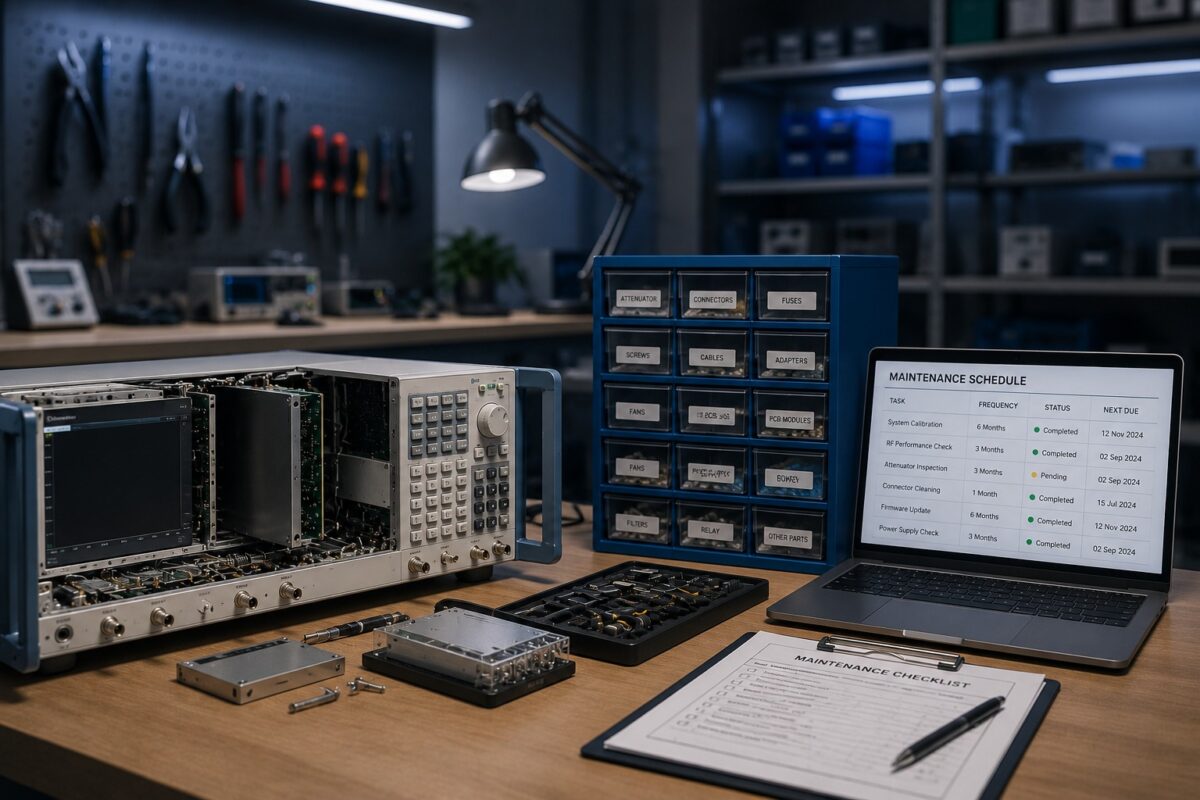
A maintenance program can be well designed and still stall out if nobody has the right part on hand when it’s needed. This is where spare part management earns its place. Instead of waiting on procurement after something fails, labs that plan their inventory in advance can start repairs the same day.
A workable approach to spare part management starts with figuring out which components matter most to daily operations. From there, it’s mostly about visibility: keeping stock levels tracked for high-priority parts, noting when each one was last replaced, and adjusting inventory as equipment ages or usage patterns shift. Stock gets reviewed periodically alongside the broader maintenance schedule, not as an afterthought but as part of the same planning conversation.
Paired with scheduled maintenance services, this kind of planning stops being reactive and starts functioning as real risk management. Teams can swap out aging components during a planned service window rather than scrambling once something has already failed. The payoff is less downtime overall, and a testing environment that stays dependable instead of lurching from one repair to the next.
Effective spare parts management:
- Reduces equipment downtime
- Improves maintenance efficiency
- Prevents production losses
- Optimizes inventory costs
- Ensures critical spares are available when needed
Building a Maintenance Scheduling Strategy for Labs
Putting dates on a calendar is only the surface layer of maintenance scheduling. A useful maintenance scheduling for labs strategy also has to account for how each system actually gets used day to day, what conditions it operates under, and how central it is to ongoing testing work.
Several factors shape this kind of planning. Equipment age is one. Operating hours matter too, along with the surrounding environment and whatever past maintenance records happen to show. Manufacturer guidance plays a role as well, though it’s rarely the only input. Labs that build their schedules around this combination of factors tend to see fewer unexpected failures, steadier equipment availability, and workloads that maintenance teams can actually plan around instead of reacting to.
There’s a longer-term payoff too. Regular test equipment maintenance builds a documented history for each system over time. That history makes future planning easier, and it gives teams a clearer sense of when a system is approaching the point where replacement makes more sense than another repair.
Lifecycle Support and Long-Term Performance
Commissioning new equipment feels like the finish line, but it’s really just the starting point. From there, every system moves through a much longer stretch that includes routine checks, occasional repairs, scheduled servicing, and eventual part replacement. Labs that treat maintenance as part of this whole stretch, rather than a string of separate events, tend to end up with better outcomes.
That’s really the value of lifecycle-focused planning. Instead of responding to each issue as it comes up, teams that think in terms of the full equipment life cycle can plan upgrades ahead of time, budget for replacements before they’re urgent, and manage inventory with a longer view in mind.
Orbis Systems supports this kind of thinking through spare part management, repair and maintenance services, and periodic scheduled maintenance, aimed at helping customers keep their testing environments dependable for as long as the equipment stays in service.
[Request a Lifecycle Support Consultation from Orbis Systems →]
Conclusion
Reliable testing doesn’t happen on its own. It gets built, gradually, through steady maintenance habits, spare part inventories that are actually organized, and schedules that reflect how equipment gets used rather than how a calendar template says it should. These practices rarely draw attention until something goes wrong. Labs that invest in them consistently tend to avoid that moment altogether.
As test environments keep growing more complex, treating maintenance as an ongoing lifecycle commitment rather than a response to breakdowns makes a real difference. Preventive maintenance planning, paired with solid spare part management and regular test equipment maintenance, supports stronger test lab uptime and a longer RF equipment lifecycle over time.
Orbis Systems offers lifecycle support built around periodic scheduled maintenance, repair and maintenance, and spare part management, helping labs maintain dependable performance across the full working life of their RF and automated test systems.
Frequently Asked Questions
1. Why is preventive maintenance important for test lab uptime?
Preventive maintenance helps catch small equipment issues before they grow into failures that interrupt testing. Routine inspections, calibration checks, and planned part replacement all support measurement accuracy and steadier system availability, and together these habits contribute directly to stronger test lab uptime.
2. What is spare part management in a testing laboratory?
Spare part management means identifying, storing, and tracking the components most likely to need replacement during repairs or routine maintenance. Having those parts ready ahead of time shortens repair delays considerably and helps testing systems get back online faster after an issue comes up.
3. How does maintenance scheduling improve laboratory operations?
A structured maintenance scheduling approach for labs lets servicing happen at planned intervals rather than only after equipment breaks down. This cuts down on surprise disruptions and gives maintenance teams a workload they can actually plan around instead of one they’re constantly reacting to.
Benefits:
- Increased equipment reliability.
- Increased Productivity
- Better Spare Parts Planning
- Reduced unplanned downtime
- Extended equipment life
- Improved safety
- Lower repair costs
- Higher Customer Satisfaction
4. How does regular maintenance extend the RF equipment lifecycle?
Routine inspections, calibration, cleaning, and timely part replacement all reduce unnecessary wear on RF systems over time. This kind of consistency helps preserve equipment performance and supports a longer, more reliable RF equipment lifecycle overall.
5. What services support long-term maintenance of RF test systems?
Long-term maintenance support usually includes scheduled maintenance services, test equipment maintenance, repair work, calibration support, and spare part management. Together, these services help labs maintain equipment reliability and reduce downtime across the full operational life of their systems.