
Table of Contents
- Why Precision Matters in RF Testing
- Understanding Programmable Attenuators
- What Is a Phase Shift Matrix Module?
- How the Two Work Together
- Where These Tools Are Used
- Choosing the Right Signal Control Solution
- Conclusion
- FAQs
Modern RF testing depends on tight control over signal strength and phase. Engineers validating wireless devices, checking antenna performance, or testing communication systems need tools that hold up across many test conditions, not just one. That reliability is the job of RF signal attenuation control, programmable attenuators, and phase shift matrix modules. Used together, these tools let RF laboratories automate testing, tighten measurement accuracy, and keep pace with increasingly complex wireless systems.
Key Takeaways
- RF signal attenuation control helps keep power levels steady from the start of a test to the end, so results stay consistent even when conditions change.
- Programmable attenuators let engineers adjust signal strength through software instead of swapping hardware by hand, which makes the process faster and easier to repeat.
- A phase shift matrix module gives engineers a way to control phase accurately across several RF paths at once, which matters more as antenna and beamforming systems get more complex.
- When attenuation and phase are managed together, RF signal conditioning becomes more reliable across the entire testing workflow, not just in isolated steps.
- Precision RF calibration tools support long-term consistency, helping labs get dependable results across both wireless validation work and production testing.
- Automated signal control cuts down on manual work, which reduces the chance of error and speeds up overall testing time.
- Modular, scalable solutions give laboratories the flexibility to grow their setup as wireless standards and testing needs continue to change.
Why Precision Matters in RF Testing
Wireless technology keeps changing. Antenna systems have grown more advanced, operating frequencies have climbed, and performance expectations have gone up along with them. RF laboratories now need to recreate a wide range of signal conditions while keeping measurement accuracy steady from one test run to the next.
Small shifts in signal power or phase can throw off results in ways that are hard to trace later. This is why engineers lean on precision RF calibration tools to manage signal behavior at every stage of testing. Careful calibration also cuts down on measurement uncertainty, which in turn builds more confidence in the final results.
Good RF signal attenuation control lets engineers adjust signal levels without adding distortion they didn’t ask for. In a similar way, phase control in RF testing keeps signal behavior synchronized across multiple RF paths. That synchronization matters most in setups involving multiple antennas or beamforming, where timing between paths can make or break a test.
When attenuation and phase management are handled well together, RF laboratories end up with testing environments that hold steady across research projects, product validation, and manufacturing runs alike.
Understanding Programmable Attenuators
A programmable attenuator is an electronically controlled device that reduces RF signal power by a set amount. Fixed attenuators can’t be adjusted once installed, but programmable models let engineers change attenuation levels remotely, through software or as part of an automated test system.
That flexibility is what makes an RF programmable attenuator so useful in labs where test scenarios shift often, and signal levels need to change to match. Rather than swapping hardware by hand every time conditions change, engineers can set attenuation values through software, which speeds things up and removes a common source of error.
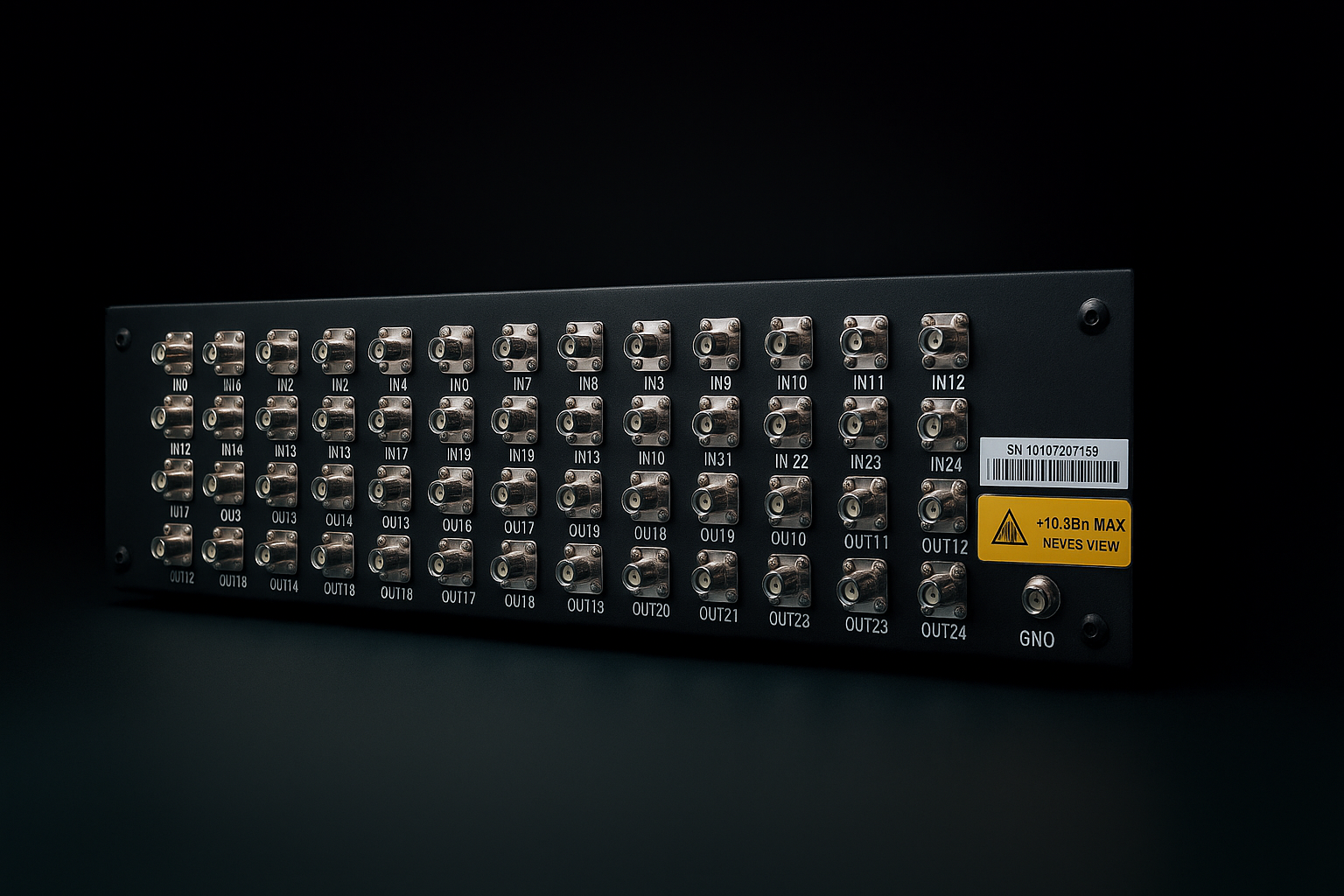
Some of the advantages worth noting:
- Precise, repeatable adjustment of RF signal power across test cycles
- Faster automated testing workflows with less manual setup
- Remote software control that fits into larger integrated test systems
- Consistent signal conditioning across a range of devices under test
A variable attenuator RF lab setup usually leans on programmable attenuation for exactly this reason. Multiple products, frequencies, and test conditions often need to run through the same shared infrastructure, and programmable control makes that possible without constant rewiring.
See how Orbis Systems’ programmable attenuator models fit into your test setup. Request a Free Consultation
What Is a Phase Shift Matrix Module?
Where programmable attenuators manage amplitude, a phase shift matrix module manages the phase relationship between RF signals.
Phase control has become more important as wireless systems move toward multiple antennas,controlling phase adjustment across multiple signal paths,By precisely altering the phase of RF signals, it enables beam steering, channel emulation, signal synchronization, and advanced testing applications.Engineers often need to introduce specific, controlled phase differences to see how a device responds under different signal conditions.
A phase shift matrix module makes those adjustments possible with a level of precision that manual methods can’t match, and it does so in a way that fits into automated test environments. Instead of adjusting individual signal paths by hand, engineers can set phase values through software and move on to the next test faster.
This kind of module typically supports:
- Accurate phase adjustment across multiple RF channels at once
- Automated multi-channel testing with less manual intervention
- Better repeatability during antenna validation work
- Signal synchronization that holds steady across test runs
As wireless technology advances, dependable phase control in RF testing has turned into a baseline requirement rather than an extra, particularly for teams evaluating communication performance and antenna behavior in detail.
How the Two Work Together
Few RF laboratories rely on just one signal control device. More often, programmable attenuators and phase shift matrix modules sit side by side in a larger automated test environment, each handling a different part of the job.
Programmable attenuators manage signal strength. Phase shift matrix modules manage timing and phase relationships. Put together, they give engineers the range to reproduce a wide variety of real-world operating conditions inside a controlled lab setting.
During antenna or wireless device validation, for instance, an engineer might need to lower signal power while introducing a specific phase difference across several RF paths at the same time. Doing both through software, rather than manual configuration, tends to produce more consistent results across repeated test runs.
This pairing also supports steady RF signal conditioning, giving engineers the means to fine-tune a test environment as validation requirements shift over the course of a project.
When these two technologies are folded into a shared automated workflow, laboratories generally see better repeatability, shorter setup times, and smoother handling of multiple concurrent projects.
Where These Tools Are Used
Programmable attenuation and phase control show up across a wide range of RF testing work, wherever precision and repeatability matter most.
Typical applications include:
- Automated RF Test Systems
- Wireless device validation
- Antenna testing
- Over-the-Air (OTA) testing
- MIMO testing
- Phased Array and Beamforming evaluation
- Research and development labs
- Manufacturing and production testing
- RF calibration and validation environments
Across all of these, engineers depend on RF signal conditioning to keep test conditions stable while still adapting to each device’s specific requirements. As test complexity grows, both high-precision attenuator hardware and accurate phase management play a bigger role in producing results that hold up under scrutiny.
Choosing the Right Signal Control Solution
The right RF signal control setup depends on what a laboratory is trying to accomplish, how much automation it needs, and how complex its testing environment already is.
A few factors worth weighing before making a decision:
- Required attenuation range and resolution
- Accuracy and repeatability across test cycles
- Number of RF channels involved
- Software programmability and ease of integration
- Compatibility with existing RF infrastructure
- Room to scale as testing needs grow
A high-precision attenuator should hold its performance steady across repeated test cycles without drifting. A phase shift matrix module, in turn, should offer phase adjustments accurate enough to integrate cleanly into an automated workflow.
Organizations developing advanced RF test systems, including Orbis Systems, build programmable signal control components with these needs in mind. Their published solutions show how programmable attenuators and phase management technology can support flexible RF testing architectures without giving up measurement consistency.
Explore Orbis Systems’ full range of test and switching solutions. [View Solutions]
Conclusion
RF laboratories need more precision than ever as wireless systems keep getting more advanced. Programmable attenuators and a phase shift matrix module help meet that need by giving engineers control over both signal strength and phase, without relying on manual setup.
Together, these tools support RF signal attenuation control, dependable phase control in RF testing, and steady RF signal conditioning across a lab’s daily work. The result is less manual adjustment, faster setup, and results engineers can trust from one test to the next.
For labs working on wireless validation or production testing, reliable precision RF calibration tools remain a practical investment. Companies such as Orbis Systems continue to build modular solutions around this need, helping labs bring programmable signal control into automated test environments without losing accuracy.
Frequently Asked Questions
What is an RF programmable attenuator used for?
An RF programmable attenuator is used to electronically adjust RF signal power levels electronically during testing. It allows engineers to make precise attenuation adjustments through software, which makes automated RF testing faster and more consistent than manual adjustment would allow.
Why is phase control important in RF testing?
Phase control in RF testing keeps signals aligned to the phase relationships a test requires. This matters most in antenna testing, beamforming evaluation, and MIMO systems, where multiple channels need to stay synchronized for results to mean anything.
How do programmable attenuators improve RF signal conditioning?
Programmable attenuators support RF signal conditioning by adjusting signal strength accurately without requiring engineers to swap hardware by hand. That helps labs maintain consistent test conditions across a wide range of validation scenarios.
What is the role of a phase shift matrix module?
A phase shift matrix module introduces controlled phase changes across RF channels. This lets engineers simulate different operating conditions and evaluate how a wireless system performs with a level of accuracy manual methods can’t reach.
How do programmable attenuators and phase shift matrix modules work together?
Programmable attenuators manage RF signal power, and phase shift matrix modules manage signal phase. Together, they give RF laboratories the combined control needed for better automation, repeatability, and measurement accuracy in modern test environments.