Table of Contents
- Why Shielding Alone Is Not Always Enough
- RF Shielding and Radiated Signals
- EMI Filtering and Conducted Signals
- Why Many RF Test Environments Use Both
- How Interference Actually Moves in RF Testing
- Use in Wireless and Telecom Testing
- Conclusion
- Frequently Asked Questions
Here is a question that comes up often in RF testing: if a test environment is properly shielded, why does interference still appear?
The answer is straightforward. Interference does not always enter a system the same way.
A shielded room, RF test enclosure, or RF test chamber can block a good amount of unwanted RF energy coming from outside. However, shielding does nothing to stop interference that moves through power lines, signal cables, or network connections. That is exactly why so many engineers run into situations where shielding alone is not enough to solve the problem.
Understanding what RF shielding and EMI filtering each do is important for anyone working toward reliable electromagnetic compatibility. They handle different interference paths, and in many real testing situations, you need both working at the same time.
Key Takeaways
- RF shielding controls signals that travel through the air, while EMI filtering controls signals that travel through cables and power lines.
- Shielding alone cannot stop interference coming in through connected infrastructure.
- Filtering alone cannot block radiated interference coming from outside sources.
- Both technologies support electromagnetic compatibility but in different ways.
- An RF shielding rack system, RF test enclosure, and RF test chamber help create controlled testing environments.
- EMI filtering is one of the most widely used noise suppression techniques in EMC design.
- Combining shielding and filtering gives engineers better RF interference control and stronger signal integrity protection.
- Most modern RF testing environments need both approaches to get accurate and repeatable results.
Why Shielding Alone Is Not Always Enough
Picture a wireless device sitting inside a shielded environment. The chamber blocks nearby cellular networks, Wi-Fi signals, and other outside transmitters well. From a radiated standpoint, everything looks fine.
Still, measurement problems show up.
Most of the time, the shielding itself is not the issue. The problem is that unwanted signals are getting in through the cables and connections tied to the test setup. Power feeds, Ethernet lines, monitoring cables, and control interfaces can all carry interference straight into the test area.
So electromagnetic compatibility is not only about keeping outside RF signals away. It is just as much about managing every path through which unwanted energy can reach the equipment being tested.
RF Shielding and Radiated Signals
RF shielding is the right tool when you need to separate a test environment from outside electromagnetic activity. It puts up a barrier that reduces how much RF energy can enter or leave a controlled space.
This is especially important when accurate measurements depend on a stable, consistent environment.
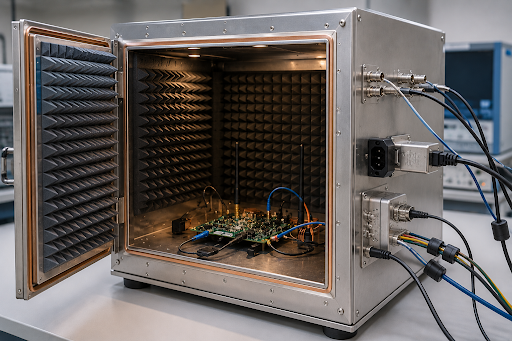
An RF shielding rack system helps protect sensitive equipment. An RF test enclosure gives engineers a controlled space to work in during development. An RF test chamber reduces the impact of outside signals during wireless and telecom testing.
At its core, shielding is about radiated interference control. When you limit unwanted RF activity around the test area, measurement results improve and signal integrity protection becomes easier to maintain.
Even so, no shielded environment exists in isolation. Cable entry points and connected systems still need attention, no matter how well the shielding performs.
EMI Filtering and Conducted Signals
Every shielded space still needs connections to the outside world. Equipment needs power. Test systems pass data back and forth. Control systems communicate with instruments.
Each of those connections is a possible route for interference.
Conducted interference is different from radiated interference because it travels through physical wires rather than through the air. Electrical noise can ride into a test environment along power lines, communication cables, or network links. Once it gets inside, it can affect how equipment behaves and reduce measurement quality.
That is the problem EMI filtering is built to address.
Rather than dealing with signals in the air, filtering works on unwanted energy moving through electrical connections. It is one of the most practical noise suppression techniques available and plays a big role in conducting interference reduction throughout EMC design.
In many testing facilities, filtering is set up right alongside shielding because the two technologies each handle a different piece of the interference problem.
Why Many RF Test Environments Use Both
It is tempting to think of shielding and filtering as separate choices. In practice, they usually belong to the same overall plan.
Shielding keeps outside RF sources from affecting the test area. Filtering keeps unwanted signals from sneaking in through connected cables and power lines.
Take away the filtering, and electrical noise can still reach sensitive equipment. Take away the shielding, and outside RF activity can still throw off measurements.
Because of this, many modern EMI shielding solutions are designed with both types of interference in mind from the start.
Using both together supports:
- Better electromagnetic compatibility
- Stronger RF interference control
- More reliable signal integrity protection
- More consistent radiated interference control
Adding filtering on top of shielding also brings:
- Better conducted interference reduction
- More effective noise suppression techniques
- Steadier measurements over time
- Greater overall testing consistency
How Interference Actually Moves in RF Testing
In real testing situations, interference rarely comes from just one direction.
A shielded test chamber might perform exactly as expected, yet problems still appear because electrical noise is coming in on the power lines. At the same time, a filtered power connection might cut out electrical noise, but nearby transmitters can still affect measurements if the environment is not properly shielded.
This matters most in OTA testing, wireless validation, and telecom work, where small measurement shifts can change results in a big way.
Tracking down these interference paths takes time because the source is not always obvious. The first step is usually figuring out whether the problem is radiated or conducted, and then choosing the right approach from there.
Use in Wireless and Telecom Testing
The demand for solid RF interference control keeps growing as wireless technology advances.
Test environments need to deliver repeatable measurements while blocking both outside RF activity and electrical noise. This applies across telecom equipment testing, wireless device validation, research labs, and product development work.
An RF shielding rack system, RF test enclosure, and RF test chamber each play a role in building controlled testing conditions. However, reaching reliable electromagnetic compatibility almost always involves filtering as well.
Orbis Systems works in areas where controlled RF environments are central to testing and validation work. In environments like these, shielding and filtering are not two competing options. They are two parts of the same approach, working together to produce accurate and repeatable results.
Conclusion
RF shielding and EMI filtering each solve a different problem. That is why both remain important in modern RF testing. Shielding manages unwanted RF energy in the space around the test area. Filtering handles unwanted signals that move through electrical connections.
When only one of these paths gets addressed, measurement quality and system performance can still suffer. Combining filtering with shielding creates a comprehensive Electromagnetic Compatibility (EMC) solution. While shielding blocks radiated energy, filtering stops conducting energy. EMI shielding solutions with filtering gives engineers a stronger foundation for electromagnetic compatibility, better signal integrity protection, tighter radiated interference control, and more effective conducted interference reduction.
Frequently Asked Questions
1. What is the main difference between RF shielding and EMI filtering?
RF shielding blocks radiated electromagnetic signals that travel through the air. EMI filtering removes unwanted signals that travel through power lines, signal cables, and other electrical connections. While both support electromagnetic compatibility, they each deal with a different type of interference. Shielding handles what comes in through the air, and filtering handles what comes in through wires.
2. Can RF shielding eliminate all interference?
No, it cannot. RF shielding is built to control radiated interference, but it has no effect on unwanted signals that enter through cables or power connections. Those signals travel through conductors, not through the air, so shielding alone will not catch them. In most real-world testing environments, EMI filtering is also needed to get proper interference control across the board.
3. Why is electromagnetic compatibility important?
Electromagnetic compatibility makes sure that electronic devices can operate properly without disrupting other equipment nearby and without being disrupted themselves. Without it, devices may produce interference that affects other systems or may fail to work correctly when exposed to outside interference. It is a key consideration for reliability, performance, and passing compliance testing.
4. Where are RF test chambers commonly used?
An RF test chamber is used in wireless testing, telecom validation, research labs, and product development environments. These chambers create controlled conditions that reduce the influence of outside signals, which helps engineers get consistent and accurate test results. They are common anywhere that precise RF measurements are needed.
5. When should shielding and filtering be used together?
They should be used together whenever both radiated and conducted interference are present in the same environment. This is common in RF testing, telecom systems, and wireless development work. If a test setup has connections running into it, such as power lines or data cables, there is a good chance that filtering is needed alongside shielding to keep the environment fully controlled.