Table of Contents
- Why FR3 is becoming more important
- Why older RF labs face limitations
- Challenges in higher-frequency testing
- Why OTA testing matters
- Building a future-ready lab
- Preparing for Future Testing Needs
- Frequently Answered Questions
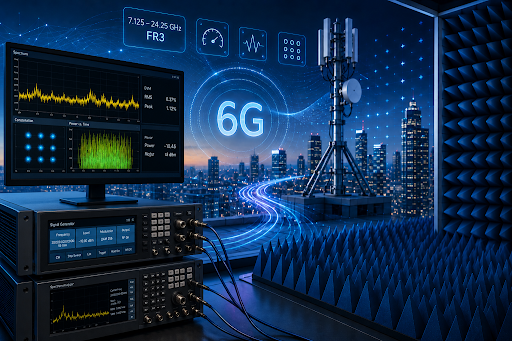
The transition toward 6G is pushing RF testing into new frequency ranges, and many RF labs are not yet fully prepared for this shift. Most existing labs were originally designed for FR1 testing and later adapted for FR2 requirements. FR3 introduces new challenges because the 7 GHz to 24 GHz frequency range requires improved shielding, higher measurement accuracy, advanced automation, and reliable OTA (Over-the-Air) validation.
As more companies invest in FR3 spectrum testing, 7 GHz to 24 GHz RF testing, and future sub-THz RF validation, they need scalable lab environments capable of supporting evolving test requirements without frequent infrastructure upgrades.
Key Takeaways
- FR3 offers a balance between bandwidth capacity and coverage for future wireless networks.
- Many legacy RF labs may not support modern FR3 spectrum testing requirements. 7 GHz to 24 GHz RF testing requires improved shielding and higher measurement accuracy.
- FR3 OTA chamber testing helps engineering teams validate real-world wireless device performance.
- Future sub-THz RF validation will require flexible and scalable RF lab infrastructure.
- Reliable 6G spectrum testing solutions will become increasingly important as next-generation wireless technologies evolve.
Why FR3 Is Becoming More Important
Wireless data traffic continues to increase, and network operators need additional spectrum resources to support future demand. FR1 still provides strong coverage and propagation characteristics, but available bandwidth is limited. FR2 supports significantly higher data rates, but higher propagation loss, reduced coverage range, and deployment complexity create additional challenges.
FR3 is gaining attention because it occupies the frequency range between FR1 and FR2. It offers wider bandwidth availability than FR1 while avoiding some of the propagation and coverage limitations associated with higher-frequency FR2 bands. This makes FR3 a strong candidate for future wireless and 6G network development.
Researchers and manufacturers are already exploring FR3 for technologies such as massive MIMO, beamforming, integrated sensing and communication (ISAC), and non-terrestrial network (NTN) systems. These technologies require stable and highly accurate RF testing environments, increasing the demand for reliable 6G spectrum testing solutions.
As RF testing requirements continue to evolve, laboratories need to prepare their infrastructure before these technologies become widely deployed.
Why Older RF Labs Face Limitations
Many RF labs were originally designed for lower-frequency validation and compliance testing. Some facilities later added support for FR2 testing, but FR3 introduces new requirements that older systems may struggle to support effectively.
RF shielding is often one of the biggest challenges. At higher frequencies, even small sources of electromagnetic interference or signal leakage can affect measurement accuracy and testing repeatability. Older RF chambers may also lack the flexibility and performance needed for modern OTA and beamforming validation requirements.
Positioning systems can create additional limitations. Advanced antenna and OTA testing require highly precise movement, alignment, and measurement control. Older positioning systems may not provide the accuracy or automation needed for advanced wireless validation.
Manual workflows can further slow testing operations. Engineering teams often work under strict development timelines, and slower validation processes can delay product qualification and time-to-market.
Orbis Systems focuses on controlled RF environments designed to improve measurement reliability and testing accuracy. Its OTA chamber systems help support advanced wireless device validation for emerging RF technologies.
Challenges in 7 GHz to 24 GHz Testing
Moving into 7 GHz to 24 GHz RF testing introduces several technical challenges that require more advanced RF infrastructure and measurement capabilities.
RF signal propagation behavior changes as frequencies increase. Even small environmental factors inside the lab, such as reflections, leakage, cable losses, or electromagnetic interference, can affect measurement accuracy and repeatability. This makes RF chamber design and shielding performance more critical than in lower-frequency testing environments.
Beamforming validation also becomes more challenging as antenna systems grow increasingly complex. Advanced phased-array antennas and massive MIMO architectures require highly accurate OTA testing conditions to evaluate real-world wireless performance.
Device complexity is increasing as well. Companies are testing products such as smartphones, IoT devices, automotive radar and communication systems, network infrastructure equipment, and non-terrestrial or satellite communication platforms.
At the same time, many organizations are preparing for future sub-THz RF validation requirements. They need flexible and scalable RF test systems that can support future technology evolution without requiring major infrastructure replacement.
Why FR3 OTA Chamber Testing Matters
Traditional conducted RF testing cannot always accurately represent how a wireless device performs in real-world operating environments. This is why FR3 OTA (Over-the-Air) chamber testing is becoming increasingly important.
OTA testing allows engineers to evaluate wireless device performance inside controlled RF environments before products move to commercial deployment. It helps engineering teams identify performance issues earlier in the development cycle while improving measurement accuracy and testing repeatability.
These tests commonly evaluate parameters such as antenna efficiency, radiation patterns, beamforming performance, throughput, total radiated power (TRP), total isotropic sensitivity (TIS), and overall wireless device behavior.
Orbis Systems continues to focus on modular RF testing environments designed to support repeatable and reliable measurements for evolving wireless technologies.
Building a Next-Generation RF Lab Setup
Many companies wait until their existing RF labs begin creating significant operational or measurement limitations before investing in upgrades. At that stage, modernization projects can become more expensive, complex, and time-consuming.
Planning ahead is often a more effective approach. A modern next-generation RF lab setup should support both current and future wireless testing requirements.
RF laboratories should focus on improved shielding performance, advanced automation, modular chamber systems, and high-precision positioning equipment. They should also be designed with scalability in mind to support future expansion as wireless technologies continue to evolve.
Orbis Systems also supports evolving wireless validation requirements through RF engineering services, OTA chamber systems, and test equipment engineering solutions.
Implementing these improvements early can help organizations reduce long-term upgrade costs, improve testing efficiency, and accelerate product development cycles.
Preparing for Future Testing Needs
FR3 is already influencing how next-generation wireless products are tested. Older RF lab systems may create validation delays, reduced measurement accuracy, and costly infrastructure upgrades in the future.
Companies preparing for 7 GHz to 24 GHz RF testing and future sub-THz RF validation should invest in flexible and scalable RF test infrastructure today. Orbis Systems continues to support RF testing environments designed for evolving wireless and RF validation requirements.
Frequently Answered Questions
1. What is the FR3 spectrum?
FR3 refers to the emerging frequency range between approximately 7 GHz and 24 GHz, positioned between FR1 and FR2. FR1 provides wider coverage and strong propagation characteristics, but the available bandwidth is limited for future network demand. FR2 can deliver significantly higher data rates, but higher propagation loss and shorter coverage range create additional challenges.
This is where FR3 becomes important. It offers wider bandwidth availability than lower-frequency bands while avoiding some of the propagation limitations associated with higher-frequency FR2 bands. Because of this, companies and research organizations are exploring FR3 for future 6G development.
FR3 is also being studied for technologies such as beamforming, massive MIMO, integrated sensing and communication (ISAC), and non-terrestrial network (NTN) systems.
2. Why do older labs face problems with FR spectrum testing?
Many RF labs were originally designed for lower-frequency testing and validation. Some were later upgraded to support FR2 testing, but that still may not be sufficient for FR3 spectrum testing requirements.
For example, older RF chambers may not provide adequate shielding effectiveness to prevent electromagnetic interference or signal leakage. Positioning systems may also lack the precision needed for advanced antenna and OTA measurements. In addition, manual testing workflows can slow validation processes and reduce overall testing efficiency.
These limitations become more noticeable as testing moves into higher-frequency RF environments.
3. Why is FR3 OTA chamber testing needed?
Traditional RF testing still plays an important role, but it does not always accurately represent how a wireless device performs in real-world operating conditions.
This is why FR3 OTA (Over-the-Air) chamber testing is becoming increasingly important. OTA testing helps engineering teams evaluate antenna performance, radiation patterns, beamforming behavior, throughput, total radiated power (TRP), total isotropic sensitivity (TIS), and overall wireless device performance inside controlled RF environments.
OTA validation also helps teams identify performance issues earlier in the product development cycle, before commercial deployment.
4. Why is sub-THz RF validation difficult?
RF testing becomes significantly more sensitive as frequencies increase toward the sub-THz range. Signal attenuation increases, and even small environmental effects inside the testing environment can affect measurement accuracy and repeatability.
Some organizations also discover that their existing RF infrastructure cannot adequately support these higher frequencies. They may require improved shielding, higher-precision measurement equipment, lower-loss RF interconnections, advanced calibration methods, and increased automation.
This is why many engineering teams are preparing early for future sub-THz RF validation requirements instead of waiting until deployment timelines become critical.
5. What makes a good next-generation RF lab setup?
A modern next-generation RF lab setup should be flexible and scalable enough to support evolving wireless testing requirements. This typically includes improved RF shielding, high-precision positioning systems, modular chamber configurations, advanced automation, and scalable RF measurement infrastructure.
Labs that prepare early are usually better positioned to support future FR3, OTA, and sub-THz testing requirements while avoiding repeated infrastructure upgrades later.