Table of Contents
- The Real Challenge Behind OTA Measurements
- When Manual Positioning Starts Becoming a Limitation
- What Changes When Positioning Becomes Automated
- Looking at a Typical OTA Testing Workflow
- Why Repeatability Often Becomes the Deciding Factor
- Lessons From Automotive OTA Testing
- The Value of Repeatable Positioning in OTA Testing
- Frequently Asked Questions
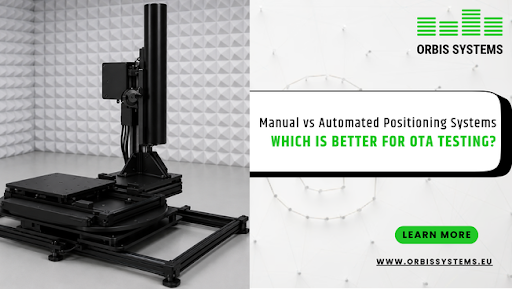
For OTA testing, an automated positioning system is often the better option when repeatability, throughput, and measurement consistency are priorities. That does not mean a manual antenna positioner no longer has a place in modern RF laboratories. The decision usually depends on the type of testing being performed, the number of measurements required, and how frequently the test environment is used.
As wireless devices become more complex and validation programs become larger, many organizations are taking a closer look at how positioning affects both measurement quality and overall OTA testing efficiency.
Key Takeaways
- A manual antenna positioner remains a practical solution for smaller testing programs.
- Larger validation projects often benefit from an automated positioning system.
- Repeatability is one of the most important considerations in OTA measurements.
- Improved OTA testing efficiency is often achieved by reducing repetitive manual tasks.
- Antenna measurement automation supports more consistent testing workflows.
- An advanced RF positioning system can help maintain measurement consistency across multiple test cycles.
- Custom positioners for automotive testing address specialized positioning requirements in connected vehicle validation.
The Real Challenge Behind OTA Measurements
Positioning is sometimes viewed as a supporting function within an OTA chamber. In practice, it has a direct impact on the quality of the measurements being collected.
A wireless device may need to be measured at dozens or even hundreds of different angles before engineers have a complete picture of its performance. The challenge is not simply moving the device. The challenge is moving it in a controlled and repeatable way every time a test is performed.
Consider a development team validating a new antenna design. Initial measurements are taken, adjustments are made to the design, and the device returns for another round of testing. Engineers expect those results to be comparable. If positioning conditions change from one session to the next, comparing data becomes more difficult.
This is one reason why positioning systems have become an important part of modern RF testing solutions. The objective is not only movement. The objective is to maintain consistency throughout the measurement process.
When Manual Positioning Starts Becoming a Limitation
A manual antenna positioner can work very well in the right environment.
Many research facilities, universities, and development laboratories perform relatively small testing programs. Engineers may only need a limited number of measurements to validate a concept or investigate a specific issue. In these situations, manual positioning can be practical and cost-effective.
The situation changes when testing requirements begin to expand.
A larger validation project may require repeated measurements across multiple device orientations and operating conditions. The engineer performing the test must continuously reposition the device, verify alignment, and restart the measurement sequence. Repeating these steps throughout the day increases the amount of time required to complete the project.
The challenge is not necessarily accuracy. Skilled operators can position devices carefully and achieve good results. The challenge is maintaining the same positioning conditions repeatedly over long testing campaigns.
As workloads increase, manual processes often become one of the factors limiting OTA testing efficiency and overall test chamber productivity.
What Changes When Positioning Becomes Automated
Automation changes the workflow more than it changes the measurement itself.
With an automated positioning system, movement instructions are programmed into the test sequence. Once testing begins, the system carries out those movements according to predefined parameters.
The benefit becomes clear during larger measurement programs. Instead of stopping after every measurement point to reposition equipment, engineers can allow the system to progress through the sequence automatically.
Several practical advantages emerge from this approach:
- Consistent movement between measurement points
- Reduced dependence on manual adjustments
- Improved repeatability across test cycles
- Better use of engineering resources
The value of an automated positioning system becomes even more apparent when measurements need to be repeated weeks or months later. Returning to the same test conditions is generally easier when positioning follows predefined movement routines rather than manual adjustments.
For laboratories managing multiple projects, automation can also contribute to better scheduling and resource utilization. This engineering-led approach is reflected in companies such as Orbis Systems, where positioning solutions are designed to support repeatable and controlled OTA measurement environments.
Looking at a Typical OTA Testing Workflow
The differences between manual and automated positioning become easier to understand when viewed through a practical testing scenario.
Imagine a team evaluating a wireless device across a large set of orientations inside an OTA chamber.
With a manual antenna positioner, the operator performs a measurement, adjusts the position, verifies the angle, and starts the next measurement. The process continues until the entire test plan has been completed.
There is nothing inherently wrong with this approach. However, as the number of measurement points increases, the amount of manual effort grows as well.
Now consider the same workflow using an automated positioning system.
The measurement sequence is configured in advance. Once initiated, positioning and measurement activities proceed according to the programmed workflow. The engineer’s role shifts from repeatedly adjusting hardware to monitoring results and analyzing data.
This difference is one reason many organizations investing in antenna measurement automation focus on workflow improvements rather than movement capabilities alone.
In practical terms, the discussion is not simply about motorized positioning. It is about reducing repetitive tasks that consume time without contributing additional measurement value.
Why Repeatability Often Becomes the Deciding Factor
When engineers compare manual and automated systems, repeatability frequently becomes the deciding factor.
Most measurement programs do not end after a single test session. Devices return for additional validation. Design changes require verification. Production samples may need to be compared against earlier results.
In all of these situations, confidence in the data depends on confidence in the testing conditions.
An advanced RF positioning system helps create consistent measurement environments by reducing variation introduced during repositioning. This consistency can be especially valuable when comparing measurements collected over extended periods.
For many organizations, repeatability is ultimately more important than movement speed alone.
The Value of Repeatable Positioning in OTA Testing
The discussion surrounding manual and automated positioning is less about choosing a universally superior technology and more about understanding testing requirements.
For laboratories conducting occasional measurements, a manual antenna positioner may continue to provide the functionality required for successful testing. However, as measurement programs grow in scale and complexity, the advantages of an automated positioning system become increasingly difficult to ignore.
Organizations evaluating modern RF testing solutions are often looking beyond movement capabilities alone. Consistency, repeatability, workflow efficiency, and long-term testing requirements all influence the decision.
This focus on measurement quality is reflected throughout the industry, including in the positioning technologies developed by Orbis Systems. As wireless testing requirements continue to evolve, Orbis Systems and other industry participants continue to emphasize the importance of reliable positioning in achieving dependable OTA measurement results.
Frequently Asked Questions
1. Is a manual antenna positioner still suitable for OTA testing?
Yes. A manual antenna positioner can be effective for research projects, prototype development, and lower-volume testing environments where measurement requirements are relatively limited.
2. Why do many laboratories adopt an automated positioning system?
Many laboratories adopt an automated positioning system to improve repeatability, reduce manual intervention, and support more efficient testing workflows.
3. How does automation improve OTA testing efficiency?
Automation reduces the time spent repositioning devices during measurement campaigns, allowing engineers to focus more on data analysis and validation activities.
4. What is the role of antenna measurement automation?
Antenna measurement automation helps standardize testing procedures, improve workflow consistency, and support larger measurement programs.
5. Why are custom positioners for automotive testing important?
Custom positioners provide precise, automated, and repeatable positioning of vehicles, antennas, sensors, and test targets during automotive RF, OTA, radar, GNSS, and ADAS testing. They improve measurement accuracy, reduce alignment-related errors, accelerate validation cycles, and ensure reliable, standards-compliant test results for modern connected and autonomous vehicle technologies.