Table of Contents
- The Need for Reliable Testing in Electronics
- What Custom Test Fixtures Are
- Common Problems in Electronics Testing
- How Custom RF Test Fixtures Improve Accuracy
- How Automated Test Fixture Solutions Improve Efficiency
- Importance of High-Frequency Test Fixture Development
- Integration with Test Systems
- Improving Testing with the Right Setup
- Frequently Asked Questions
The Need for Reliable Testing in Electronics
Electronics testing has become increasingly demanding as devices continue to shrink in size, operate at higher speeds, and integrate more complex functionalities. As a result, high measurement accuracy is required at every stage of testing to ensure the final product performs as intended.
In many cases, teams begin with basic test setups. However, these setups often vary between tests, leading to poor repeatability and increased measurement variation. This inconsistency can cause delays and increase the risk of errors.
To address these challenges, companies use custom RF test fixtures and precision electronics test fixtures. These fixtures provide a mechanically stable and electrically controlled testing environment, ensuring consistent contact and signal paths. In RF applications, they also help maintain controlled impedance and reduce signal reflections. As a result, both measurement accuracy and testing efficiency improve over time.
What Custom Test Fixtures Are
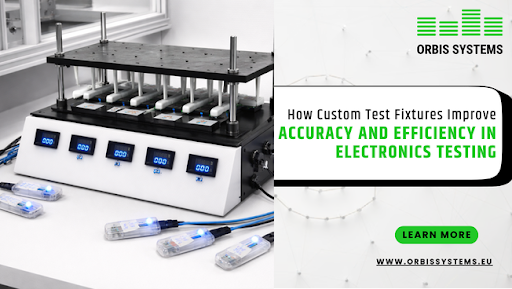
Custom test fixtures are specialized tools designed to provide mechanical alignment and electrical interfacing for a device under test (DUT). They are developed based on the product design and specific testing requirements.
These fixtures are used across different stages, including development, validation, and production. They create a stable and repeatable setup where the device remains securely positioned and consistently connected during testing.
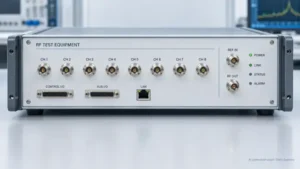
In addition, test fixtures interface with automated test equipment (ATE) and instrument racks such as oscilloscopes, vector network analyzers, and power supplies forming part of complete test systems and modules. Together, they enable a structured and controlled testing process.
Since each fixture is designed for a specific application, it significantly reduces setup variation and improves contact reliability. This leads to better repeatability and overall measurement reliability.
Common Problems in Electronics Testing
Before using proper test fixtures, many teams face common challenges that affect both the speed and quality of testing.
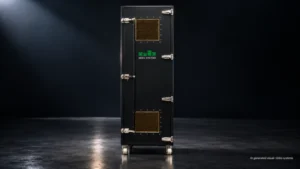
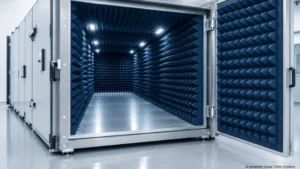
Manual handling of devices can introduce positional variations, leading to inconsistent contact and changes in signal paths. Even small shifts can impact measurements, especially in high-frequency or high-speed applications. In RF testing, signals are also affected by electromagnetic interference (EMI) and insufficient shielding issues that are specifically addressed by RF Shielded Rooms and RF Shielded Boxes.
In addition, manual setups require frequent adjustments, increasing test time and operator dependency. Repeatability is another major concern, as it becomes difficult to perform the same test under identical conditions, leading to measurement variation and reproducibility issues.
Because of these challenges, transitioning from lab testing to production becomes difficult. A setup that works in a controlled lab environment may not scale effectively to production without standardization and fixture-based testing.
How Custom RF Test Fixtures Improve Accuracy
Accuracy is critical in electronics testing, as reliable measurements are necessary to validate product performance.
Custom RF test fixtures improve accuracy by providing a stable and repeatable test environment. First, they hold the device in a fixed position, ensuring consistent alignment and signal paths for every test. This reduces measurement variation and improves repeatability.
Second, they enhance signal integrity. In RF testing, signals are sensitive to noise, impedance mismatch, and reflections. A well-designed fixture maintains controlled impedance, minimizes signal reflections, and reduces external interference.
Third, they provide stable electrical connections. Unlike manual probing, fixtures ensure consistent contact force and low, stable contact resistance, improving measurement reliability.
Fourth, they support controlled testing conditions. Many RF fixtures are used with shielding and proper grounding to reduce electromagnetic interference (EMI) and external noise.
Because of these advantages, precision electronics test fixtures are widely used in both development and production environments to ensure accurate and repeatable measurements.
How Automated Test Fixture Solutions Improve Efficiency
Efficiency is a key factor in electronics testing, as faster test execution reduces overall time and cost.
Automated test fixture solutions improve efficiency in several ways. First, they reduce manual work by enabling tests to run automatically through software-defined sequences. This minimizes human-induced variability and reduces the risk of errors.
Second, they increase test throughput. Each test follows a predefined sequence without delays between steps, and in some cases, multiple tests can be executed in parallel using switching systems.
Third, automation ensures consistent and repeatable testing. The same process can be executed multiple times without variation, which is essential in high-volume production environments.
In addition, setup time is significantly reduced. Unlike manual testing, automated fixtures maintain consistent positioning and connections, eliminating the need for repeated adjustments.
Finally, when integrated with overall test system design and hardware development, these solutions support scalability from early-stage validation to full production, enabling long-term reuse of the same test platform
Importance of High-Frequency Test Fixture Development
High-frequency testing is more sensitive than standard testing, as small physical and electrical variations can significantly affect measurement results.
This is why high-frequency test fixture development is critical. One key factor is signal attenuation. At high frequencies, signals experience loss due to conductor and dielectric effects. A well-designed fixture minimizes insertion loss and preserves signal integrity.
Another important factor is impedance matching. If there is an impedance mismatch in the signal path, part of the signal is reflected back, leading to errors. Proper fixture design ensures controlled impedance (typically 50Ω), reducing reflections and improving measurement accuracy.
Shielding is also essential. External electromagnetic interference (EMI) can affect measurements, so fixtures are often designed with proper shielding and grounding to reduce external noise.
In addition, the fixture must maintain consistent electrical performance across the required frequency range. This includes stable mechanical design and controlled signal paths to ensure accurate and repeatable results under all conditions.
Because of these factors, high-frequency test fixtures require careful design and optimization to ensure reliable and accurate testing.
Integration with Test Systems
Custom test fixtures deliver maximum value when integrated into a complete test system. Such systems typically include automated test equipment (ATE), electronic test equipment racks, switching systems, and control software.
When these elements are integrated, testing becomes standardized and automated. Test sequences can be executed in a predefined order using software control, and results can be captured and logged automatically for analysis and reporting.
This integration reduces manual intervention, minimizes human-induced variability, and improves measurement repeatability and reliability. It also enables real-time monitoring of test performance, including pass/fail results and statistical trends.
Another key benefit is scalability. The same system can be expanded by adding more test channels, instruments, or switching capabilities as testing requirements grow. In addition, when supported by structured hardware development services, the overall system design becomes more reliable and easier to scale across different testing stages.
By combining custom RF test fixtures with fully integrated test systems, companies can build a stable, efficient, and scalable testing process.
Improving Testing with the Right Setup
Accurate and efficient testing is essential in electronics to ensure reliable product performance. Without a properly designed setup, achieving repeatable and consistent measurements becomes difficult.
Custom test fixtures provide a clear solution by creating a mechanically stable and electrically controlled test environment, ensuring that each test follows the same process and conditions.
By using custom RF test fixtures, precision electronics test fixtures, and automated test fixture solutions, companies can improve both measurement accuracy and test throughput.
In addition, when these fixtures are integrated with complete test systems, they enable scalability and reuse across the product lifecycle, allowing testing processes to remain stable from development through to full production.
Frequently Asked Questions
1. What are custom RF test fixtures used for
Custom RF test fixtures are used to connect devices to test systems in a stable and repeatable manner. They help maintain signal integrity, ensure controlled impedance, and enable accurate RF measurements, where even small variations can impact results.
2. How do precision electronics test fixtures improve testing accuracy
They improve accuracy by providing stable positioning and consistent electrical connections, including controlled contact resistance. This reduces measurement variation and improves repeatability over time.
3. Why are automated test fixture solutions important
They reduce manual work and increase test throughput by enabling software-controlled test sequences. This allows the same process to run repeatedly without variation, improving consistency and reducing human-induced errors.
4. What challenges are addressed by high-frequency test fixture development
High-frequency testing faces challenges such as signal attenuation, electromagnetic interference (EMI), and impedance mismatch, which can cause signal reflections. Proper fixture design minimizes these effects and ensures accurate and stable measurements.
5. How do custom fixtures support both development and production
Custom fixtures are designed for repeatable and standardized use, allowing them to be applied in both development and production environments. This ensures consistent testing conditions and supports scalability across the product lifecycle.