Table of Contents
- Introduction: Why Positioning Is Important in OTA Testing
- What an AZ Positioner Does
- How Advanced Positioning Systems Support OTA Measurement Accuracy
- Key Features That Improve Test Reliability
- Why RF Measurement Automation Matters
- Where These Systems Are Used
- How to Choose the Right AZ Positioner
- Frequently Asked Questions
- Conclusion: Ensuring Reliable OTA Results
Introduction: Why Positioning Is Important in OTA Testing
Over-the-air (OTA) testing evaluates the real-world performance of wireless devices without direct RF connections. As wireless technologies become more advanced, measurement accuracy and repeatability become increasingly critical. In any OTA setup, the position and orientation of the device under test (DUT) must be precisely controlled, since even small angular deviations can significantly affect measured radiation characteristics.
Advanced positioning systems provide precise and stable control of DUT movement. They enable controlled rotation with high repeatability, ensuring consistent measurement conditions across test cycles. As a result, the reliability and comparability of measurement data are greatly improved.
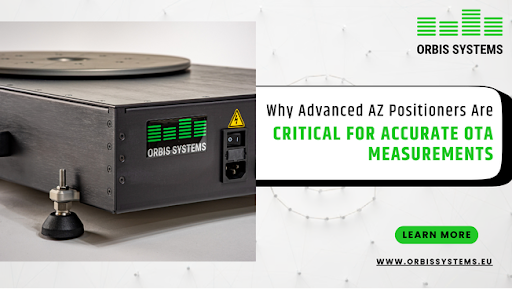
OTA measurement accuracy depends not only on RF instrumentation but also on mechanical positioning precision. Therefore, a high-quality azimuth (AZ) positioner is an essential component of a professional OTA test chamber. This becomes especially important for devices that must meet stringent performance requirements for modern wireless technologies, including 5G.
Key Takeaways
- Advanced positioning systems are essential for reliable OTA testing.
- Accurate azimuth control directly affects OTA measurement accuracy.
- Stable mechanical construction improves repeatability.
- RF measurement automation increases efficiency and consistency.
- Careful system selection supports long-term test reliability.
What an AZ Positioner Does
An AZ positioner rotates the device under test around the vertical axis. This movement is called azimuth rotation. It allows a full 360-degree sweep so that engineers can measure signal performance from every direction.
During antenna pattern testing, the device must be turned step by step. Each step must be accurate. If the rotation is not correct, the radiation pattern will not reflect the real performance of the device.
In addition, AZ positioners are often used together with elevation systems. However, azimuth movement remains one of the most important motions in OTA testing. Because of this, advanced positioning systems must deliver smooth and precise control.
How Advanced Positioning Systems Support OTA Measurement Accuracy
OTA measurement accuracy depends strongly on the precise alignment of the device under test (DUT). If the DUT is not positioned at the exact intended angle, the measured gain, beam direction, or radiation pattern may shift, causing the results to deviate from the device’s true performance.
Advanced positioning systems address this challenge in several ways. First, they provide fine angular resolution, enabling movement in very small incremental steps. Second, they ensure high repeatability, meaning the system can return to the same angular position with minimal deviation across multiple measurements.
In addition, robust mechanical construction minimizes vibration and unintended motion. Mechanical stability is critical because any movement during measurement can distort the received signal and introduce errors. Consequently, precise azimuth positioning plays a direct role in maintaining OTA measurement accuracy.
When tests are repeated over time, consistent positioning ensures that results remain comparable and reliable. This is particularly important for modern wireless devices that rely on directional antennas and advanced beamforming techniques, where small angular errors can significantly affect measured performance.
Key Features That Improve Test Reliability
Several mechanical and control features are essential for dependable OTA testing.Important mechanical characteristics include:
- High angular accuracy for precise orientation control
- Low backlash to minimize positioning errors during direction changes
- A strong, rigid structure to ensure stable and vibration-free rotation
- Adequate payload capacity to support devices of varying sizes and weights
Control and integration capabilities are equally important:
- Programmable motion sequences for automated test procedures
- High-precision position feedback for monitoring and verification
- Compatibility with chamber control and test automation systems
By incorporating these features, advanced positioning systems significantly reduce measurement uncertainty. As a result, engineers can rely on the accuracy and repeatability of the collected data. In some applications, custom positioning solutions may also be required to accommodate specific device dimensions or chamber configurations.
Why RF Measurement Automation Matters
In modern laboratories, RF measurement automation is widely used to improve test efficiency and consistency. Automation integrates the motion control system with RF test instruments, enabling the positioner and measurement equipment to operate in a coordinated manner.
With automated control, predefined test sequences can run without manual intervention. The system rotates the device under test (DUT) to a specified angle, allows the motion to settle, and then automatically triggers the measurement. After completion, the positioner moves to the next programmed angle, repeating the process across the entire scan range.
This approach improves efficiency while reducing human error. Automated data logging also ensures that each measurement is accurately associated with its corresponding angular position. As a result, OTA measurement accuracy improves because motion control and RF data acquisition are synchronized.
Automation further enables repeatable testing under identical conditions. When test cycles are repeated, the system follows the same programmed trajectory and timing sequence, making results easier to compare, validate, and reproduce.
Where These Systems Are Used
In modern laboratories, RF measurement automation is widely used to improve test efficiency and consistency. Automation integrates the motion control system with RF test instruments, enabling the positioner and measurement equipment to operate in a coordinated manner.
With automated control, predefined test sequences can run without manual intervention. The system rotates the device under test (DUT) to a specified angle, allows the motion to settle, and then automatically triggers the measurement. After completion, the positioner moves to the next programmed angle, repeating the process across the entire scan range.
This approach improves efficiency while reducing human error. Automated data logging also ensures that each measurement is accurately associated with its corresponding angular position. As a result, OTA measurement accuracy improves because motion control and RF data acquisition are synchronized.
Automation further enables repeatable testing under identical conditions. When test cycles are repeated, the system follows the same programmed trajectory and timing sequence, making results easier to compare, validate, and reproduce.
How to Choose the Right AZ Positioner
Selecting the correct AZ positioner requires careful review of technical needs. First, determine the level of angular precision required for the measurement task. Next, evaluate the maximum weight of the device under test.
In addition, confirm that the system supports the required control interfaces for RF measurement automation. The positioner should integrate smoothly with existing chamber equipment.
Long-term stability should also be considered. Durable mechanical design ensures consistent performance over extended test cycles.
By reviewing these factors carefully, organizations can select advanced positioning systems that match their OTA testing goals.
Conclusion: Ensuring Reliable OTA Results
Reliable wireless testing depends on both accurate RF instrumentation and precise mechanical positioning. Advanced positioning systems provide the controlled motion required for consistent azimuth rotation, while integration with RF measurement automation enhances efficiency, synchronization, and repeatability.
High-quality AZ positioners are therefore fundamental components of modern OTA chambers. By ensuring precise orientation and stable operation, they help maintain measurement accuracy and support dependable wireless device validation across research, compliance, and production environments.
Frequently Asked Questions
1. Why is azimuth rotation critical in OTA testing?
Azimuth rotation allows engineers to measure device performance from all horizontal angles. Accurate control ensures that radiation patterns are captured correctly. Without precise azimuth positioning, OTA measurement accuracy can decrease and lead to incorrect conclusions.
2. How do advanced positioning systems improve repeatability?
They use precise motion control and strong mechanical structures. As a result, the device can return to the same angle with minimal variation. This repeatability ensures that repeated measurements remain consistent across test sessions.
3. What role does RF measurement automation play in OTA testing?
RF measurement automation links motion commands with measurement triggers. Therefore, each angle position is matched with the correct data capture. This coordination reduces manual errors and improves overall reliability.
4. Can small positioning errors affect millimetre wave testing?
Yes. At higher frequencies, even small angular shifts can change measured beam direction or gain. Therefore, precise azimuth positioning is essential to maintain dependable OTA measurement accuracy.
5. What should be checked before selecting an AZ positioner?
Key factors include angular accuracy, payload capacity, mechanical stability, and compatibility with automation systems. Reviewing these points ensures that the selected system supports precise and repeatable OTA testing.