Table of Contents
Introduction
Why Positioning Is Critical in RF Testing
Efficiency Gains from Tailored Positioning Solutions
Integration with Modular Test Chambers and Anechoic Environments
Measuring Performance Improvements
Frequently Asked Questions
Introduction
Wireless devices are evolving rapidly, with operating frequencies expanding into FR1 and FR2 bands. As a result, test requirements have become significantly more stringent, particularly for over-the-air (OTA) performance validation. To meet these demands, laboratories increasingly rely on automated test systems to achieve higher throughput and consistency. However, automation alone cannot guarantee accurate results.
The physical position of the device under test (DUT) has a direct and often critical impact on RF measurements. Even minor variations in orientation, alignment, or distance can significantly alter radiation patterns, signal strength, and overall performance metrics. Without precise and repeatable positioning, measurement uncertainty increases, and test results may become unreliable.
Tailored positioning solutions address this challenge by providing controlled multi-axis motion, precise alignment, and highly repeatable positioning. When integrated with RF test automation, these systems enable structured, unattended testing while maintaining measurement integrity. By minimizing manual intervention and setup variability, tailored positioners significantly enhance both test accuracy and operational efficiency.
In modern automated test environments, tailored positioners are not merely mechanical accessories. They are essential components that ensure reliable, repeatable, and high-quality measurement outcomes.
Key Takeaways
- Automated test setups require precise and repeatable motion control.
- Tailored positioning solutions improve alignment and reduce variability.
- RF test automation benefits from synchronized motion and measurement.
- Modular test chambers and anechoic chamber integration require stable and compact positioners.
- Measurable improvements include faster setup and higher throughput
Why Positioning Is Critical in RF Testing
In RF testing, the orientation of the device under test (DUT) directly determines how signals are transmitted and received. Incorrect positioning can lead to measurement variability, forcing engineers to repeat tests and increasing overall test time.
Automated test setups require precise and consistent motion control. Without accurate positioners, manual adjustments introduce unwanted variation. Tailored positioning solutions, however, move the DUT in precise angular increments, ensuring that each measurement is performed under controlled and repeatable conditions.
Repeatability is particularly critical in high-frequency testing, especially at millimetre-wave (mmWave) bands, where even small positional deviations can significantly affect results. A system capable of returning to the exact same position repeatedly ensures high data integrity and reliable validation.
Furthermore, RF test automation depends on tight synchronization between measurement instruments and motion systems. When positioning is automated and programmable, tests can run faster with minimal operator intervention. As a result, laboratories can significantly increase throughput while maintaining confidence in measurement accuracy.
Efficiency Gains from Tailored Positioning Solutions
Efficiency in automated test setups depends on accuracy, speed, and seamless system integration. Tailored positioning solutions enhance these factors in practical and measurable ways.
Improved Accuracy and Repeatability
Tailored positioners are designed to accommodate specific DUT sizes, shapes, and weights, ensuring optimal mechanical stability during motion. This stability enables precise angular positioning across repeated test cycles.
Accurate motion control provides several key benefits:
- Reduced measurement uncertainty
- Stable alignment for antenna pattern evaluation
- Consistent data during regression testing
With improved repeatability, engineers can confidently compare results across multiple test sessions without concerns about setup variability. This reduces the need for repeated measurements, shortens validation time, and improves overall test efficiency.
Faster Setup and Reduced Manual Intervention
Tailored positioning solutions significantly reduce manual setup time in automated test environments. With preconfigured motion sequences, the system can automatically move the device under test (DUT) to required orientations, eliminating the need for engineers to manually adjust hardware for each measurement.
This automation provides several operational benefits:
- Shorter preparation time before testing
- Faster switching between different test scenarios
- Increased daily testing capacity
By minimizing manual interaction, the likelihood of positioning errors is also reduced. As a result, testing becomes more consistent, efficient, and reliable, leading to higher overall productivity.
Reliable Support for RF Test Automation
Tailored positioners play a vital role in enabling structured RF test automation. Motion commands can be precisely synchronized with measurement triggers, ensuring that data acquisition occurs only when the device under test (DUT) reaches the intended position.
This synchronization makes automated scanning procedures more efficient, accurate, and predictable. In addition, complex motion trajectories can be preprogrammed, allowing the system to execute sophisticated test routines without manual intervention. As a result, testing becomes highly consistent across different projects and operating conditions.
By integrating seamlessly with automated measurement systems, tailored positioners help laboratories achieve reliable, repeatable results while maximizing test throughput.
Integration with Modular Test Chambers and Anechoic Environments
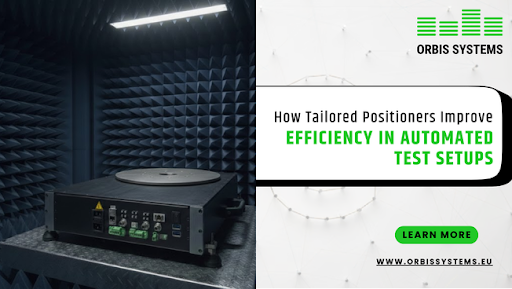
Controlled environments are essential for accurate wireless validation. Modular test chambers offer flexibility to accommodate different frequency ranges, device sizes, and testing requirements. When tailored positioning solutions are specifically designed for these chambers, installation becomes efficient, stable, and space optimized.
Integration within anechoic chambers is particularly critical for over-the-air (OTA) measurements. These chambers absorb electromagnetic reflections and isolate the device under test (DUT) from external interference. Motion systems operating inside such environments must therefore function without disturbing the chamber’s electromagnetic characteristics.
Tailored positioners are engineered to fit within chamber dimensions while maintaining precise alignment with reference antennas. This specialized integration provides several benefits:
- Stable motion with minimal mechanical vibration
- Consistent electromagnetic conditions during movement
- Efficient utilization of available chamber space
As a result, automated test setups can deliver accurate measurements while supporting complex dynamic motion requirements.
Measuring Performance Improvements
To fully evaluate the benefits of tailored positioning solutions, key performance indicators should be monitored. Clear, quantifiable metrics help determine whether automated test setups are operating more efficiently after implementation.
Important indicators include:
- Reduction in setup time
- Increase in total tests completed per day
- Lower variation between repeated measurements
- Decrease in re-testing caused by alignment errors
Improvements in these metrics demonstrate that precise positioning enhances both measurement accuracy and operational flow.
In production environments, time savings directly translate into increased output and reduced costs. Optimized motion control not only improves measurement reliability but also streamlines workflows, enabling laboratories to operate more efficiently while maintaining high data quality
Conclusion
Accurate positioning is fundamental to wireless device validation. Automated test setups depend on controlled motion to ensure consistent and repeatable measurement results. Without precise alignment, data quality may degrade, and testing time can increase due to rework and variability.
Tailored positioning solutions deliver the required precision and repeatability while supporting structured RF test automation workflows. They integrate seamlessly with modular test chambers and maintain stable operation within anechoic environments, preserving electromagnetic conditions during motion.
By reducing manual adjustments and minimizing positional variation, tailored positioners enhance both operational efficiency and measurement integrity. As wireless technologies continue to evolve into higher frequencies and more complex architectures, precise motion systems remain essential for reliable, scalable, and future-ready testing operations
Frequently Asked Questions
1. Why are tailored positioning solutions important in automated test setups?
Tailored positioning solutions ensure accurate and repeatable placement of the DUT, reducing measurement variation and enabling reliable validation across multiple test cycles. This improves both data quality and testing efficiency.
2. How do tailored positioners improve RF test automation?
They enable programmable motion sequences synchronized with automated measurement triggers. This coordination minimizes manual intervention, improves consistency, and increases overall test efficiency.
3. What is the role of repeatability in wireless testing?
Repeatability ensures that the same DUT position can be reproduced across multiple tests. High repeatability enables reliable data comparison, reduces measurement uncertainty, and supports long-term validation accuracy.
4. How do modular test chambers support automated testing?
Modular test chambers provide adaptable environments for different device sizes, configurations, and frequency ranges. When combined with tailored positioning solutions, they enable efficient, stable, and scalable automated testing conditions.
5. Why is anechoic chamber integration necessary for OTA measurements?
Integration with anechoic chambers ensures that motion systems operate without disturbing the controlled electromagnetic environment. This preserves reflection-free conditions and maintains measurement accuracy during automated OTA testing.