
Custom RF Shield Room Design: Engineering for Your Specific Requirements
Table of Contents
- Key Takeaways
- Understanding the Purpose of RF Shield Rooms
- What Is an RF Shield Room
- RF Shield Room vs RF Shielded Box vs OTA Chamber
- Important Engineering Factors in RF Shield Room Design
- Who Needs a Custom RF Isolation Chamber
- A Complete Look at Custom RF Shield Room Planning
- Frequently Asked Questions
Key Takeaways
- A custom RF shield room or RF isolation chamber provides a controlled electromagnetic environment by attenuating external RF interference and containing internally generated signals
- RF shielded boxes are suitable for small DUTs and early-stage testing, while full RF shield rooms are better suited for larger systems, multi-DUT setups, and scalable long-term test requirements.
- Key engineering considerations include shielding effectiveness, proper grounding for noise control and safety, filtered power and signal interfaces, and well-planned environmental infrastructure.
- A properly engineered RF isolation chamber enables repeatable and reliable measurements for 5G, IoT, and emerging wireless technologies, including higher-frequency applications.
- Custom RF shield room designs offer flexibility and future readiness as test standards and frequency requirements evolve.
Understanding the Purpose of RF Shield Rooms
Wireless devices continue to improve and include more advanced technology. Because of this, testing environments must be stable and free from interference. If outside radio signals reach a device during testing, measurements may become inaccurate. As a result, engineers may not receive reliable results or may need to repeat testing.
A custom RF shield room or RF isolation chamber creates a clean and controlled space. This supports accurate performance testing and helps maintain consistent testing over time. As testing expands into areas like sub-6 GHz and mmWave, controlled test environments are now an essential part of device development and manufacturing.
What Is an RF Shield Room
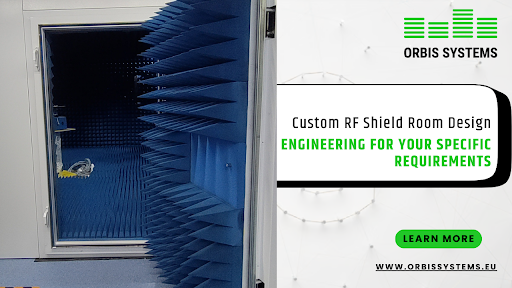
An RF shield room is a specially designed, enclosed space used to block radio frequency (RF) signals from entering or leaving the area. It creates a controlled electromagnetic environment so that wireless devices can be tested without interference from external signals or leakage from internal sources.
RF shield rooms are constructed using conductive materials such as steel, copper, or aluminum panels. They incorporate RF-tight doors, sealed joints, filtered power and signal feedthroughs, and shielded ventilation to maintain high shielding effectiveness across the required frequency range.
For smaller testing tasks, an RF shielded box may be the right choice. Orbis Systems offers RF shielded box solutions suitable for smaller DUTs. These can support accurate testing in a limited space or during early development phases.
RF Shield Room vs RF Shielded Box vs OTA Chamber
Choosing between these options depends on the product size, testing goals, and long-term needs.
Requirement | RF Shielded Box | RF Shield Room or RF Isolation Chamber | OTA or Anechoic Chamber |
Small DUT testing | Suitable | Possible but not necessary | Not needed |
Multi-DUT or extensive DUT testing | Limited | Suitable | Suitable |
Throughput and antenna testing | Limited | Suitable with absorbers | Ideal |
High frequency or mmWave testing | Limited | Suitable | Suitable |
Long-term growth or scalability | Limited | Suitable | Suitable |
An RF shielded box is helpful for compact devices. A complete RF shield room is better for larger equipment and environments where future testing may increase. For antenna performance testing, an OTA chamber may be required.
Important Engineering Factors in RF Shield Room Design
Several engineering elements help ensure a reliable RF shield room.
Shielding Integrity and Material Quality
The room needs proper shielding panels, sealed access points, and a continuous conductive structure. Every seam, connection, or entry must maintain shielding performance.
Filtered Access and Connectivity
Power lines, communication lines, and ventilation should use filtered paths. This protects the shielding performance while allowing the room to operate as a working test area.
Grounding
Grounding is essential for safety and noise control. A properly designed grounding scheme helps minimize conducted interference and supports stable and repeatable RF measurements
Environmental Planning
HVAC, lighting, and cable routing must be planned from the start. This ensures the room remains functional and avoids interference or performance loss.
Modularity
A modular RF shield room supports expansion. This helps engineers adjust the room if testing needs increase.
Frequency Compatibility
The shielding must support the tested frequency range. This includes sub-6 GHz, 5G, and mmWave signals.
Who Needs a Custom RF Isolation Chamber
Custom RF shield rooms are suitable for many environments, such as:
- Research labs working with wireless product development
- Consumer electronics and IoT device manufacturers
- Telecom companies testing 5G and network hardware
- Automotive and aerospace companies are testing communication systems
- Defence and government testing environments
- Production lines running multi-DUT automated testing
In these environments, consistent and repeatable results are significant. A custom enclosure helps achieve those results.
A Complete Look at Custom RF Shield Room Planning
A custom RF shield room is a long-term testing solution. It helps ensure controlled RF isolation and protects test accuracy. As devices grow in capability, the need for reliable testing conditions also increases.
Choosing between an RF shielded box, an RF shield room, or an OTA chamber depends on the type of testing, device size, and long-term plan. A custom RF isolation chamber supports flexibility and repeatable results for both current and future wireless testing.
This is especially important for advanced wireless technologies such as 5G, mm Wave, and future standards that require strict control of the RF environment
Frequently Asked Questions
1. What Is the Necessity of Putting a Shield Between a Test and Its Environment for RF Testing?
To avoid measuring results that have been compromised by outside sources, RF tests need to be conducted in an isolated environment. Testing inside an enclosed area (RF shield room) will also help to ensure that the test signals being used will not interfere with any other devices or communication systems in the immediate area.
2 What are the limitations and advantages of using an RF Shielded Box?
When testing small devices, an RF shielded box is suitable as it does not require a fully enclosed room for testing. This can also be helpful during early testing stages of the research and development process of a product, when more limited scenarios of use will be under investigation.
3 Can a custom RF Shield Room be used for 5G and mmWave testing?
Yes, a custom RF shield room can support testing at 5G and mmWave frequencies; however, to achieve accurate results at these frequencies, the custom RF shield room must be designed and constructed using the appropriate materials, design elements, and placements of absorbers.
4 Do Proper Grounding and Shielding Affect RF Shield Room Performance?
Yes. Proper grounding is essential for safety and for minimizing conducted electrical noise. While grounding does not directly improve RF shielding effectiveness, an improper grounding scheme can introduce noise and stability issues that affect measurement repeatability and overall test reliability.
5. Can a custom RF shield room be modified or expanded in the future
Yes. If the room is built using a modular design, it can be expanded or reconfigured. This helps align the testing environment with future products or new testing requirements.