
Automating OTA Testing: Essential Methods for Accurate MIMO & Beamforming Validation
Table of Contents
- Why OTA Testing Automation Is Important for Modern Wireless Systems
- What OTA Testing Automation Means in Practice
- Why 5G OTA Testing Is More Complex
- Practical Methods Used for MIMO and Beamforming Validation
- Core Elements of an OTA Test System
- Why Calibration and Repeatability Matter
- How Automation Supports Daily Testing Work
- What Consistent OTA Testing Automation Achieves
- Frequently Asked Questions
Key Takeaways
- OTA testing automation supports stable and repeatable wireless measurements
- Automated testing is essential for validating MIMO and beamforming performance.
- Controlled RF environments reduce unwanted signal effects
- Calibration is required to maintain measurement accuracy
- Automation improves consistency across test cycles
Why OTA Testing Automation Is Important for Modern Wireless Systems
Wireless devices today depend on antenna performance more than ever before. Technologies such as MIMO and beamforming are no longer optional features. They are part of how 5G systems are designed to work. Because of this, antenna testing must reflect how signals behave in real conditions.
OTA testing automation allows engineers to measure wireless performance through radiated signals instead of cables. This matters because antennas interact with their surroundings. When tests are automated, the same conditions can be repeated again and again. As a result, test results become more reliable and easier to compare over time.
What OTA Testing Automation Means in Practice
OTA testing automation means running over-the-air measurements using systems that do not rely on constant manual input. The device under test is measured through radiated signals. Automation controls movement, orientation, and test order.
Because of this, tests can be repeated without changes in setup. This is important because antenna performance is sensitive to position and direction. Even small differences can affect results. OTA testing automation helps remove these differences and supports stable measurements.
Why 5G OTA Testing Is More Complex
5G devices use multiple antennas at the same time. These antennas interact with each other. Cable testing cannot fully represent this behavior. Therefore, radiated testing becomes necessary.
In addition, antenna behavior changes across different frequencies. Performance also changes when the device is rotated or tilted. Because of this, testing must take place in a controlled space where external signals are blocked. OTA testing provides this control and supports accurate evaluation.
Practical Methods Used for MIMO and Beamforming Validation
Accurate OTA testing automation depends on a small number of essential methods that work together.
Controlled RF Environment
A shielded chamber blocks outside signals. This allows measurements to focus only on the device being tested. Because the environment does not change, results from different test runs can be compared directly. This is important when validating beam patterns and signal direction.
Precision Position Control
Automated positioning systems control how the device and antennas move during testing. This allows measurements to be taken at defined angles. As a result, engineers can see how performance changes with orientation. This is especially useful for beamforming evaluation.
Automated Test Execution
Test steps are defined in advance and executed automatically. This reduces the chance of human error. It also allows large test sequences to run without interruption. Over time, this improves efficiency and data consistency.
Core Elements of an OTA Test System
A standard OTA test system usually includes the following elements:
- An RF-shielded chamber to isolate the test environment
- Positioning equipment to control device and antenna movement
- Measurement instruments connected to control software
- Interfaces that allow remote test operation
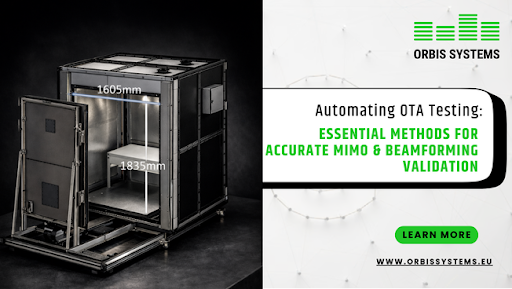
Many test setups rely on a dedicated 5g ota chamber to keep test conditions stable and predictable during automated measurements.
Why Calibration and Repeatability Matter
Calibration ensures that measurements remain accurate. Without calibration, test results can slowly drift. Therefore, calibration must be performed before testing begins and reviewed.
This approach supports confident validation and helps ensure wireless systems perform as expected before deployment.
Repeatability is just as important. When the same test is run multiple times, the results should match within acceptable limits. Automation helps achieve this by keeping setup conditions the same. As a result, engineers can trust the data they collect during OTA testing automation.
How Automation Supports Daily Testing Work
Automation makes daily testing easier to manage. Tests can be scheduled in advance. Measurements can run without supervision. Data can be collected in a consistent format.
In addition, automated testing allows the same test sequence to be used during different project stages. This helps teams track performance changes. Over time, this leads to better test control and clearer decision-making.
What Consistent OTA Testing Automation Achieves
Consistent testing leads to reliable results. OTA testing automation provides a structured way to evaluate MIMO and beamforming performance under controlled conditions. By combining stable environments, accurate positioning, and repeatable execution, testing teams can reduce costs.
Frequently Asked Questions
1. What is OTA testing automation?
OTA testing automation is the use of automated systems to perform over-the-air measurements. These systems control device position, test order, and measurement timing to ensure repeatable results.
2. Why is OTA testing needed for MIMO systems?
MIMO systems use several antennas at the same time. OTA testing is required to measure how these antennas interact through radiated signals rather than cables.
3. How does beamforming affect testing methods?
Beamforming directs energy in specific directions. OTA testing allows engineers to measure how well these directions are formed and maintained under different orientations.
4. What role does a 5G OTA chamber play?
A 5G OTA chamber blocks external signals and creates a stable RF environment. This allows accurate and repeatable radiated measurements during automated testing.
5. How does automation improve measurement reliability?
Automation reduces manual changes and setup variation. This ensures that tests follow the same steps each time, which improves consistency and trust in results.