
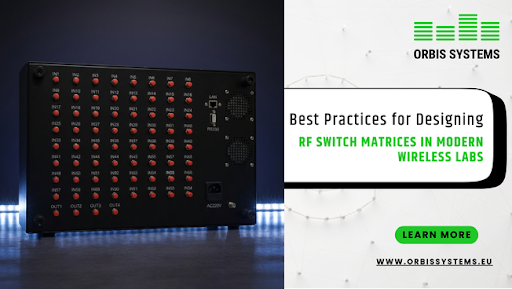
Best Practices for Designing RF Switch Matrices in Modern Wireless Labs
Table of Contents
- Importance of RF Switch Matrix Design
- Key Points for High-Frequency Switching
- Selecting the Right Matrix Structure
- Power Handling and High-Power RF Switching
- Automation and Control Considerations
- Installation and Ongoing Validation
- Key Takeaways
- Frequently Asked Questions
Summary Highlights
- A well-planned RF switch matrix improves test repeatability
- High-frequency behaviour must be carefully checked
- Modular structures support future lab growth
- Stable RF test routing reduces manual errors
- Automation and validation are essential for consistent results
Wireless testing labs today are not simple places. Engineers work with many devices, many frequency ranges, and many test setups. Some tests focus on Sub-6 GHz. Others involve mmWave or OTA testing. Often, more than one device is tested at the same time.
In such conditions, signal routing must remain stable and repeatable. If signal paths change often, test results can change too. This creates confusion and wastes time.
This is where an RF switch matrix becomes important. It allows RF signals to move between instruments and devices without constant cable changes. When done correctly, this improves repeatability and reduces physical handling of test equipment. This article explains how to design RF switch matrices for modern wireless labs in a clear and practical way.
Importance of RF Switch Matrix Design
Wireless testing has changed over the years. Earlier, labs worked with fewer bands and simpler devices. Today, the situation is very different. Multiple radios, antennas, and instruments are used together.
Because of this, RF test routing must be reliable. A well-designed RF switch matrix helps engineers keep test conditions the same across repeated measurements. This improves confidence in results.
Another benefit is reduced cable movement. Frequent manual reconnections can damage connectors over time. Centralized switching reduces this risk. Many labs that use modular switching platforms, including those from Orbis Systems, focus on improving test stability while keeping lab operations efficient.
Key Points for High-Frequency Switching
High-frequency testing requires extra attention. Small losses or reflections can affect measurements more than expected.
Engineers should focus on the following:
- Insertion loss, which should stay as low as possible
- Isolation, to avoid signal leakage between paths
- Return loss and VSWR, which affect impedance matching
- Switching speed, especially for automated testing
A high-frequency switch matrix must perform well across its full frequency range. Testing only at one frequency is not enough. Cable quality, connector type, and adapters also affect performance. Therefore, these parts must be considered as part of the overall RF path.
Selecting the Right Matrix Structure
The internal structure of a switch matrix affects how flexible the system will be in the future. Choosing the wrong structure can limit expansion.
Common structures include:
- Blocking matrices, suitable for fixed and predictable routing
- Non-blocking matrices, which allow several paths at the same time
- Modular matrices, which can grow with changing lab needs
Scalability matters most in R&D and validation labs. New devices and new frequency bands are added regularly. Modular designs reduce the need for complete system changes later. This is one reason modular RF switching solutions from Orbis Systems are often considered for long-term lab setups.
Power Handling and High-Power RF Switching
Not all RF tests use low signal levels. Some tests involve transmitters, power amplifiers, or stress conditions. In these cases, power handling becomes critical.
Designers must review:
- Continuous power limits
- Peak power ratings
- Heat build-up during repeated switching
Using switches beyond their limits can cause unstable readings or hardware damage. A properly rated high-power RF switch is required in such setups. Choosing the right high power RF switch helps protect both the test system and the device under test.
Automation and Control Considerations
Manual switching is no longer practical in many labs. Automation improves speed and reduces mistakes.
When selecting switching systems, engineers should check:
- Support for common control interfaces
- Software-based control options
- Compatibility with automated test systems
Automation ensures that switching paths remain the same every time a test runs. This improves repeatability. Many switching platforms from Orbis Systems are built to support automated environments while keeping system control straightforward.
Installation and Ongoing Validation
Design alone is not enough. Installation quality has a strong impact on performance.
Good practices include:
- Avoiding sharp cable bends
- Keeping cable lengths consistent where possible
- Clearly marking signal paths
- Performing regular performance checks
Validation should confirm that each RF path meets defined limits. Over time, cables and connectors can degrade. Regular checks help detect problems early and keep the RF switch matrix reliable.
Designing RF Switch Matrices for Reliable Lab Operation
Designing an RF switch matrix is not only about connecting signals. It is about ensuring stable, repeatable, and scalable testing. By focusing on structure, frequency performance, power handling, and automation, labs can build systems that support both current and future testing needs.
A careful and practical design approach helps wireless labs maintain accuracy and efficiency as technology continues to evolve.
Frequently Asked Questions
1. What does an RF switch matrix do in a wireless lab?
An RF switch matrix routes RF signals between instruments and devices without manual cable changes. This saves time and improves test consistency.
2. Why is high-frequency performance difficult to manage?
At higher frequencies, losses and reflections become more significant and sensitive to small variations. A high-frequency switch matrix is designed to control these effects and keep measurements stable.
3. When should a high-power RF switch be used?
A high-power RF switch should be used when testing involves strong RF signals, such as transmitter output testing or power stress tests.
4. How often should validation be performed?
Validation should be done after installation and repeated at regular intervals. This helps ensure long-term performance stability.
5. Can RF switch matrices support automated testing?
Yes. Modern switching systems, including those from Orbis Systems, are designed to work with automated test setups using software control